It was nearly three in the afternoon when the industrial engineering lecture ended. I headed to the university cafeteria to gulp down a sandwich with a light soda, getting ready for the long trip home, which usually takes an hour or more in peak traffic.
I found Risha in the narrow street where I park my car; he was leaning against a vehicle, smoking a cigarette with one of his boys. The moment he saw me, he handed the boy my key from a bulky keychain. Risha then ran to the far end of the street, where a police sergeant was signaling to him. The kid began shuffling the tightly parked cars with ease.
As I got into mine, I glimpsed Risha passing a wad of cash to the sergeant, who inspected it quickly before slipping it into his pocket. After a series of acrobatic maneuvers to free my car from the jam, I rolled forward toward Risha, who hurried over to collect the overdue monthly fee. His eyes scanned the interior for my wallet, and he relaxed when I pulled out a quarter of my monthly allowance. As I drove off, he called after me:
— If you’re going to Heliopolis, take the October Bridge! Al-Hussein road is closed, one of the bigwigs is visiting the mosque!
I waved my thanks and headed straight toward the most crowded bridge.
I turned left after the Ministry of Interior entrance, topped by a huge banner: “The Police Serve the People.” I entered Falaki Street, looping back toward Tahrir Square, asking myself: why do I pay 80 pounds a month to park here, the cheapest in the university’s area? Strangely, Mansour, the valet on Mohamed Mahmoud Street, charges 150. No escape... I’ll have to ask my father for a higher allowance.
Luckily, Tahrir Square wasn’t as crowded as usual. I stopped briefly at the light, then veered right toward Abdel Moneim Riyad Square, preparing to ascend the bridge. Twice I slowed to let pedestrians cross outside the underpass — a sight that had vanished last year when fines were enforced, only to return after General Ahmed Rushdi’s resignation following the Central Security riots.
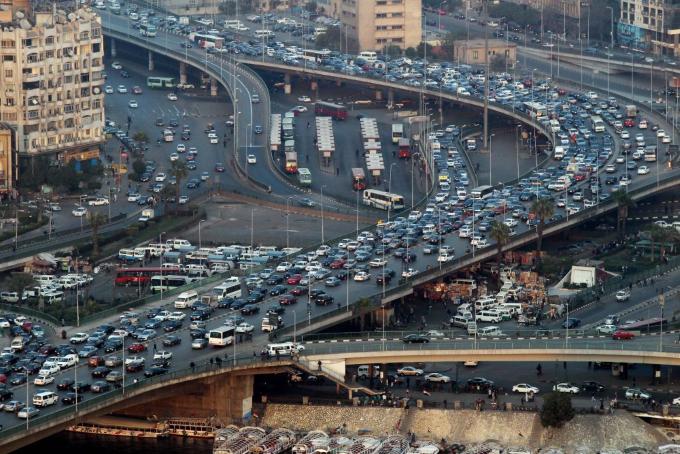
At the bridge entrance, my optimism collapsed. Drivers crept forward in desperate attempts to slip into a faster lane. Above, the narrow passage was crammed with cars in both directions, flanked by massive concrete trees tinged with dirty brown from years of dust. Even time itself seemed to weigh heavy on the asphalt, the car rattling over worn-out metal joints. Horns blared endlessly, with no purpose. On either side, balconies sealed with iron bars; windows of wood, krital, and aluminum, all shut. Air conditioners suffocated in exhaust fumes. Billboards crushed smaller signs beneath them — names of lawyers, doctors, translation offices, maintenance companies. The buildings themselves seemed embarrassed by their age.
A barefoot boy selling tissues appeared, pointing to his mouth in plea. Beside him, a teenager carried bags of bread, silently competing. In the cars around me: a man shouting at his wife, a woman putting on makeup in her mirror, a taxi driver singing along with Abdel Wahab as if at a private concert. Amidst this circus, I felt utterly alone. But it wasn’t unpleasant — rather, a faint, unjustified freedom, as if something inside me finally exhaled after a long suffocation.
After half an hour of turtle-speed crawling, I reached the top by Ramses Square and Cairo’s main train station, where the horizon widened a little. The square and Ramses Street now separated the aligned buildings, yet nothing on the ground had changed. Black exhaust wove into the air, cars shuffled between lanes only to end up in the same spots. At the Gamrah exit, I muttered to myself with pride:
— Made it in less than six hours.
The distance between the “Victory Day” Bridge exit and the Gamrah on-ramp is barely a kilometer, but it wasn’t without its scenes. In front of a juice shop, dozens crowded beneath a canopy of hanging fruit, swarmed by flies buzzing over banana clusters and sugarcane stalks stacked at the entrance. The street swelled with pedestrians from every direction. My eye caught a group of veiled girls, led by two bearded men, their robes white over pants that didn’t touch the ground — a sight repeated often in recent years.
At the bridge entrance, another jam — this time from an accident. More than ten cars stopped, and about twenty people crowded around an unmoving victim sprawled on the ground. Everyone shouted advice; no one listened. I got out to help, but a man in his thirties rushed forward, pointing ahead and yelling:
— I saw the bus that hit him and ran! Come on, let’s catch it before it disappears in the crowd and the poor guy loses his right! The ambulance will be here in five minutes... hurry, hurry!
Without thinking, I jumped into the car. He leapt in beside me, giving directions:
— Stay right, he can’t cut left. No exit near Demerdash Garden.
— What color?
— White! There, on the right!
— I see two!
— The one on the right! You can’t see it yet, but I’ll tell you how to go!
A discomfort stirred in me, but the thrill of doing the right thing pulled me on.
— Speed up a little, we’ll catch him before the Abbasiya light... or better, take a right and cut left — we’ll get ahead and block him.
It seemed logical... I turned into a side street, relatively empty.
— Good... faster now.
I pressed the gas through the narrow street, cars lined on both sides, pedestrians in the middle, horn blaring nonstop. After about 400 meters:
— Stop... stop!
I thought he’d spotted the bus or was checking another street, so I hit the brakes. Suddenly, he flung the door open, hopped out, leaned back in, and with a sly grin laced with triumph said:
— Thanks a lot for the ride!
He darted off in a flash, while I sat frozen behind the wheel, eyes glued to him as he turned right into an even narrower alley. I stayed in shock, my gaze locked on the corner he vanished into. Then I slowly looked around, right and left, searching for proof that what had just happened was a dream... or a nightmare.
Everything in the street was utterly normal, as if nothing had occurred. Pedestrians carrying grocery bags, a young man on a bicycle struggling to keep a bread basket from toppling off his head, and a peddler in a tattered dark-blue galabiya, cigarette dangling between his fingers, exhaling blue smoke as he bellowed in a booming voice:
— Crazy, ya Qooooota!