An Uber car drops me off in front of the gate of the public school. I open the door and a wave of suffocating heat slaps me in the face. The gust of air forces me to hold my skirt so my legs won’t be exposed. Students are gathered at the entrance with their mothers; prayers and hurried advice flutter through the air, mingling with a trembling anxiety in their eyes. Beside them stand private tutors, trying in a few minutes to compress what they failed to instill over months. They wave small sheets of paper and exchange English phrases in nervous voices.
I pass through the gate toward an employee sitting behind a small wooden desk. She lifts her head coldly, points to the signature line, then returns to the assignment sheet as if my presence were a trivial detail. I sign. This dry routine softens, slightly, the chaos of voices outside. I go upstairs. The classroom I’ve been assigned to supervise has old wooden desks. Heavy air seeps through two large windows in the eastern wall, stirring the papers on the desks like panting breaths.
I sit in the middle. The hall is a stage waiting for its actors. A few minutes later the door opens, and the students enter in small groups. Fragmented whispers, winks, concealed smiles—as if a silent agreement passes from one desk to another. I distribute the exam papers, then say in a voice that cuts through all hesitation:
Any attempt at cheating will be recorded immediately… and the penalty may extend to failing the entire final secondary exam.
The room freezes for a moment. Then heads lower onto the papers with affected calm. I announce the start of the exam and sit watching.
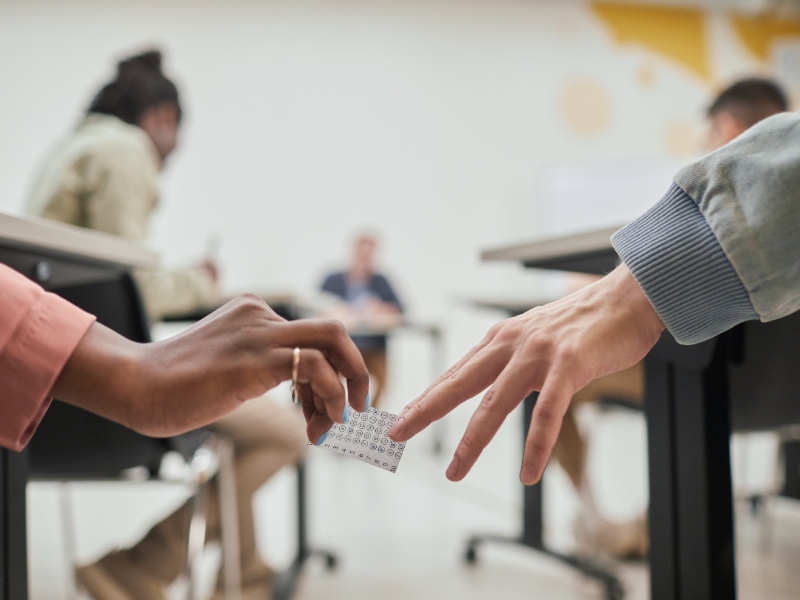
A few minutes pass. Then a faint whisper rises from the back row—a trapped chirp. Two students exchange quick glances while one hides something in her palm. When her eyes meet mine, she deliberately drops her pen. Silence returns—a tense silence floating above their heads. Soon small slips of paper flash between hands and disappear; finger signals, deliberate coughing. An invisible thread grows clearer, a fabric of collusion forming before me like a map of shadows. At its center appears Fatma’s face—Fatma, who entered the operating room laughing and telling me, “I’ll be back in an hour.” But she never returned.
I try to tighten control over the classroom, but deceit moves like water: each side takes advantage of my distraction with the other. I slam my hand on the desk and muffled laughter falls silent, yet the movement resumes immediately, as if nothing happened. I pick up a small sheet that has rolled onto the floor and tear it in front of its owner. A wave of gloom spreads, soon breaking into hushed murmurs—murmurs like those that accompanied the cold body of Fatma emerging from beneath hands that claimed knowledge.
Suddenly, before I can finish another sweep with my eyes, a strange voice rises from the street:
Question one… the answer is option (C).
Heads shoot up at once. The answers are being broadcast through a microphone blaring from a car parked in front of the school. Tension rises like thick smoke. The students hover between shock and suppressed laughter, while some rush to write as if receiving a gift from heaven. I move toward the window to close it, but the students shout:
The air is unbearable, Miss! Let us breathe!
I step back amid their protests, while the microphone continues reciting the answers like a hurried sermon.
A student in the front row stands and says angrily:
Why don’t you let us get the answers like the other supervisors do? You’re ruining our future with this strictness!
I answer instinctively:
I’m not ruining your future… I’m preventing you from building it on emptiness.
Silence falls for a moment. Then another student suddenly stands and points to my wrist and says sharply:
She doesn’t want us to succeed because we’re Muslims!
The room trembles. The accusation passes like a spark over gunpowder. Some looks are convinced, others hesitant. A heavy wall chokes the air. It feels as if the classroom is no longer a place for an exam but a courtroom hastily assembled. I steady myself, take out my phone, and say to the chief supervisor:
Come immediately… and bring another supervisor. I can’t control this alone.
Before I receive a reply, a police siren blares outside. The car with the microphone speeds away. But inside, nothing calms down. Burning eyes. Whispers flaring and fading. Students looking at me as if I were the enemy. I say clearly:
No cheating will leave this classroom while I’m standing here… another Fatma will not be lost.
Time crawls. I watch them one by one. Every signal is cut off, every attempt extinguished as it is born, until the bell finally rings. I collect the answer sheets from reluctant hands—some angry, some broken, some marked by confusion that does not know which side to choose. I leave the classroom drained in spirit, exhausted in body. I want to leave—no, to disappear from this place.
I descend the stairs like a train into the schoolyard. A crowd waits at the gate: veiled and niqab-wearing mothers, others unveiled—as they are called—and men waving angry arms, while private tutors hide their anxiety behind fabricated complaints. The moment they see me, the words explode:
Are you the reason our daughters couldn’t answer?!
Why did you make things harder for them?! They’ll fail because of you!
You’re lying in wait! You want to humiliate Muslim girls!
I feel the circle tightening. Fingers accuse. Faces grow harsher. A police officer tries to calm the crowd, his voice almost lost in the storm. I approach the gate, but the accusations keep striking me like crashing waves:
Immoral!
Heartless!
Spiteful!
I reach for the handle, and at that same moment a hand from behind grabs my arm. I turn in alarm. One of the school supervisors—I had seen him earlier while signing the assignment sheet. His face is tense, but his voice steady as he whispers:
Don’t go out there… they’ll lose control. Come, we’ll leave through the back door.
I follow him down a narrow corridor. The noise of the crowd recedes, though its echo still scratches the air. As he walks ahead of me with quick steps, he says:
Hold on… just a little more.
We reach a small iron door behind the school. It opens like an escape route. I step into a quiet side street empty except for the shadow of a long wall. I breathe deeply. Sweat runs down my forehead, and the emptiness slowly draws the tension from my chest. The supervisor turns to me and says softly:
You won’t win these battles alone… but today you stood where many like me couldn’t.
I extend my hand to him.
Thank you… without you I wouldn’t have gotten out safely. What’s your name?
He smiles faintly.
My name is Youssef.
I repeat his name silently, like a brief glimmer in all this darkness. I nod to him in gratitude and walk along the back street, barely catching my breath. When I mentioned the name of my lifelong friend Fatma, questions had clouded the students’ faces. How I wished at that moment I could reveal to them that the hands that were supposed to heal the gentlest soul I had ever known carried a degree obtained through cheating.
As I walk away, I hear the roar of engines approaching. I stop. Luxurious cars with darkened windows pass along the road, preceded by sharp sirens and surrounded by guards with rigid faces. The gleam of metal under the setting sun looks like another world passing beside me—a world that does not see us and cares only about reaching its destination.