The Islamic Nation Through Time

All praise is due to Allah, Lord of the Worlds, and peace and blessings be upon our Prophet Muhammad, and upon his family and companions.
The story of the Islamic nation is the story of one of the greatest civilizations in human history. It is the story of a nation that emerged from the Arabian Peninsula to establish an intellectual, spiritual, and material empire that stretched from the borders of China to the shores of the Atlantic, carrying the torch of knowledge, faith, and justice. But it is also a story of rise and fall, unity and division, strength and weakness.
The pre-Islamic Arabian environment (approximately the sixth and seventh centuries CE, and perhaps earlier) was a complex mix of interwoven economic, social, religious, and political life patterns. This period can be envisioned as a world where nomadic and urban life, trade, and religion intersected, and where concepts of tribalism, honor, revenge, generosity, and poetry emerged as central elements of societal identity. This book presents a detailed picture of the geography, economy, tribal structure, social customs, and religious and pagan practices of pre-Islamic Arabia. It analyzes the rise of trading cities, the emergence of conflicts and major tribes, and the influence of external powers (the Persians and Byzantines). The book also discusses why the society was termed "Jahiliyyah" (ignorant of God) and how this created a yearning for a monotheistic message.
The pre-Islamic Arabian environment, commonly referred to as "Jahiliyyah," was not a historical vacuum. Rather, it was a complex and contradictory system that had reached a peak of social and political disintegration, thus preparing it for radical transformation through the monotheistic message. This environment was a stage where nomadic trading patterns intersected with urban agriculture, and where noble ideals were intertwined with harsh practices.
Pre-Islamic Arabia appears as a geographical and inhabited space that embodies a blend of desert and oases, fertile mountain ranges in the southwest, and vast sandy expanses in the center and east. Here, diverse lifestyles took shape—nomadic Bedouin life, oasis-based agriculture, and trade connecting the Atlantic Ocean with the Fertile Crescent—giving rise to a dynamic, vibrant society with diverse beliefs and tribal loyalties that formed its social and political fabric.
The Arabian Peninsula in the pre-Islamic era represents a unique model of major historical transformations, where elements of strength and weakness, unity and division, darkness and light converged in a single geographical crucible, forming the prelude to the greatest event in human history.
The revelation to the Prophet Muhammad (peace be upon him) was the greatest event in human history, radically altering the course of intellectual, social, and religious life. The revelation descended upon the Prophet's heart in the Cave of Hira, heralding a new era of guidance and enlightenment, after humanity had been immersed in the darkness of polytheism, ignorance, and injustice. The revelation to the Prophet Muhammad (peace be upon him) marked the dawn of a great transformation in the course of humankind, the birth of a new religion—Islam—and the birth of a unique nation—the Muslim Ummah. This is a nation chosen by God to be a witness to humanity, bearing the banner of pure monotheism and its eternal motto: "There is no god but God, Muhammad is the Messenger of God." From the moment the revelation dawned in the Cave of Hira, this nation rose to the divine message, spreading the light of faith and guiding humanity to the worship of the One True God. And it will continue—as long as night and day endure—to carry the banner of Islam, calling to the Oneness of God Almighty, until God inherits the earth and all that is on it, for He is the best of inheritors.
This book aims to trace the historical trajectory of this nation, not merely by recounting events, but by analyzing the factors that forged its glory and those that led to its trials. It is a journey through time to understand the present of the Ummah and envision its future through the lens of its past.
Further Reading
Upcoming Events
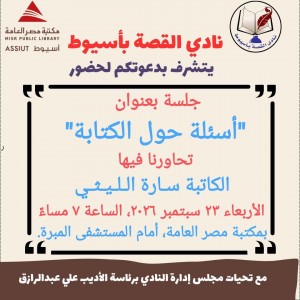
Questions about writing
September 23, 2026
The Assiut Story Club invites you to a session tit...

Online discussion of A Grain of Wheat by Ngugi wa Thiong'o
October 20, 2026
Join us for a special discussion of A Grain of Whe...
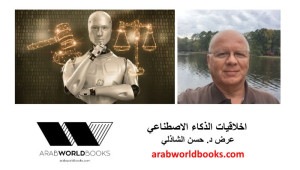
Artificial Intelligence: Ethical Concerns
May 23, 2026
This presentation took place on May 23rd, 2026. Yo...
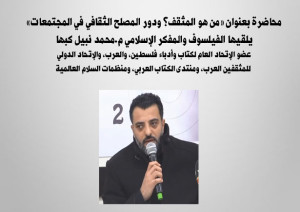
?Who is the intellectual? And what is the role of the cultural reformer in societies
April 13 - 15, 2026
محاضرة يلقيها الفيلسوف والمفكر الإسلامي م.محم...