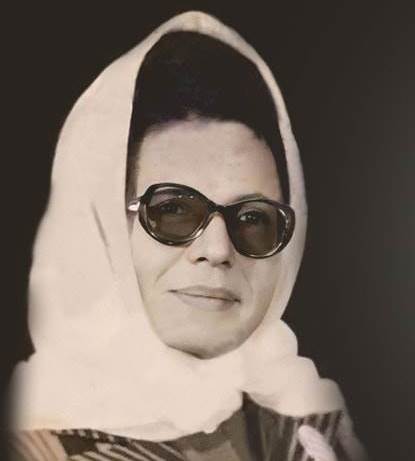
Dr. Iglal Mahmoud Khalifa was a pioneer of Egyptian journalism and a remarkable example of overcoming adversity to achieve academic excellence.
She was born on April 16, 1924, in the city of El Mahalla El Kubra. She was related to several prominent figures: she was the cousin of the mother of the great radio director Muhammad Marei (who was also the former head of Sawt al-Arab Radio), the patron artist Ahmed Marei, and the late interior designer Salah Marei
She had several siblings whose interests she cared for in Cairo during their higher education stages. These siblings included Dr. Abdel Moneim, who received his education in England, Engineer Ezzat, and Professor Yousry, a professor at the Faculty of Engineering, Cairo University, who authored many global scientific research papers in the field of engineering sciences. Her siblings also included Professor Dr. Ahmed Sami, a pediatric scientist and professor at the Faculty of Medicine, Ain Shams University, who also authored international scientific research in this field, in addition to Mrs. Aisha, the lawyer.
In an era that did not encourage women's education, Iglal Khalifa initially did not contemplate receiving any kind of schooling. Her family believed that the girl's function was limited to serving her male siblings and looking after their comfort. Consequently, the family sent her to Cairo with her brother to serve him when he enrolled in university. More siblings subsequently arrived in Cairo for their education, and she took on the responsibility of serving them.
Despite these circumstances, Iglal Khalifa possessed a persevering and ambitious spirit and a strong will. After arriving in Cairo, she was keen on studying and learning despite her older age. She would serve her brothers during the day and take her lessons at night in a nocturnal section of a school. She obtained her illiteracy eradication certificate, which is also known as the Primary Certificate, after she passed the age of thirty, specifically in 1955, at the age of 32. By doing so, she achieved a great accomplishment as an Egyptian woman who challenged her circumstances and learned in a time that did not encourage women's education.
Khalifa continued her educational journey, achieving something of a miracle. She began by obtaining a Bachelor of Arts degree in Journalism in 1962. She then continued her path, obtaining a Master's degree in "Women in the Qur'an" from the Institute of Islamic Studies in 1964, followed by another Master's degree in "Women's Journalism and its Role in Women's Liberation" in 1966. She then went on to obtain a PhD in "Women's Journalism in Egypt 1940-1965" in 1970, making her one of the pioneers in Egyptian journalism. This was a remarkable achievement for a woman who was once illiterate and unable to read or write.
Dr. Iglal Khalifa worked for several major institutions, including Dar Al-Hilal Press Foundation, Al-Ahram newspaper, and the General Information Service. She also worked for the Ministries of Foreign Relations and Tourism. She worked as a university professor in Egypt, and was the first woman to teach in the Journalism Department at Al-Azhar University. Dr. Khalifa has held a number of senior academic positions, serving as Chair of the Journalism Department at the Faculty of Mass Communication at Cairo University in the mid-1970s. She then became Vice Dean for Graduate Studies and Research at the Faculty of Mass Communication in the early 1980s. In addition to her work in Egypt, she has served as a visiting professor at several universities in Arab countries, including Morocco, Libya, Sudan, Kuwait, Iraq, and the UAE. She has represented Egypt at international academic conferences.
In 1980, she visited the British University of Leicester, where she worked at the Centre for Mass Communication Research, presented a study on the mosque and its role in serving the Islamic Da'wah (call), and participated in several seminars
Social Work and Legacy
Dr. Iglal Khalifa was active in social and community work
She was a founding member of the "Awladi" (My Children) association starting in 1954
She was a member of the Social Progress Association in 1968
She was also a member of several other social welfare organizations
In 1962, she published a weekly magazine for her residential area named Hay Al-Maadi
She established an annual prize dedicated to the top students of the Journalism Department at the Faculty of Mass Communication, Cairo University
Her personal life was dedicated entirely to her work and learning: she did not marry and lived like a nun devoted to the pursuit of knowledge, Her life serves as an example of challenging difficulties and self-affirmation, and she struggled until she became one of the luminaries of media in Egypt.
Iglal Khalifa passed away on November 17, 1997
Key Publications
Dr. Khalifa authored a number of significant works focusing on journalism and the feminist movement
These publications include:
• Modern Trends in the Art of Journalistic Editing (1972)
• The Modern Feminist Movement (1974)
• Woman and the Palestine Issue (1975)
• The Science of Journalistic Editing and its Practical Applications (1980)
• Journalistic Media and the Challenges of Contemporary Islamic Society (1980)