I received Samer’s message with the last light of day.
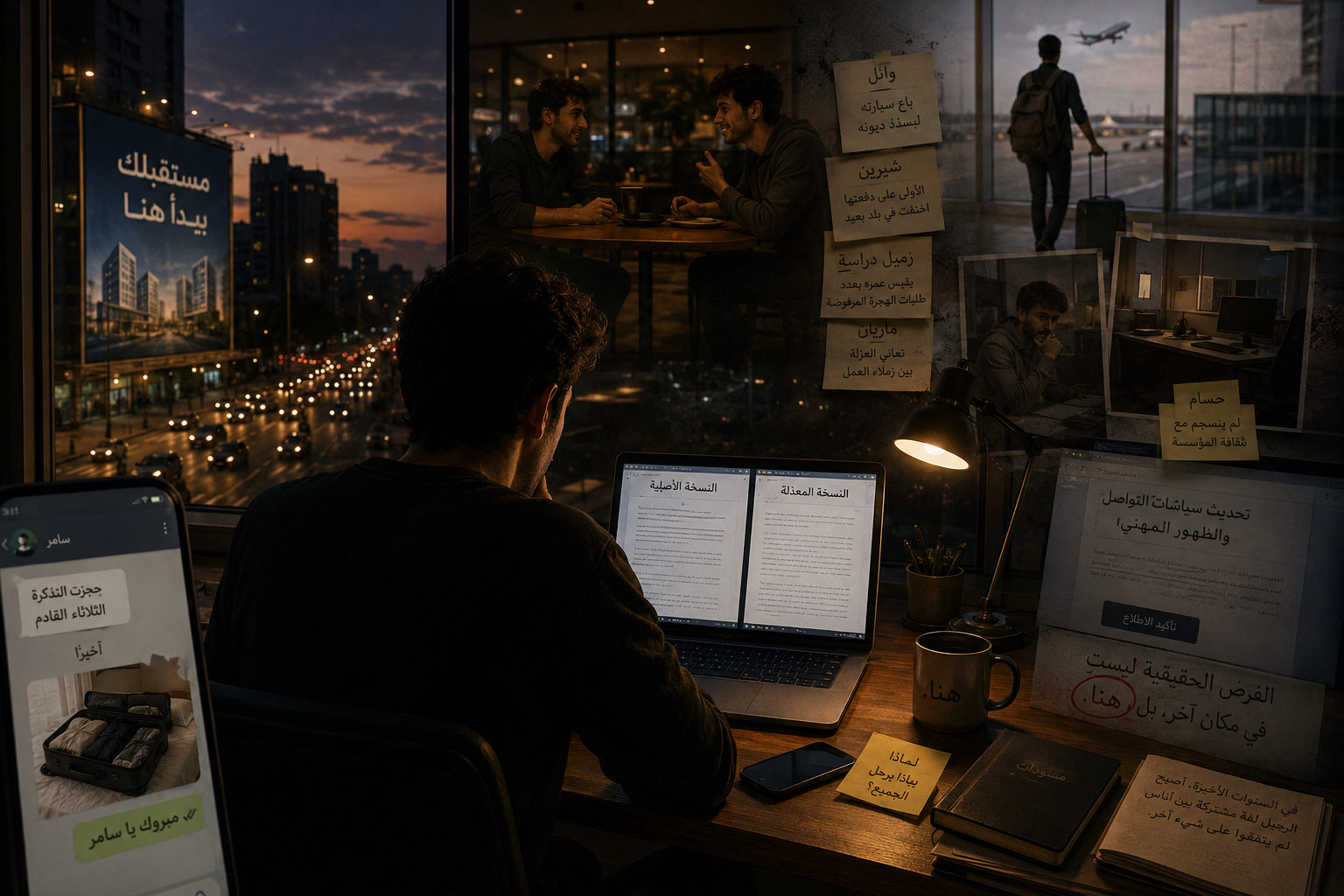
The first thing I saw was a picture of an open suitcase lying on a bed, with the word “Finally” written beneath it. I scrolled up through the message. Before the picture, it said: I booked the ticket. Next Tuesday. I read it twice, then typed: Congratulations. I sent the reply and slipped my phone back into my pocket. I turned off the screen and looked out the window at the street. The notification chime kept repeating, but I left the messages to pile up.
Below, the cars crawled slowly beneath the fading light. The café Samer and I used to frequent was as crowded as ever. My eyes fell on the table where we used to sit. I could almost see Samer talking excitedly about the startup he would one day build, while I talked about writing and journalism. We behaved as though the roads ahead of us were clear. Samer never founded a company, and I never became a journalist. He spent years working for a small software company that came close to shutting its doors every year, while I ended up as a content creator at a marketing firm.
I went to the kitchen to make myself a cup of coffee, then returned to my room and sat in front of the computer, reviewing the details of an advertising campaign I was preparing for a real estate developer. For half an hour, I replaced the same words with others that sounded almost identical: better opportunities, a promising future, a life you deserve. Shiny phrases that could be used for anything but meant nothing in particular. Messages from the team kept appearing in the side chat window, each one suggesting another minor, endless revision.
I closed the advertising campaign and opened a blank document. I typed a single title: Why Does Everyone Leave? At first, I wrote about Samer, but soon I found myself writing about others as well. About Wael, who sold his car to pay off his debts, then disappeared without a trace. About Shereen, who had been the top student in her class before vanishing into a distant country. About a former classmate who had begun measuring his age by the number of rejected immigration applications he had received. And Marian, who struggled with loneliness among her coworkers. I wasn’t writing to convince anyone of anything. I was simply trying to understand: Why had leaving become a subject that kept coming up in every conversation? And why did staying sometimes feel like a decision that needed to be justified?
When I finished, it was past midnight. I reread the post. For the first time in years, I felt that I was writing something that had nothing to do with my work. No client had asked for it. No manager had approved it. I had written it simply because I wanted to. It belonged to me. I sent it to Ahmed and Marwan, then closed the computer.
The next morning, I received two messages. The first was from Ahmed: The best post you’ve written in a long time. The second was from Marwan: Strong piece. But if you decide to publish it on your blog or social media pages, you need to ask yourself: Is it worth the price? At the very least, you’ll lose credibility with the company’s clients.
I stared at the message for a long time. For the first time, it occurred to me that the post which, while writing it, had felt like the thing that resembled me most might also be the thing that threatened the little stability I had managed to build: the job, the insurance, the salary that made the end of every month a little less to worry about. I put the phone on the desk.
As soon as I arrived at the office, my manager asked to see me. I picked up my notebook and went into his office. He was in a good mood. We have a major new client, he said. He turned the screen toward me. A phrase appeared: Tomorrow’s opportunities start today. He smiled and added: We want a campaign targeting young people. Something that makes them feel that the future is here, not somewhere else. I nodded. I want you to write it, he added.
I left his office and sat down at my desk. The new campaign file was open on the right, and the post I had written the night before was open on the left. I opened the campaign file. It was the kind of project everyone in the company talked about—the kind that came with an extra bonus if the campaign succeeded. I stared at the two files for a long time, then placed my hands on the keyboard.
At lunchtime, I went downstairs to the restaurant with my colleagues. There was an empty chair at the end of the table. Where’s Hossam? I asked without thinking. Two of my colleagues exchanged glances. You didn’t hear? I shook my head. He left the company. Another colleague laughed. Or they made him leave. A few of them laughed. Why? I asked. He shrugged. I don’t know the details. Then, after a moment, he added, Management said he didn’t fit the company's culture. A third colleague laughed. That sentence works for everything. The conversation ended quickly, but the empty chair stayed with me.
I knew Hossam. We weren’t close friends, but we sometimes talked by the coffee machine. A few days earlier, I had run into him making coffee. He had made fun of the company’s new slogan. He always said what he thought. After lunch, I passed by his office. It was empty. The screen was off, and the drawer was slightly open, as though he had just stepped out and would be back in a few minutes. But he never returned to that office.
That evening, I went to visit my mother. As soon as she opened the door, she complained about the elevator constantly breaking down. Then she spent half an hour talking about the electricity bill and the medicine that had gone up in price. I sat and listened. For some reason, all of it seemed more real than any grand discussion about the future or immigration. While she was making tea, she asked me: Is it true that Samer is leaving? Yes, I replied. She nodded: What a shame. She was silent for a moment, then added: But he’s doing what he thinks is right. She placed the cup of tea in front of me and continued: In the end, a person looks for a life he can actually live. She said nothing more, and yet it was enough to occupy my thoughts all the way home.
That night, I opened the post. I read the first paragraph, then the second, and began editing. I replaced one word with another. Deleted a sentence. Added an explanation here, softened something there. After an hour, I reread the post again. I wasn’t sure what had changed, but I was certain that something had disappeared. I closed the computer and went to bed.
The next morning, I left for work early. The bus stopped at a long red light. On the building opposite was a huge billboard for a real estate company. The same slogan I had spent the previous night revising: Your future starts here. I stared at it until the bus moved. I wasn’t thinking about the apartments. I was thinking about the word “here.” How many times had I written it over the past few years? And how many times had I believed it?
I arrived at the office before most of my colleagues. The room was unusually quiet. I put down my bag and sat in front of the screen. For several minutes, I stared at the desktop before opening anything. Everything was where I had left it: the advertising campaign shortcut, the browser, the email inbox, and a small folder titled “Drafts.” I hovered over it, then pulled it away. A little later, the offices began filling with voices. The room returned to what it usually was, and I returned to my work.
When I opened my email, I found a message addressed to all employees. The subject line read: Updated Communication and Professional Visibility Policies. It was long and filled with legal language. It spoke about the company’s image, its reputation, and employees’ responsibilities both inside and outside the workplace. I skimmed through it at first, then went back and read it again. There was nothing unusual in it, but it was the kind of message that made me feel that the few words written on the screen were hiding more words behind them. At the end of the message, we were required to confirm that we had read it. One click. I closed the email without clicking.
That afternoon, my manager walked past the desks. He stopped at mine and read a few lines from the new campaign he had recently assigned to me. Then he smiled: Excellent. This is exactly what we need. I thanked him. The moment he walked away, I felt a sudden tightness in my chest. The line he had praised read: Real opportunities aren’t somewhere else. They’re here. I stared at it for a long time. Then I opened the original version of “Why Does Everyone Leave?” in the next window. Its first line read: In recent years, leaving has become a common language among people who agreed on almost nothing else. I closed both files.
That evening, I met Samer. We sat in the old café near the university campass. Almost everything was the same. Even the tables had barely changed. Everything was as it had always been, except that most of the tables had grown silent; people sat around them, each staring at a different screen.
Are you excited? I asked.
He laughed.
More nervous than excited.
Then why are you doing it?
He looked out at the street through the glass.
Because I’m tired of waiting.
He was silent for a moment, then added: Do you remember the first apartment we went to see?
I laughed.
How could I forget? We were twenty-six. We left convinced that we’d buy our own apartments within a few years.
He said: Ever since that day, I kept telling myself: soon.
He fell silent for a while before adding:
I realized that the word ‘soon’ can swallow an entire lifetime.
I didn’t know what to say.
He continued:
I’m not looking for a great life, Karim. I just want an ordinary one.
It was the most honest sentence I had heard in a long time.
On the way home, I didn’t think about leaving. I thought about the post. I got home a little before midnight. I opened the computer, then opened the two versions of the post: the original and the edited one. I began reading the original slowly. When I finished, I moved to the edited version. I stopped at the first paragraph. Then I went back to the original. I read the two sentences side by side. This word had become another. That sentence was shorter. A question had disappeared. An explanation had been added to explain something that had never needed explaining. I kept reading until the end. I closed the original version. Then opened it again. Time passed slowly.
Outside the window, the sounds gradually faded. The shops closed their doors, the cars disappeared from the street, and the glow of the screen became the only light filling the room. At two in the morning, I got up and went to the kitchen. I drank a glass of water, then returned. The cursor was still blinking at the end of the final line. Steady. As if it knew nothing about hesitation. I sat down. I placed my hand on the mouse, then pulled it away. I looked at the window, then at the screen, then at the email still open in the background. The company’s message was still there. The confirmation button was waiting. The post was still open.
The city was asleep. Only the blue lights coming from the windows across the street remained, reminding me that somewhere nearby, someone else was still awake in front of another screen. I remained there for a length of time I could not measure. I reached for the keyboard. I opened the edited version of the post. I read the first line, then closed it. I opened the original version. The cursor was blinking at the end of the final line. Outside, buses began filling with passengers. The voices of street vendors grew louder. Shop doors began opening one after another. A new day was beginning, while I remained where I was.
I stared at the names of the two files for a long time. For the first time, I was no longer sure which one contained the original… or which one had written me.