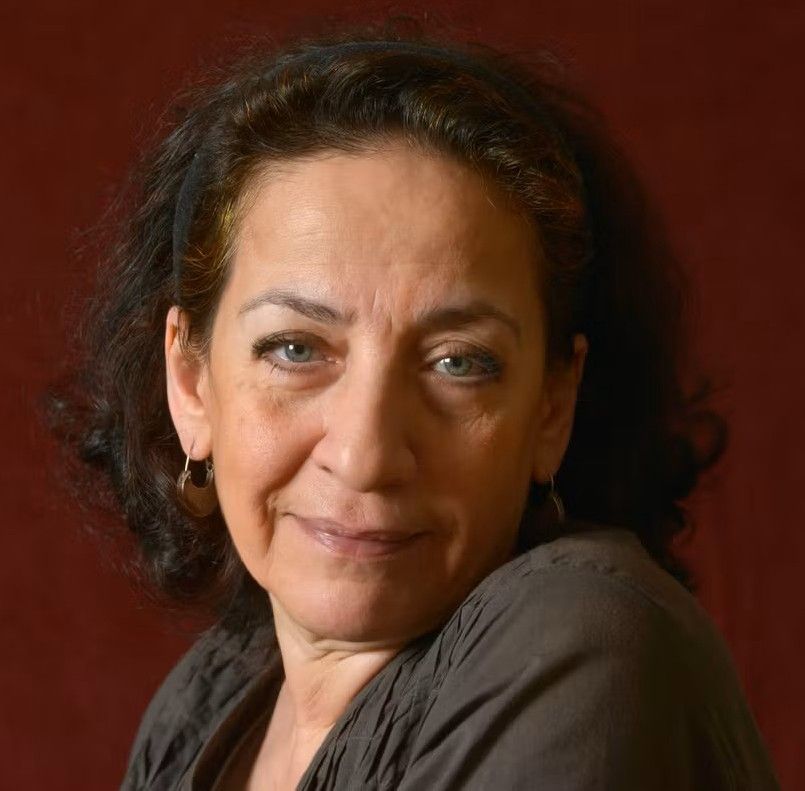
Hoda Barakat (born September 7, 1952) is a renowned Lebanese novelist and journalist who has spent much of her life in Paris, where she currently resides. Widely recognized as one of the most innovative voices in modern Arabic literature, her work frequently explores the profound impacts of trauma, exile, and the Lebanese Civil War.
Early Life and Education
Barakat was raised in Bsharré, a Maronite Christian town in Lebanon. She later moved to Beirut to study French Literature at the Lebanese University, graduating in 1975. Following her graduation, she moved to Paris to pursue a PhD, but the outbreak of the Lebanese Civil War prompted her to return to Lebanon. During the war years, she worked in various capacities, including as a teacher, translator, and journalist, while beginning her literary career.
Literary Career
Barakat’s formal entry into the literary world began in 1985 with the publication of her short story collection, Za'irat ("Women Visitors"). In 1989, she moved back to Paris permanently, where she has published the majority of her major works. Despite her long residence in France and her background in French literature, she writes exclusively in Arabic, asserting a deep commitment to her native language.
Her novels are celebrated for their psychological depth and their focus on characters living on the margins of society. Her early works, in particular, often featured male protagonists navigating the social and mental disintegration caused by war. Her work has been translated into nearly 20 languages, including English, French, Spanish, Hebrew, and Turkish.
Notable Works translated into English include:
The Stone of Laughter (1990): The first Arabic novel to feature a gay man as its central character.
The Tiller of Waters (1998): A novel exploring memory and the physical landscape of war-torn Beirut.
The Night Mail (published in English as Voices of the Lost, 2019): A series of interconnected letters from displaced individuals.
Hind or the Most Beautiful Woman in the World (2024): Her most recent publication, which examines themes of death and vanity.
Awards and Recognition
Barakat has received numerous prestigious international awards, including:
The International Prize for Arabic Fiction (IPAF) (2019) for The Night Mail, making her only the second woman to win the prize.
The Sheikh Zayed Book Award (2025) in the Literature category for Hind or the Most Beautiful Woman in the World.
The Naguib Mahfouz Medal for Literature (2001) for The Tiller of Waters.
Al-Naqid Prize for The Stone of Laughter.
She has also been twice decorated by the French government, receiving the Chevalier de l’Ordre des Arts et des Lettres in 2002 and the Chevalier de l’Ordre national du Mérite in 2008.
Academic and Professional Contributions
Beyond her novels, Barakat has worked in radio broadcasting and has held several prestigious academic appointments. She has served as a fellow at the Nantes Institute for Advanced Study and was the first Arabic Scholar in Residence at the University of Texas at Austin in 2013. She has also taught at Dartmouth College, Sorbonne Université, and the Central European University. In her academic and public conversations, she often reflects on writing from the "borderlands"—the space between home and exile—and how literature functions during times of political turmoil.