The Nobel Prize reminds us that true honour is never shaped by power, popularity, or predictions. The unexpected can prevail —just as a powerless Venezuelan opposition leader rose over the world’s most dominant figure, Donald Trump.
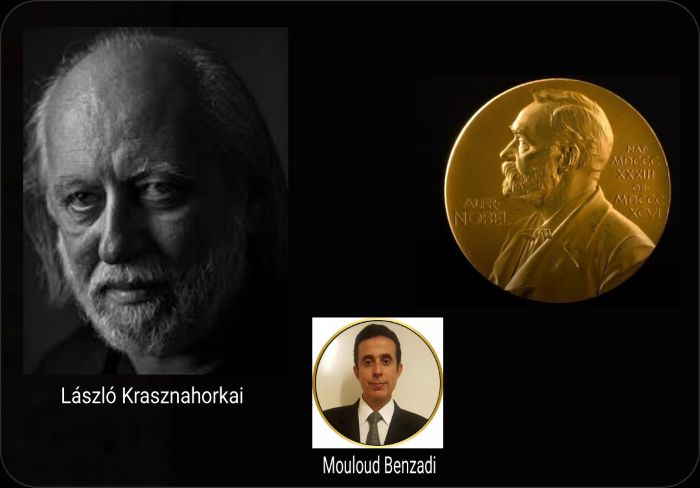
In literature, much like in previous years, an unfamiliar figure—László Krasznahorkai—emerged from among the renowned favourites, reminding us that the Nobel Prize is defined by unpredictability, surprise, and thrill. Media coverage highlighted his background, education, and achievements, emphasizing his distinctive style marked by long, intricate sentences that can stretch over several pages. Yet they largely overlooked a crucial aspect of his work: a deep sense of pessimism. How does this pessimism influence his perspective on language and technology, and how does it shape his views on humanity, civilization, and the modern world?
Pessimism About Humanity
In his interviews, László Krasznahorkai often speaks with a deep distrust of human nature. His view of humanity is marked by disappointment and fear—an awareness that people inevitably corrupt what they create. When asked about the state of the modern world, he replied with stark simplicity:
“Whatever falls into human hands is bound to be turned to evil uses.”
That single line captures the core of his pessimism: human beings, in his eyes, are incapable of sustaining goodness. Even their finest inventions or ideals become instruments of harm. His tone is not one of anger but of weary recognition—a belief that humanity’s decline is both ancient and continuous.
This bleak outlook also shapes his fiction. In War and War (1999), a man’s desperate attempt to preserve a manuscript becomes a mirror for human confusion and futility:
“He understood nothing, nothing at all about anything… the worst part being that for forty-four years he thought he had understood it.”
Krasznahorkai uses this moment to expose a broader illusion: the belief that humanity can ever truly comprehend the world it so often damages.
In The World Goes On (2013), his narrator delivers an unambiguous verdict on human morality:
“Evil exists, and the good, sad to say, can never catch up with it.”
The line suggests a permanent imbalance between cruelty and kindness—a pattern that defines human behaviour across generations.
And in Sátántangó (1985), he pushes the idea even further, stripping humanity of any special status:
“I’ve long understood there is zero difference between me and a bug, or a bug and a river… There’s no sense or meaning in anything.”
From interviews to fiction, Krasznahorkai’s vision of humanity is consistently and relentlessly pessimistic. He portrays a species lost in confusion, bound to repeat its failures, and fated to destroy its own world.
Pessimism about History and Modern Civilisation
Building on his bleak view of human nature, Krasznahorkai extends his pessimism to history and modern civilisation. For him, history is not a march toward progress but a slow, continuous collapse. He sees the modern world as trapped in a long, grinding apocalypse — a process of moral and cultural decay that has already begun. In an interview with The Yale Review (2025), he said:
“The apocalypse is not a single event… The apocalypse is now. The apocalypse is an ongoing judgment.”
To him, humanity’s belief in a better future is only self-deception. As he put it in the same conversation:
“We can only delude ourselves with the future; hope always belongs to the future. And the future never arrives.”
This vision runs throughout his fiction, from The Melancholy of Resistance to Baron Wenckheim’s Homecoming, where whole towns crumble under confusion, greed, and spiritual emptiness. In The Paris Review (Art of Fiction No. 240, 2018), he summed it up bluntly:
“Dear Adam — we shouldn’t wait for an apocalypse; we are living now in an apocalypse.”
Krasznahorkai’s pessimism extends beyond metaphysics to politics and society. Speaking about the war in Ukraine and the Orbán regime in Hungary, he described a world ruled by corruption and madness:
“A dirty, rotten war is unfolding before my eyes… This Hungarian regime is a psychiatric case.” (The Yale Review, 2025)
For him, this “new brutality” — what critics call “anarcho-capitalist-klepto-nihilism” — shows that history has not advanced but merely repeated its violence in new disguises. The tools have changed, but the cruelty remains the same.
And yet, amid this despair, he still turns to art as a fragile defence. “Art,” he told The Yale Review, “is humanity’s extraordinary response to the sense of lostness that is our fate.” In that sense, beauty is not salvation but a witness — a final gesture of resistance against the ruins of civilisation.
His Pessimism About Language
Building on his pessimism about humanity and history, Krasznahorkai extends his bleak outlook to language itself. One of the most striking features of his writing is his long, unbroken sentences — sometimes stretching for pages without a single pause. This stylistic choice is not merely artistic but deeply philosophical. It reflects his belief that words can never fully express what he means or capture the depth of human experience.
In an interview with The Guardian (2015), he confessed:
“Words are constantly betraying what I wish to say.”
That quiet despair drives his resistance to conventional punctuation. Krasznahorkai sees the full stop as an illusion — a false ending that interrupts the natural flow of thought. As he explained to Asymptote Journal (2024):
“The dot is an artificial border between sentences.”
And in a later conversation with The Yale Review (2025), he gave the idea a spiritual weight:
“The dot belongs to God. Only He can end a sentence.”
For him, language should move as the mind moves — without barriers, without closure. The very act of writing becomes a struggle against the limits of speech, an act of persistence in the face of inevitable failure. His pessimism lies in knowing that every attempt to describe the world is doomed to fall short, yet he continues to write because silence would mean surrender.
In The Hopkins Review (2011), he described this inner tension:
“I write my sentences in my head — outside there is a terrible, almost unbearable noise, inside there is a terrible, almost unbearable pounding silence.”
That silence is both the origin and the enemy of his art. Krasznahorkai’s long sentences, his rejection of the full stop, and his despair over words themselves all spring from the same conviction: that language, like humanity, is broken — yet still the only way to confront the world’s collapse.
His Pessimism About Artificial Intelligence
Extending his bleak view of humanity, history, and language, Krasznahorkai turns his attention to artificial intelligence, which now inhabits the same landscape of unease. When asked directly whether AI had appeared in his dystopian worldview, he answered without hesitation in Tank Magazine (Interview, 2019):
“Yes, it has. By now, anything whatsoever can scare me.”
That brief reply encapsulates his anxiety: AI is not an abstract idea of the future but a present source of dread. In the same Tank Magazine conversation—later widely circulated online—he expanded on the thought:
“I have no time to marvel at AI, even though we would have every reason to do so, because as soon as I began to admire it, it immediately occurred to me that, good Lord, this AI is not only a fantastic technological achievement brought about by humans, but it also happens to be in the hands of humans! And whatever falls into human hands is bound to be turned to evil uses. Horrendous uses.”
He then linked AI to the long, grim history of technology’s corruption:
“They were invented to do good but wrought evil … As for electricity—it is dreadful to see what it does to the condemned in the electric chair … Whatever falls into human hands is bound to be turned to evil uses.”
“Our brilliant evil is being deified via AI.”
For Krasznahorkai, the danger lies not in the machine itself but in humanity’s incurable tendency to misuse what it creates. The very brilliance of invention becomes a mirror for moral decay.
This same tension appears again in The Yale Review interview with novelist Hari Kunzru (Spring 2021). There, Krasznahorkai describes a scene where a “fundamentally twentieth-century war is raging,” while someone simultaneously dreams of a digital, interplanetary future:
“While a fundamentally twentieth-century war is raging, someone is talking about how we’ll soon be going to Mars. This is complete madness.”
Even when he does not name AI directly, the allusion is unmistakable: a civilization that glorifies its technological conquests while remaining trapped in its own violence.
In all these reflections, Krasznahorkai’s pessimism about AI is inseparable from his larger distrust of human progress itself. The machine is not the monster—humanity is.
AI's Silent Victims
László Krasznahorkai’s deep pessimism helps us understand the fragility of humanity, history, language, and technology. In his interviews and fiction, he depicts a world where human ambition and creativity are often overshadowed by failure, corruption, and moral decline.
His warnings about artificial intelligence fit naturally into this view. AI is not dangerous on its own, but in human hands it can be. This concern is shared by millions around the world who question AI’s impact on creativity and society. In literature, the issue is even more pressing: well-known writers express opposition out of fear that new technologies could harm creative work. Meanwhile, the debate over AI continues, but real harm is already occurring. Authentic voices are being denied publishing opportunities or excluded from writing competitions, often without explanation. Their only “crime” is choosing to use technology as an assistant in their creative work instead of costly human editors.