Among the most powerful quotes left by Walter Scott, the Scottish novelist and poet, one remains relevant nearly two centuries after his death:
“War is the only game in which both sides lose.”
In a single sentence, Scott expresses a universal truth, one that extends beyond geography and ideology and stands the test of time. War is often understood in terms of outcomes: victory or defeat, strategy or power. Yet beneath these labels lies a shared human reality, often overlooked, defined by loss on all sides.
Every war—whether brief or prolonged, small-scale or large-scale, precisely targeted or indiscriminate, or of any other kind—questions our morality and leaves a stain upon the record of mankind.
When humans wage war, all that matters to them is victory, not realizing that what they celebrate is only the façade that hides a horrific trail of blood, devastation, and psychological scars that time may never erase.
The cost of war is not measured only in lives lost, but also in shattered economies, ruined infrastructure, and fractured societies. It disrupts lives, instills fear, undermines trust, and closes the door on lasting peace.
The 2026 U.S.–Iran conflict reflects this reality. Though short in duration, its consequences were felt across borders and communities, reminding us that even brief wars can leave lasting effects.
Wars are Always Costly
There is no cheap war or expensive war—every war is costly. The death of a single human being is a cost. Displacement is a cost. A spouse widowed, a parent lost, a child orphaned—these are all costs. Nightmares, trauma, and the silent weeping of an innocent somewhere in the world are also costs we should never forget.
The US–Iran war resulted in thousands of deaths, widespread displacement, and significant economic disruption across the Middle East.
The New York Times reported that the conflict, which began on 28 February 2026 and lasted just over 15 weeks, resulted in approximately 3,500 deaths in Iran, along with 26 in Israel and 13 US service personnel. Thousands more were injured. The reporting also noted spillover effects in neighbouring countries, including around 3,700 deaths in Lebanon.
Along the Israeli–Lebanese border, continued hostilities forced the displacement of communities on both sides of the frontier.
The conflict also disrupted commercial activity in and around the Strait of Hormuz. Attacks and security threats in the area increased risks to shipping, trade, and civilian maritime traffic. Reuters reported more than 20,000 sailors were stuck on around 2,000 vessels in the Gulf during the height of the disruption, with the trapped fleet consisting mainly of oil and oil and gas tankers, cargo vessels, and bulk carriers.
Air transport was also affected. Regional airlines were forced to suspend or reroute operations due to airspace restrictions and security concerns, while airlines across the globe experienced indirect impacts through longer flight paths, increased fuel consumption, and rising operational costs linked to higher fuel prices and disrupted supply chains.
The economic consequences were enormous. The war contributed to higher global energy prices and increased fuel costs for consumers. Disruptions in the Strait of Hormuz affected international markets, raising transportation costs and increasing the price of goods and commodities.
The Wider Economic Impact of War
Under the heading “The Costs of the Iran War: Thousands of Lives and Billions of Dollars,” The New York Times reported, “For U.S. taxpayers and consumers, the cost of the war is at least $132 billion, according to Moody’s Analytics.”
One of the most visible effects has been rising fuel prices. Average U.S. petrol prices increased from $2.98 to nearly $4 per gallon during the war, adding an estimated $460 in annual costs for the average U.S. household.
Professor Linda Bilmes of Harvard Kennedy School estimates that the conflict is generating approximately $2 billion per day in direct costs. She says a substantial share of that spending has been used to support U.S. allies in the region. This was echoed in a 19 June 2026 report by The Washington Post, in which Vice President JD Vance stated that “two-thirds of the weapons that have defended Israel over the past three months were paid for by U.S. taxpayers.”
The economic impact has also extended across the Gulf region. Newsweek estimates that Gulf states have suffered roughly $100 billion in economic damage. Meanwhile, Goldman Sachs projects that oil-dependent economies such as Kuwait and Qatar could experience GDP contractions of up to 14 percent.
The situation could even be worse than these immediate figures suggest. Bilmes argues that the current $132 billion estimate does not capture the full cost of the war. Future expenses are expected to include veterans’ healthcare, higher long-term defence spending, and interest payments on government borrowing. She estimates that these costs could eventually push the total financial burden of the conflict beyond $1 trillion.
The Financial Burden of Modern Weaponry
The financial cost of modern warfare is driven not only by the overall scale of a conflict but also by the price of the weapons used. According to the Atlantic Council, relatively inexpensive drones costing around $30,000 can require defensive responses costing up to $2 million per interception.
The US–Iran conflict reflected this trend. The United States relied extensively on precision-guided weapons, including Tomahawk cruise missiles, which cost approximately $2–2.6 million each, and JASSM missiles, which cost more than $1–2 million per unit. Air defence systems such as Patriot interceptors can cost between $3 million and $4 million per launch.
The volume of weapons used during the conflict significantly increased the overall cost. Defence reports indicate that thousands of precision-guided munitions were expended, including more than 1,000 cruise missiles during the early stages of the war. Analysts estimate that a substantial proportion of the conflict’s direct military expenditure was linked to the use of these high-value weapons systems.
Many of these weapons cannot be replaced quickly. Depending on the system, production and replenishment can take between one and four years. As a result, the use of advanced munitions carries both an immediate financial cost and a longer-term impact on military stockpiles.
The Development Potential of Peace
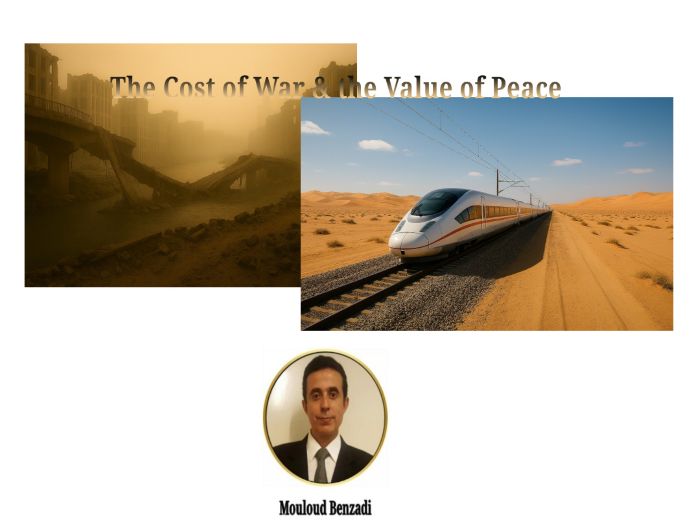
The $132 billion cost of the 2026 war is a staggering figure. But what could that same amount have achieved if it had been spent on construction rather than destruction?
Consider the infrastructure that could have been built across the Middle East. A major motorway stretching from Tehran to Beirut via Riyadh and Haifa—more than 3,000 kilometres—would cost an estimated $9–10 billion. With $132 billion, that same corridor could have been built more than a dozen times over, linking not just cities but entire economies.
Railways could have run alongside these roads, carrying workers, students, and families. Thousands of kilometres of track could have been laid, expanding trade across the region and connecting markets that have long stood apart.
Instead of spending money on ammunition that destroys bridges, that same funding could have built hundreds or even thousands of bridges, connecting people and societies. Instead of constructing underground tunnels to store and smuggle weapons, the region could have developed modern underground transport systems, metro networks, and tunnels connecting cities, supporting travel, trade, and daily life. Rather than racing to acquire weapons of mass destruction, nations could have built shopping centres, ports, and commercial hubs, opening doors to global trade and shared prosperity.
The numbers speak for themselves. With $132 billion, it would have been possible to build approximately 13 large international airports or around 65 regional airports. Around 400 large tourist hotels could have been constructed, boosting local economies and encouraging cultural exchange. About 50 major desalination plants could have been built, providing clean water to millions and reducing a key source of regional tension.
Entire energy networks could have been developed, bringing reliable electricity to remote communities and powering industries that create rather than destroy. Jobs would have been created across the region—for engineers, architects, labourers, and hospitality workers. Supply chains would have been strengthened, not disrupted.
The Path Forward Together
War consumes resources, devours lives, divides nations, and halts progress.
Peace forges connections, preserves lives, unites nations, and secures success.
There is one best way to reduce the likelihood of violence: foster cooperation and interdependence among nations, and encourage people to travel across borders to build understanding and acceptance.
The $132 billion spent on war could have funded a new era of regional cooperation, transforming the Middle East from a theatre of military action into a hub of cooperation, enhancing peace, security, and stability, and creating harmony and prosperity.
As one reflection reminds us, “War doesn't only kill humans; it also kills love, trust, and relationships.” For while war leaves behind death and disaster, peace offers something far greater: the chance to build, to restore, and to move forward together toward a brighter future.
Yet history shows that even after destruction, narratives of triumph persist, as if victory could erase the cost. But the sad reality is different. After every conflict, everyone claims victory, but in reality, there is only one winner: the ego, and one loser: humanity.