In Gaza, war doesn't end when the guns fall silent, victory isn't declared when the flags are raised, and survival isn't measured by the number of survivors. In Gaza, war isn't a passing event, but a permanent phenomenon that weaves the details of life just as death weaves its features. When it's said that the war might end in hours or days, hope doesn't rise from the rubble. Instead, people ask: Who remains? Who hasn't been lost? Who hasn't been broken? Who hasn't been buried alive in their memories?
In Gaza, survival isn't measured by heartbeat, but by what remains of humanity within. The living aren't necessarily survivors. A survivor might be someone who died before seeing their children scatter like autumn leaves, someone who didn't witness their home turn to dust, or someone who didn't hear their mother's screams as she was pulled from the rubble. Survivors in Gaza don't carry the medal of life; they carry the burden of deferred martyrdom, an unhealed memory, and faces searching for their features in broken mirrors.
In Gaza, every moment of life is a test of survival, and every survival is a betrayal of the dead who were not bid farewell or buried as martyrs deserve. When the war stops, people do not return to their homes, but to ruins where they learn how to inhabit them anew: how to raise children without schools, how to cultivate land without water, how to write letters without mail, how to love without a future.
In Gaza, the war never ends. It takes on a different form, more hidden, more cruel, more draining. Has anyone survived? Can anyone who remains alive be called a survivor? Or is survival in Gaza another form of death, postponed, repeated, not announced in the news but written in the eyes, engraved in the hearts, and told in the silence of mothers?
This is not an introduction to an article, but rather a plea from a heart that doesn't know how to rest, from a soul that doesn't know how to forget, from a memory that doesn't know how to stop bleeding. This is Gaza, where life doesn't resemble life, where death doesn't resemble death, and where survival doesn't resemble survival.
After the Silence: When the War Stops
When it's said the war is over, there's no applause in Gaza. Instead, silence descends like a heavy curtain over a city that no longer knows how to define itself: Is it alive? Is it dead? Or is it stuck in between, breathing beneath the rubble and suffocating from the overabundance of memory?
Silence doesn't resemble stillness; it resembles cemeteries where the names of those inside are forgotten, where graves resemble each other and faces are lost.
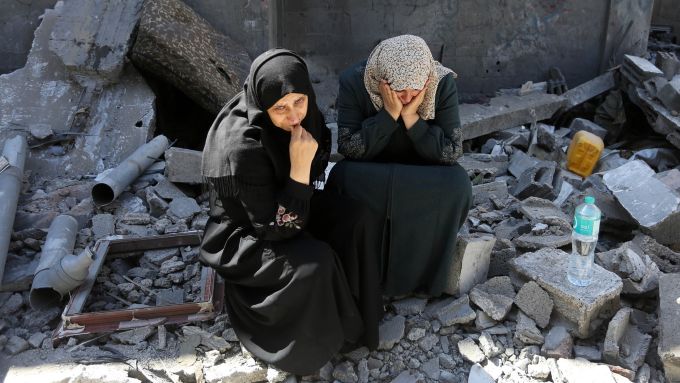
The moment the bombing is declared over, people don't emerge from their homes, but from among the rubble. They don't carry their bags, but what remains of their features, their voices, their memories that have yet to be buried, the pictures that were on the walls and have disappeared.
The streets don't regain their noise; they tremble under the dust, and the houses don't open their doors, because they no longer know who lived in them or who will return to them. Children don't run to school because schools no longer exist. And if they do, they have no walls, no blackboards, no peace of mind, no childhood.
In Gaza, when it's said the war is over, it doesn't mean that life has begun. Rather, death has changed its form, hidden in the smallest details: in the look of a mother searching for her son among the pillars, in the hand of a child trembling when he hears a sound like a plane, in a man sitting in front of a house that is no longer a home, trying to remember what the door looked like, what the kitchen smelled like, what his wife's laughter was like before the shell silenced her.
Silence in Gaza is not a comfort, but an unanswered question: Who remains? Who did not? Who remains to bear the pain of those who did not? This is the aftermath of war in Gaza: a time measured not in hours, but in scars; not written in reports, but in eyes; not announced on the news, but in the silence of the living who no longer know if they are truly alive.
Survivors: Are they alive? Or witnesses to their own deaths?
Survival in Gaza is not a victory, but a curse suspended between heaven and earth. You feel that those who remain alive lower their heads in shame, as if life itself is rebuking them for their survival. Survivors don't speak of themselves, but of those who have passed away, as if they were mere witnesses to an unfinished death, to a story with no ending, to faces that were with them but then disappeared, leaving behind an unfilled void.
In hospitals, a mother walks among the beds, not searching for treatment, but for a name on a list, a face among faces, a small hand she held before the sound of an explosion separated them. She asks the doctors about her son, and they sadly answer, "No one by that name has reached us." She leaves, carrying in her heart a death that is not announced, a funeral that is not held, and a tear that finds no place to fall.
In an alleyway, a child stands in front of a collapsed wall, asking his father, "Is this our home?" The father remains silent, not knowing how to explain to his child that home is not walls, but memories, that memories were burned by the bombing, and that what remains is not a home, but a large tombstone. The child doesn't understand, but he feels that something has broken, something irreparable, something that will stay with him forever.
A man returns to his neighborhood after the ceasefire is declared. He walks through the rubble, searching for his home, his neighbors, a familiar voice. He finds nothing. Only a small plaque on a half-destroyed wall, on which his name is written. He stands in front of it for a long time, not knowing whether this is a tombstone for his home or his grave. He touches the letters as if saying goodbye, then sits on a stone and stares into space, as if waiting for someone to emerge from underground to tell him, "You are alive, but you did not survive."
In Gaza, every neighborhood carries an inner death. People walk, but they do not move. They speak, but they don't hear themselves. They laugh sometimes, but they don't know why. Survival isn't life, but a continuation of pain, memory, and confusion. Those who survived didn't escape the fear, the guilt, the unanswerable question: Why me? Why did I stay? Why did they leave?
Survivors in Gaza don't tell stories of survival, but of loss. They don't talk about how they escaped, but about those they couldn't save. They don't sleep to rest, but to escape the images that haunt them. Every neighborhood in Gaza is a museum of death, and every neighborhood is a testament that survival is just another form of loss, of brokenness, of postponed death.
Memory as a Battlefront: We Who Have Not Yet Been Buried
In Gaza, memory is not a refuge, but a restless battlefront. Those who survived the bombing did not escape the images that haunt their minds, the sounds that invade their sleep, the smells that take them back to the moment of the explosion, to the moment when everything changed. Memory in Gaza is not recollection, but a continuation of war, an internal war that is unseen, unheard, yet destroys people as shells destroy walls.
The child who saw his brother pulled from the rubble does not forget, does not play, does not laugh. Whenever he hears a loud noise, he hides under the table, thinking the sky will fall again. When asked to draw, he does not draw a sun or a tree, but rather a destroyed house, a headless body, and blood flowing from the walls. This child is not living his childhood; he is living the memory of a death that was not understood, but that haunted him.
The woman who lost her husband and son in a single moment does not cry in public. She walks steadily, speaks quietly, but when she closes the door to her room, she collapses. She speaks to them in a low voice, as if they are still there, as if they can hear her. She places the food on the table and waits. No one comes. But she waits. Because memory is stronger than logic, harsher than truth, more truthful than reality.
The man who survived the bombing carries in his memory the sound of his friends screaming, he carries their faces when they were laughing minutes before, he carries the smell of blood, the heat of the fire, and the trembling of the earth. When he walks in the street, he doesn't see people, he sees those he has lost. When he sits in the mosque, he doesn't hear prayers, but rather hears an incessant internal scream. This man doesn't need physical therapy, he needs someone to believe that his memory is a battlefield, that he is still fighting.
In Gaza, no one has an ordinary memory. Pictures aren't arranged in albums; they are engraved in the heart. Every beautiful moment is met with a moment of loss, every laughter is accompanied by a tear, and every name spoken is feared to have been added to the list of martyrs. People don't talk about the past because the past isn't behind them, but rather dwells within them, haunts them, and gnaws at them.
Memory in Gaza isn't a luxury, it's a daily burden. Those who carry it carry an unburied death, an unspeakable pain, and an endless war. And everyone who survives is a soldier on this front, fighting to avoid collapse, to avoid forgetting, to avoid going mad. Survival in Gaza isn't an escape from death, but rather an entry into a memory that is unforgiving, unhealing, and unforgiving.
When Survival Becomes Betrayal
In Gaza, survival is not a gift, but a heavy burden, carried not on the back but in the heart. Those who survive do not celebrate; they hide from the stares of others, from the images of the martyrs, from the voices of mothers, from the memories of the houses that fell. Survival here is not salvation, but a silent betrayal, punishable not by law, but by conscience.
The survivors do not say, "We survived," but whisper, "We weren't there," "We were a minute late," "We were downstairs," "We went out to buy bread." Every sentence carries an unspoken apology, as if they are justifying their survival, as if they are asking permission from the dead to continue living. Some are ashamed to look into the eyes of a mother who has lost her children, or a father who buried his wife with his own hands, or a child who has no one left. Survival here is not a privilege, but a stigma; it is unseen, but felt, sensed, and pursued. A man who survived a bombing that destroyed his home stood in front of the camera and said, "I am alive," and then cried. He cried not because he survived, but because he couldn't save his wife, because he couldn't hold his daughter before she was crushed, because he wasn't there when they needed him. Every day that passes, he feels he has betrayed them, that he chose life when they weren't given a choice. This man doesn't sleep, doesn't eat, doesn't speak. He just lives, as if life were a punishment.
A woman emerged from the rubble, her body covered in dust, her eyes searching for something. When the journalist asked her, "How do you feel?" she said, "I feel like I stole a place in life that should have been given to my daughter." Then she fell silent. She said nothing more. Because words are not enough, and because the feeling of betrayal is not expressed, but carried in silence.
In Gaza, survival is not survival. It is a continuation of pain, guilt, and unanswered questions: Why me? Why did I stay? Why wasn't I with them? Everyone who survived feels they have betrayed those who didn't. Not because he wanted to, but because he couldn't be with them, to share their end, to disappear as they disappeared. Survival here isn't life, but a postponed death, an internal death, a death that isn't announced.
The survivors aren't asking for sympathy, but forgiveness. They aren't looking for a cure, but for justification. They don't want to be told, "Thank God you're safe," but rather, "We know you're in pain." Because true pain isn't in the wound, but in surviving it.
Gaza, which never dies, searches for its features.
Gaza never dies. Not because death doesn't knock on its doors, but because when it does, it finds a people who don't collapse, but rather are reshaped anew. Gaza isn't defeated because it fights not to win, but to survive. Every time it's said that it's over, it rises from the rubble, not to prove anything to the world, but to tell its children: We are here, we're still trying, we still love, we still dream.
In Gaza, life doesn't come easily; it's snatched from the jaws of cruelty. A child draws on a destroyed wall. He doesn't know all colors, but he knows that blue is the sky that hasn't fallen yet, that green is a tree that hasn't been uprooted, and that red is his heart when he's afraid.
A girl writes a poem in the dark. She doesn't have paper, but her words shine brighter than the absent electricity. A man plants a rose in land bombed yesterday, not waiting for it to grow, but waiting for someone to see it and smile, even if just for a moment.
Gaza doesn't die because there are those who teach death how to be defeated. There are those who build a house of one stone, those who nurture hope in a broken heart, and those who laugh, even though laughter has become an act of resistance. There are those who write, those who sing, those who cook, those who pray, those who hug, those who teach, those who heal, those who bury, and then return to life.
Gaza doesn't need miracles because it is the miracle.
When the war ends, people don't return to an ordinary life, but to a deeper, more fragile, more honest life. Every moment lived in Gaza is a small victory, not celebrated, but felt, carried, and recounted. Hope in Gaza is unspeakable, because it requires no words. It is enough to see a mother brushing her daughter's hair, a father repairing a broken bicycle, or a child running after a kite, to understand that Gaza, despite everything, does not die. The conclusion is not an end, but another beginning. Gaza is not written in a final line, but rather narrated in every heartbeat, in every sigh, in every eye that looks up to the sky and says: We are here. We still live. We still love. We still write, even though the paper is burning, the voice is bombed, and memory bleeds. Gaza does not die because it has decided to be life itself, even if life is a wound that never heals.