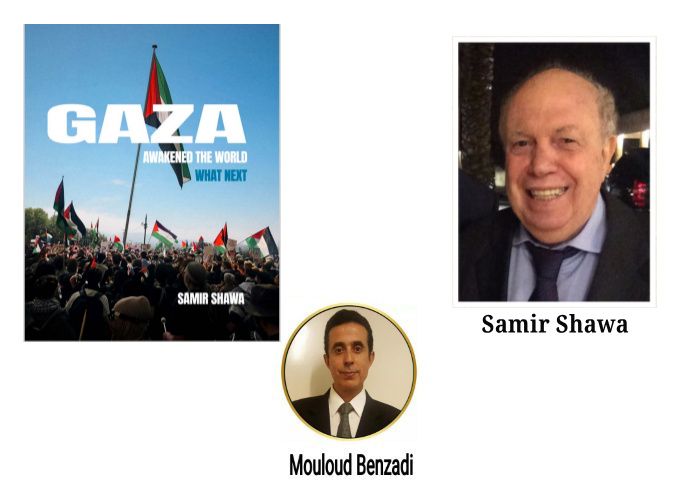
Before it became a headline on front pages across the globe, Gaza was—once upon a time—a cradle for civilisations and a crossroads for peoples from around the world. In Gaza Awakened the World: What Next?, Samir Shawa begins by tracing its remarkable diversity across millennia. "Throughout history," he remarks, "Gaza has witnessed several different, far-flung empires, embracing diverse origins, ethnicities, and religions, which had a significant impact on the demographic makeup of this historic city, including the Egyptians, Philistines, Greeks, Romans, Byzantines, Moslem Arabs, Crusaders, Mamluks, Ottomans and the British."
More Than a Name: A Sacred Crossroads
He then moves to the origin of the name itself:
"The city has acquired since its initial existence, many names depending on the civilizations that succeeded it: the early Canaanites called it 'Hazati', the Old Egyptians 'Gazato', and the Assyrians 'Azzati', the name being derived from the word 'Izza', meaning strength and power, which describes the city's steadfastness in the face of giants throughout its ancient history."
Shawa further notes that it was also named "Ghazzat Hashem" after Sayyid Hashem ibn Abd Manaf, the grandfather of the Prophet Muhammad, who died and was buried in Gaza. He also roots the city in the deep Canaanite past, where a pantheon of gods, El the supreme father, Ba'al the lord of thunder, and Anat the goddess of war, was worshipped, and where the Akkadian and Ugaritic tongues laid the foundations for Syriac and Arabic. This layered spiritual and linguistic heritage underscores a central claim of the book: Gaza was never a blank slate but a crowded, sacred crossroads.
This opening passage sets the tone for the entire book. Unlike Rashid Khalidi's The Hundred Years' War on Palestine, which begins with the political declarations of 1917, Samir Shawa opens by reaching back four millennia. This is a deliberate act of reclamation. Before addressing the bombs and the famine, Shawa establishes Gaza as a cradle of civilization: a Canaanite port, a Philistine stronghold, and the city where the great-grandfather of Prophet Muhammad lies buried. He reminds us that Gaza gave the world "gauze" fabric and minted its own coins long before modern states existed. Most strikingly, he highlights Gaza's foundational Christian history, noting that mass conversion in Palestine began here in the 4th century. This section is a necessary prelude to the tragedy that follows. It dismantles the illusion that Gaza is merely a "refugee problem" or a political "Strip." It is, Shawa insists, an ancient, sacred, and eternal city whose soul cannot be erased by modern weaponry.
From the Ottomans to the Nakba: Gaza's Long Decline
Shawa traces the slow-motion catastrophe of the modern era, beginning with a decisive rupture: “in the year 1517... the Ottoman armies attacked and easily occupied the Levant and Palestine.” This occupation set the stage for centuries of stagnation, briefly interrupted by Napoleon’s campaign. Shawa describes how the French emperor, after securing Cairo, turned his attention to “the conquest of Palestine,” capturing Gaza “without significant resistance” while brandishing the hollow slogan of “Liberty, Equality, Fraternity.”
The author’s tone shifts from historian to witness as he describes the 1948 Nakba. He argues that the emerging “Zionist movement” in Europe, led by figures like Theodor Herzl, possessed resources “the Palestinian National movement with its limited resources” could never match. The book powerfully illustrates how Gaza’s population doubled overnight with refugees, transforming a proud society into a community dependent on UNRWA aid—a dependency Shawa critiques for eroding dignity. Yet he balances this with nostalgic portraits of pre-war life: the brass bands of Fadous, the intellectual salons of Gaza College, and the scent of Taboon bread shared between Muslim and Christian neighbors. This ccontras, between a vibrant society and the “open-air prison” it became, is the emotional core of the book.
The Exile’s Return and the Two-State Illusion
One of the book’s unique contributions is its focus on the Gazan diaspora in Kuwait. Shawa documents how the Emirate became a sanctuary after the Nakba, incubating the Fatah movement—whose nucleus was formed there by Yasser Arafat, Khalil al-Wazir, and Salah Khalaf—and funding the Palestinian national cause for decades. He then turns to the false dawn of the Oslo Accords, signed with great ceremony at the White House on September 13, 1993, with the famous handshake between Arafat and Yitzhak Rabin under the gaze of President Bill Clinton. As a Gazan who returned home in October 1994 to invest in the dream of statehood, Shawa writes with personal disappointment. He recounts the laying of the foundation stone for Gaza’s seaport and the lighting of the gas field torch on September 27, 2000, monuments to a future that was systematically sabotaged when the Second Intifada erupted the very next day following Ariel Sharon’s provocative visit to Al-Aqsa.
This disillusionment culminates in Shawa’s analysis of “The Two-State Delusion.” As he notes, the ‘two-state solution’ was originally suggested by the Peel Commission following the 1936 Palestinian strike that lasted for six months. Yet negotiations faltered over decades until the idea seemed impossible to achieve. It was finally and publicly met with complete rejection by the previous Israeli government headed by Naftali Bennett, and more recently by the Netanyahu extreme right government. Shawa pointedly asks: Is the end of such an initiative the inevitable failure? This section serves as a poignant autopsy of a lost opportunity, arguing that the two-state solution became a hollow slogan—a delusion used to buy time for settlement expansion while the world looked away.
The Genocide and the Spirit of Sumud
The fourth section confronts the current genocide head-on. Shawa abandons the tone of the historian and becomes a chronicler of atrocity. He notes that Hamas named its operation on October 7, 2023 "The Flood of Al-Aqsa" (Tawafan Al-Aqsa), but the Israeli response has been a flood of a different, more devastating kind. One of Gaza's old poets, crouching in the rubble of his home in Jabalia, recalls Salah Jahin's quatrains with regret and mockery: "War doesn't give you time to cry. It steals your tears and leaves you standing in the rubble of your home, trying to remember how the door used to open and how the mornings resembled life before they resembled loss. We live in a time of recurring floods, but this time it's the Gaza flood, which has a ship without Noah."
The book cites B'Tselem's unequivocal conclusion that Israel is committing genocide and lists the staggering toll: over 200,000 people killed or injured, the vast majority women and children; over 1,650 health workers martyred; more than 240 journalists killed; and 2,700 entire families erased from the civil registry, every member, from grandparents to infants, gone. Shawa recounts specific horrors: the 335 bullets fired at six-year-old Hind Rajab, the bombing of the Al-Baqaa Cafe where journalists sat working, and the starvation of infants documented by Dr. Ahmad al-Farra at Nasser Hospital. Yet remarkably, the book resists complete despair. The chapter on Defiance is about the miracles of survival unfolding quietly behind the scenes: those children learning violin at the Edward Said Conservatory amid the rubble, those elderly women planting roses in spent bomb shells, and those families celebrating life in displacement tents. This, Shawa argues, is the essence of steadfastness and resistance. It is Gaza's response to a world that has failed to stop the slaughter.
Rebuilding from the Rubble
Shawa ends not with a political roadmap but with a stubborn, almost mystical faith in the "Phoenix Principle." He rejects the "Riviera" fantasies of outside powers, whether Jared Kushner's real estate visions or Donald Trump's peace plans, and insists that only Gazans will rebuild Gaza. He acknowledges the immense challenges: the 60 million tons of rubble laced with unexploded ordnance and human remains, the 90% of infrastructure destroyed, the trauma of a generation of children who have known nothing but siege and war. Yet he points to history as his evidence. Gaza has been destroyed by Alexander the Great, the Crusaders, Napoleon, and the Ottomans. Each time, it rose again.
Crucially, Shawa documents that Gazans are not alone in their defiance. The book's later chapters capture the unprecedented wave of worldwide solidarity that the war has awakened. London witnessed weekly demonstrations, with sometimes hundreds of thousands marching through its streets calling for a ceasefire and an end to the war. Politicians like Jeremy Corbyn and Bernie Sanders spoke out; artists like Roger Waters, Banksy, and Annie Lennox used their platforms; football players and fans from Celtic FC to Club Palestino in Chile raised the Palestinian flag in stadiums. Even within Israel, dissident voices like Gideon Levy and Ami Ayalon condemned their government's actions.
Yet this global solidarity has unfolded against a backdrop of continued suffering: repeated US vetoes at the UN, the continuous flow of American weapons, and the creation of the controversial "Gaza Humanitarian Foundation," which became synonymous with a death trap for starving civilians. The final message is unambiguous: the world may have failed Gaza, but Gaza will not fail itself. Gaza Awakened the World is a difficult, necessary read—a love letter written from the edge of annihilation, and a testament to a people who refuse to disappear.