Three Plays from the Time of the Yemeni War
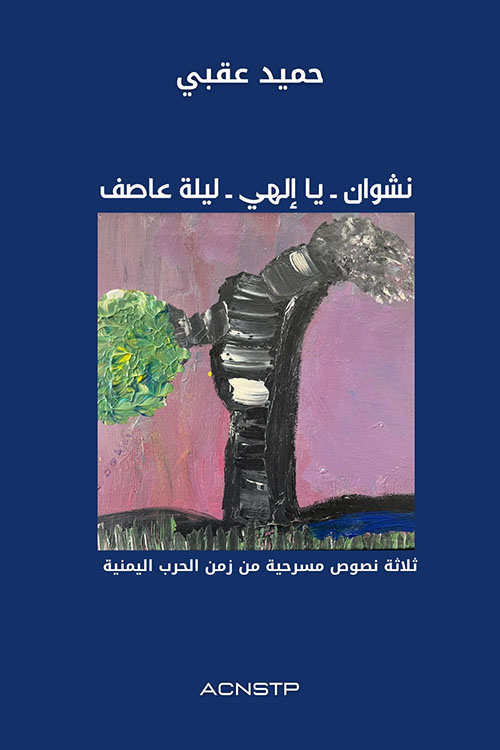
Nashwan – Ya Ilahi – Layla ‘Asifa
Three Plays from the Time of the Yemeni War
Nashwan is a poetic monodrama set in a devastated, war-ravaged space, where a solitary male character drifts between memory, delirium, and poetic hallucination. Trapped in an undefined time and space, the man interacts with symbolic objects—a stone, a circle drawn on the stage, a dead tree trunk, a missing pigeon—constructing and deconstructing his identity as an artist, farmer, soldier, or lover. The plot unfolds through a stream of fragmented consciousness, ritualistic gestures, lyrical monologues, and interactions with inanimate objects which often assume the roles of lost companions or ideals.
Writing Style
Oqabi’s language blends the lyrical with the surreal. He uses poetic prose, intertextual references (notably to Yemeni poets like Al-Maqaleh and Al-Bardouni), and recursive motifs. The dialogue transitions between elegiac tone and satirical outbursts, revealing a post-traumatic psyche trying to reconstruct a coherent sense of self and homeland. The author employs repetition, elliptical questioning, and dreamlike imagery, collapsing distinctions between reality, memory, and fantasy.
Themes
Major themes include the fragmentation of identity under war, memory as resistance, the trauma of displacement, the role of art in crisis, and the reclamation of life and joy through small acts (planting, dancing, storytelling). The recurring presence of pigeons, poetry, and ruins symbolizes survival and the fragility of hope.
Theatrical Scenography
The staging is minimal yet symbolically rich: a chaotic studio, stone columns that are gradually constructed, scattered personal objects, and a mysterious circle. Light and sound are crucial, often evoking bombing, weather shifts, or dream states. Objects gain dramatic weight—e.g., a shoe symbolizes lost mobility and dignity. The audience is constantly addressed, breaking the fourth wall and turning the play into a participatory ritual of remembrance and resistance.
Further Reading
Related Books
Upcoming Events
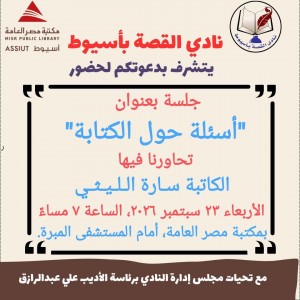
Questions about writing
September 23, 2026
The Assiut Story Club invites you to a session tit...
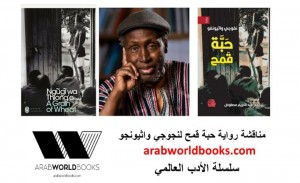
Online discussion of A Grain of Wheat by Ngugi wa Thiong'o
October 20, 2026
Join us for a special discussion of A Grain of Whe...
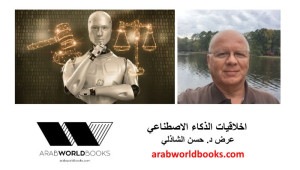
Artificial Intelligence: Ethical Concerns
May 23, 2026
This presentation took place on May 23rd, 2026. Yo...
?Who is the intellectual? And what is the role of the cultural reformer in societies
April 13 - 15, 2026
محاضرة يلقيها الفيلسوف والمفكر الإسلامي م.محم...