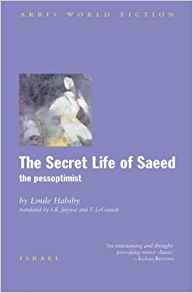
His novel The Secret Life of Saeed the Pessoptimist was our book of the month in October 2002.
You can find more information on the book's page.
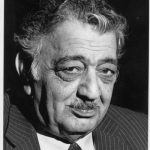
* Palestenian novelist, born in Haifa in August, 1921, where he remained until his death in May 1996.
* He shifted from one job to another early in his life.
* He was involved in the palestinian nation's resistance against the British occupier and joined the Palestinian Communist Party in the 1940s.
* Began writing short stories in the 1960s, and was editor-in-chief of the Communist Party's Arabic newspaper, Al-Ithad, in the 1970s.
* He was member of the Israeli Knesset from 1953-1972, after which he resigned to write his first novel: Saeed the Pessoptimist, depicting the life and fortunes of an Arab citizen of the state of Israel. Published in 1974, it was an instant success, and remains one of the greatest of modern Arabic novels.
* Many of his novels reflect the palestinian identity within the Arab Israeli conflict.
Emile Habibi founded the magazine Masharif, which is considered a milestone among Arabic cultural magazines. It ceased publication for a short period following the death of its founder, then resumed publication in Haifa.
A selection of his works are :
The Mandelbaum Gate: Published in 1954.
Al-Nawriyya - Qadar Al-Dunya (The Gypsy Woman - As Big as the World): A play published in 1962.
Elegy for the Crab: Published after 1967.
The Sextet of the Six Days (1969): A short story collection that discusses the Israeli occupation of the West Bank and Gaza Strip in 1967, as well as the Palestinians of 1948.
The Secret Life of Saeed the Pessoptimist (1974): A satirical novel written by Emile Habibi in three stages. It depicts the life of a Palestinian in Israel and his acquisition of self-awareness amidst the Palestinian-Israeli conflict and the Israeli authorities' treatment of the 1948 Palestinians. It is listed among the top 100 Arabic novels. It was translated into Hebrew and became one of the most famous Arabic works among the Jewish public in Israel.
Luka' bin Luka' (1980): A play published in cooperation with Dar Al-Farabi by the Department of Information and Culture of the Palestine Liberation Organization (PLO). This play was performed in Damascus in 1982, directed by Walid Al-Quwatli. The music and songs for the play were written by Syrian singer and musician Bashar Zarkan, who also participated as an actor. The play revolves around the meeting of Palestinians killed in the Israeli-Palestinian war with Israelis killed in commando operations.
Ikhtayyeh (1985)
Saraya, the Ogre's Daughter (1991): An autobiography of the author, in which he discusses the duality of his work in politics and literature.
Towards a World Without Cages (1992): In this work, Emile Habibi discusses the reasons behind his departure from the Communist Party.