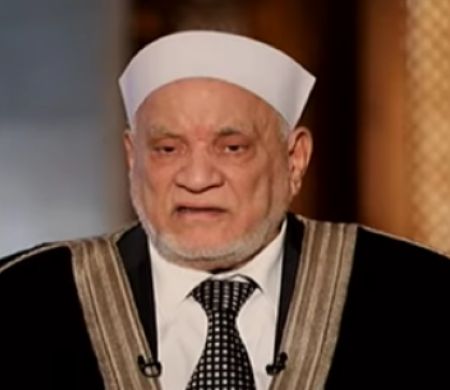
The scholar Dr. Ahmed Omar Hashem was born on Thursday, February 6, 1941 AD, corresponding to 10 Muharram 1360 AH, in the village of Bani Amer, Markaz Zagazig, in Sharqia Governorate. Dr. Ahmed Omar Hashem belongs to a noble family whose lineage traces back to Imam Hussein bin Ali . The distinguished scholar grew up and was raised in the Hashemite sahah (area) in his village, where he met scholars and righteous people. Since his tender age, he regularly attended the Quranic and scholarly study circles there.
Academic Career and Positions
Sheikh Ahmed Omar Hashem began his academic journey at Al-Azhar Al-Sharif, where he studied Islamic sciences and particularly excelled in the field of noble Hadith. He graduated from the Faculty of Usul al-Din (Theology) at Al-Azhar University in 1961. He obtained the Al-Ijaza Al-Alamiyyah Degree in 1967. Following this, he was appointed in the Hadith Department at the Faculty of Usul al-Din. He continued his postgraduate studies, earning his Master's degree in Hadith and its sciences in 1969, and subsequently obtained his Doctorate in the same specialization. He became a Professor of Hadith and its sciences in 1983. In 1987, he was appointed Dean of the Faculty of Usul al-Din in Zagazig. In 1995, he held the position of President of Al-Azhar University.
Public and Political Roles
In addition to his academic role, Dr. Ahmed Omar Hashem held several public and political positions. He was an appointed member of the Egyptian People's Assembly by a decision from former President Hosni Mubarak. He was also an appointed member of the Egyptian Shura Council by a decision from former President Hosni Mubarak. He was a member of the Political Bureau of the National Democratic Party. He held the position of Chairman of the Religious Programs Committee on Egyptian Television. He was a member of the Board of Trustees of the Egyptian Radio and Television Union.
Scholarly and Cultural Contributions
Sheikh Ahmed Omar Hashem had a great impact on the Islamic community. He contributed to the dissemination of Islamic jurisprudence and the clarification of Islamic concepts using an easy and simplified style. He played a major role in raising new generations of scholars and preachers. He gave many lessons and lectures in mosques and universities. He contributed to the dissemination of religious knowledge and the call to God using a simple and clear method. He was also a member of Islamic bodies, and actively participated in many Islamic councils and bodies. He had an active role in Al-Azhar Al-Sharif and the Islamic Research Academy (Majma' al-Buhuth al-Islamiyya).
Writings and Literary Works
Ahmed Omar Hashem presented many Islamic writings. Among his works are: Islam and Personality Building, From the Guidance of the Prophetic Sunnah, Intercession in Light of the Quran and Sunnah and a Refutation of Those Who Deny It, Solidarity in Facing Challenges, Islam and Youth, Stories of the Sunnah, and The Quran and Laylat al-Qadr. His other works include: The Muslim's Curriculum, The Indexed Lexicon of the Words of the Prophetic Hadith, and Islam and Morals. The Sheikh also wrote many articles in the field of Hadith and its sciences.
It is also known that Dr. Ahmed Omar Hashem was a poet and composed poetry
. Among his poems is a ode he wrote in praise of the Prophet Muhammad (peace be upon him). Hamed Abu Al-Gheit also wrote a poem dedicated to his professor, the scholar Dr. Ahmed Omar Hashem, who taught him at the Higher Institute for Islamic Studies.
Awards and Honors
In recognition of his outstanding contributions in the field of Islamic sciences, he received many awards and honors from various parties. Among the most important of these is the State Appreciation Award in Social Sciences in 1992 AD. He was also awarded the First Class Order of Sciences and Arts, in recognition of his pioneering missionary role and his great scientific and cultural status in Egypt and the entire world.
Passing
Dr. Ahmed Omar Hashem passed away on the morning of Tuesday, October 7, 2025, after a struggle with illness. His body was laid to rest among the family tombs in the village of Bani Amer, Markaz Zagazig, Sharqia Governorate. The Presidency of the Republic, Al-Azhar's Grand Sheikh, and Al-Azhar University mourned the deceased.