No one knows exactly when melancholy begins, but everyone knows how it settles in the soul: like an old stone at the bottom of a well.
I was in the middle of the bridge, and the city was exhaling the day’s final breath. Dusk is nothing more than the sun’s last attempt to delay the dark, yet it sets all the same. So it goes with the things we believe are over; we place tombstones over them, engrave farewell dates upon them, and then discover years later that we were not burying them... but planting them.
A scar is not the mark of a healed wound, but the conclusive proof that it was there, and that somehow... it is still breathing.
She told me one day, wrapping herself tightly in her coat on a bitter autumn night:
“Every beginning carries its own end within its womb, but the true sin is believing that the end is a wall.”
I didn't understand her words back then. I was young enough to believe that separation meant returning to square zero. But today, rummaging through the drawers of the old library, I find a folded piece of paper that had fallen between the pages of a book we never finished. The ink has faded, the paper yellowed, but the words pulse with the very same warmth with which they were written ten years ago.
Is that story truly over? And if it is, what makes my heart leap now like that of a frightened child?
At the station, trains do not stop to say goodbye to anyone. They arrive to take, or to let other passengers off.
I sat on the worn wooden bench, watching the millions of people passing by each day. Every person carried some sort of ending in their bag: an ousted love, a suspended dream, or someone who had left without any apparent reason.
People believe that departure is a minor death, but the truth is that departure is the greatest doubt. To keep asking yourself: Do they cry as we cry? Do they look up at the dark sky at the exact same moment? A true ending requires oblivion, and oblivion is a virtue that neither lovers nor poets possess.
I wrote her a letter I never sent:
“My companion in loss..
We do not end because we drift apart; we end when we stop feeling nostalgic. And I, unfortunately, still feel your presence in the corners of the room. In the smell of burnt coffee this morning, and in the long silences that punctuate my conversations with others. You are not the past; you are the present that insists on wearing the robe of absence.”
I put the letter inside the sandalwood box—the box that safeguards dozens like it. A box that is nothing less than a graveyard for living words.
At midnight, it begins to rain. Steady drops beat against the windowpane like fingers searching for shelter.
Memories are like water: they always find a way through the smallest cracks. You can lock the doors, change your phone number, move to a city where you know no one, but how do you escape a voice that shapes itself in your mind whenever silence falls?
The endings whose notebooks we delude ourselves into thinking we have closed always return in the form of unanswered questions.
I met her by chance in a narrow alley that frequented the evening shadows.
We didn't shout, we didn't reproach each other, nor did dramatic tears fall. We simply stopped. We greeted each other with a borrowed coldness, asking about ordinary things: work, health, and the cloudy weather.
But our eyes were fighting a different war. There was an entire language spoken beneath the silence. I realized then that endings are not a moment of sharp severance, but a continuous flow. We were two people who had closed the page, yet carried within ourselves a pulse that denied that end.
“How are you?” she asked me.
I replied with a faded smile: “I'm fine.. as much as I am permitted to be in order to keep moving forward.”
She said, looking far off into the distance: “We weren't wrong; we simply reached the limit of what the cloud could bear of rain. We had to fall.”
I pondered her words. Falling is not the end of the rain, but the beginning of life for the earth upon which it alights. Perhaps our ending was the only way for something of us to remain alive elsewhere.
The poet is never cured of his poems, and the lover is never cured of his endings.
Every time I try to write a new piece, I find you slipping between the lines. I wanted to write about the sea, and I wrote about your eyes. I wanted to describe solitude, and I described my last night with you. You are not a subject of writing; you are the ink I write with.
And how can an ending be fulfilled, if the ink refuses to dry?
They say that time takes care of mending broken souls. That is only half-true. Time does not mend; it merely teaches us how to live with the fracture without screaming. It gives us the ability to smile while bearing the corpse of an old hope inside our ribs.
I look at the wall clock. The hands turn in their vicious circle, never stopping, but always returning to the exact same points. So are our endings: perfect circles of nostalgia, which we delude ourselves into thinking we have exited, only to discover that we are standing right at their center.
Now the night retreats slowly, leaving room for a pale grey light.
I close the wooden box, set my pen aside, and look out the window. The city begins to awaken, and people head out in search of new beginnings, unaware that they are dragging behind them the tails of unfinished endings.
I will not say goodbye, for goodbye is a word for travelers who do not return. And you never left to ever come back.
I will leave the door ajar—not in anticipation of you, but out of respect for a pulse that insists on not dying... Another ending begins now, pulsating with life.
Pulsating Endings
By: Abdel latif Moubarak - on: Wednesday 2 September 2026 - Genre: Stories
Upcoming Events

Questions about writing
September 23, 2026
The Assiut Story Club invites you to a session tit...

Online discussion of A Grain of Wheat by Ngugi wa Thiong'o
October 20, 2026
Join us for a special discussion of A Grain of Whe...

Artificial Intelligence: Ethical Concerns
May 23, 2026
This presentation took place on May 23rd, 2026. Yo...
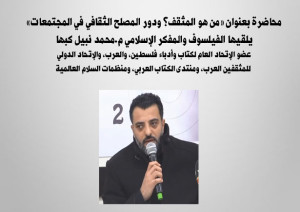
?Who is the intellectual? And what is the role of the cultural reformer in societies
April 13 - 15, 2026
محاضرة يلقيها الفيلسوف والمفكر الإسلامي م.محم...