Dear Mr Fitoussi,
You have acknowledged that you were one of the people behind the anonymous X account Balance ton Claude, which on 21 September 2026 published AI-detection results concerning the novel C’était ça ou mourir by Canadian-Haitian writer Thélyson Orélien.
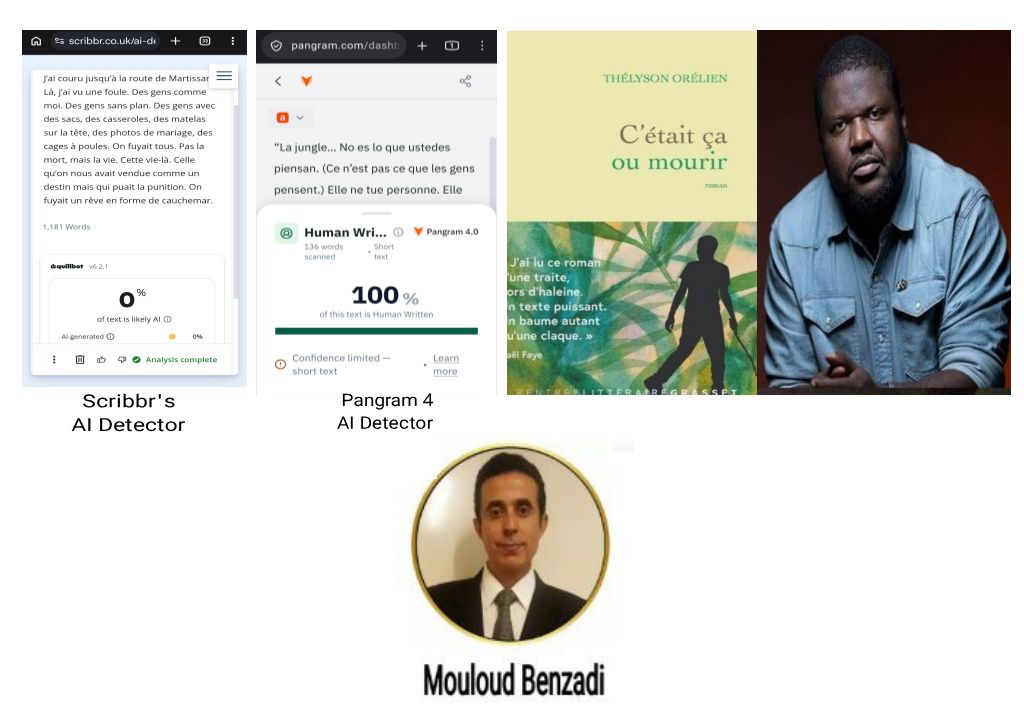
Those results, produced using Pangram, classified passages from different parts of the novel as 100% AI-generated. The allegations attracted media attention, created a controversy and led to the removal of the novel from the Prix Goncourt longlist.
As an author, lexicographer and researcher, I have published several articles on AI and studied AI detectors. With no clear rules governing AI use in writing, and with accusations increasingly affecting writers, students and professionals, I wrote The Right of Authors to Use AI Freely to establish rules for responsible AI use, define authorship more accurately in the age of AI, and address the confusion surrounding AI-assisted writing.
Through practical examples, I show how AI can serve as an assistant rather than an author, performing editorial tasks traditionally done by human editors: proofreading, rephrasing, improving clarity and readability, reducing repetition, strengthening style, and ensuring consistency. I explain why such use does not transfer authorship to the machine when the ideas, arguments, knowledge, creativity, responsibility and overall direction remain the author’s own.
I also document the limits of AI detectors with concrete evidence, warn against treating their output as proof of authorship, and propose more reliable alternatives. I also highlight how AI can empower global voices by helping non-native speakers communicate ideas, research and perspectives more effectively, so that language barriers do not keep their contributions out of global knowledge and debate.
This background led me to take a close interest in the controversy, and I recently conducted an independent investigation into the reliability and consistency of the AI-detection evidence surrounding this novel. I tested material from seven chapter units, covering the 3 parts of the book, using three recognised detection systems: Pangram 4.0, Scribbr and Copyleaks.
The detectors frequently returned conflicting results, contradicting one another, and in some cases Pangram contradicted its own verdict on the novel. The details are set out in the questions below.
The Media Reported the Allegations. Will They Report the Evidence?
These findings raise serious questions about the consistency of the evidence you presented and the credibility of your allegations. Given the public interest in this controversy, I am putting my questions to you in an open letter, so that the public can see them and judge for themselves.
I also intend to immediately share my findings and this open letter with the same newspapers and media organisations that reported on or amplified the allegations, including Le Figaro, Libération, La Presse, Radio-Canada, RFI and Euronews. In the interests of fairness, transparency and informed public debate, I believe that the evidence presented in this investigation should receive the same opportunity to be considered by the public as the allegations that originally attracted widespread attention. Readers deserve access to both the allegations and the evidence that challenges them, so that they can assess the matter for themselves. If one side of a public controversy is widely reported while the evidence questioning it is overlooked, future generations may reasonably ask why the original accusations were given prominence while the evidence challenging them was not.
I would therefore like to ask you the following questions:
ON THE PANGRAM CONNECTION AND THE POSSIBILITY OF A CONFLICT OF INTEREST
Question 1: Why Was the Question About a Possible Connection to Pangram Not Answered Directly?
As part of my investigation, I sought to understand why Pangram, among the many AI-detection tools available, was relied upon by an AI investor to support allegations of AI authorship. In my research, I read a 20 Minutes article about your role in the X account Balance ton Claude. According to the journalists, when asked whether there was any relationship between your account and the AI-detection company Pangram, no direct answer was provided.
I must admit that I expected a clear denial if no such relationship existed, and was therefore surprised that the question didn’t receive a clear answer.
For transparency, can you state clearly whether any direct or indirect relationship has ever existed between you, Balance ton Claude and Pangram? If not, what led you to rely on Pangram rather than other detectors, and were others tested before the allegations were made public? Even if you believe that Pangram performs better than its competitors, as an AI investor you would know that no detector can establish authorship with certainty.
ON EVIDENCE AND CERTAINTY
Question 2: Given these conflicting results, including Pangram’s own inconsistencies, do you still consider the Pangram findings you publicised reliable enough to support the allegations? If so, on what basis?
Scribbr and Copyleaks classified material from Chapters 1 and 16 as entirely human-written, while Pangram rated one extract 100% and the other 96% AI-generated. In Chapter 34, Scribbr returned 100% human-written while Copyleaks and Pangram returned 100% AI-generated.
ON FAIRNESS AND THE AUTHOR’S RIGHT TO RESPOND BEFORE PUBLICATION
Question 3: Should the Author Have Been Given a Chance to Respond Before the Allegations Were Published?
The author learned of the allegations only after they had been made public and had begun to influence media coverage and the novel’s standing in the Prix Goncourt. He was not shown the passages or the results, and was given no opportunity to defend himself before the accusations were published.
Do you think it was fair to publish allegations of this seriousness without first giving the author a chance to respond? Would anyone be found guilty without a trial?
ON THE CLAIM OF AI AUTHORSHIP
Question 4: In Light of the Conflicting Results, Do You Still Believe the Novel Was Almost Entirely AI-Generated?
You publicly claimed that the novel was almost entirely AI-generated, yet subsequent testing produced very different results. When I tested dialogues and quotations from Chapters 4 and 18, Pangram itself classified them as 100% human-written, as did Scribbr and Copyleaks. Scribbr and Copyleaks also classified material from Chapters 1 and 16 as entirely human-written.
Given that the very tool you relied on classified some passages as 100% human-written, do you still believe the novel was almost entirely AI-generated?
ON THE LOGIC OF A 100 PER CENT AI VERDICT
Question 5: How Can a Book Be Considered 100 Per Cent AI-Generated If Part of It Is 100 Per Cent Human?
This is a matter of logic, not interpretation, as these passages form part of the novel itself. If they are human-written, on what basis can the novel be described as 100 per cent AI-generated? And if Pangram was wrong about those passages, why should its conclusions about the rest of the novel be regarded as reliable? Pangram, which cannot provide certainty and returns low-confidence results for many passages, cannot reasonably be relied upon as proof of authorship.
ON AUTHORSHIP AND EDITORIAL ASSISTANCE
Question 6: Did You Consider the Possibility of AI-Assisted Editing Rather Than AI Authorship?
As an AI investor, did you know that AI detectors do not detect authorship? They analyse words and statistical patterns to predict how likely a text is to have been generated by AI. Yet the same predictions can arise when a writer uses AI for editing tasks that human editors routinely perform, such as smoothing transitions, standardising terminology, reducing repetition, tightening prose, checking consistency and improving readability.
Suppose you write a complaint letter to your local council, then use AI to improve the wording, make it more formal and improve readability. Is it still your letter and your complaint, or does it suddenly become AI-generated? Who decided to complain? Who initiated the process? Whose ideas, arguments and facts does the letter contain? And who remains responsible for those facts: you or the AI assistant?
Why is human assistance in editing and polishing a book accepted, but AI assistance treated differently? Is it not a double standard to ask authors to disclose their use of AI? I agree 100% that disclosure is necessary when AI is used to generate the work. But when AI is used only for editorial tasks similar to those carried out by human editors, there is no reason whatsoever to treat it differently or to ask for disclosure. For generations, authors have relied on human editors, friends, spouses and proofreaders to improve their manuscripts, and no one has demanded that this help be disclosed. Some writers have chosen to acknowledge it voluntarily, but it has never been an obligation. If disclosure was never required for human editorial help, why should it be required for AI used for the same editorial tasks? The same standard should apply to both. It is a question of consistency.
Did Pangram indicate with high confidence which passages were generated by AI and which were merely edited with AI assistance? And did you consider these facts before presenting the detector’s output as proof of AI generation?
ON THE LIMITS OF DETECTOR ANALYSIS
Question 7: Can a Detector Assess Authorship or Only Patterns in Text?
A novel reflects far more than patterns of language. It may reflect imagination, lived experience, cultural influences, personal convictions, artistic choices and intellectual effort. A detector cannot measure who developed the ideas, created the characters, shaped the narrative or made the creative decisions. It can only analyse linguistic and statistical patterns in the finished text.
Given these limitations, what led you to regard Pangram’s output as reliable evidence of authorship rather than as a statistical assessment of the text alone?
Question 8: Before Making the Allegations, Did You Check How Often AI Detectors Make Mistakes?
Independent research has shown that AI detectors are inaccurate, and the companies that developed them acknowledge that their results should not be treated as evidence of authorship. Pangram’s own website states, I quote: “Not a certainty —a signal. Pangram’s percentage score is a statistical estimate produced by an AI model, based on patterns commonly found in machine-generated text and images. It is not a definitive determination of who or what created a piece of content.”
Before making these allegations, did you consider this disclaimer, the research on detector error rates and the risk of false positives, particularly for literary writing, stylised prose and writers working in a second language?
Were you also aware that detectors have at times classified human-written works as AI-generated, including historical documents, literary texts and passages from the Book of Genesis?
Given this, do you believe a detector’s classification of selected passages as 100% AI-generated is enough to support allegations that could seriously damage a writer’s reputation and career? If so, why?
ON HUMAN JUDGEMENT AND LITERARY ASSESSMENT
Question 9: Why Was Human Literary Assessment Replaced by a Prediction Score?
I am sure you would agree that a novel is far more than a collection of words. It is also an expression of culture, imagination, memory, emotion, intellectual influence, lived experience and artistic intention.
With that in mind, before presenting Pangram’s findings publicly, did you apply your own human judgment? Did you ask yourself whether an AI, left to itself and without human direction, could produce a novel of this complexity and cultural and emotional depth, one that moved readers worldwide and was longlisted for the Prix Goncourt?
Did anyone examine its cultural references, narrative structure, themes, literary influences, emotional depth or intellectual content?
ON THE FUTURE OF LITERARY JUDGEMENT
Question 10: What precedent does this controversy set for the future of literature?
If major media outlets and institutions like the Académie Goncourt can be this easily influenced by an anonymous social media post showing screenshots of a few passages, and by the output of a single detector that offers predictions, not evidence, do you realize the dangerous precedent you are helping to set? Genuine works, in which AI was used only as an assistant to improve expression, consistency and readability, may be wrongly discredited, and writers’ reputations tarnished, without a fair investigation.
You may attract considerable media and public attention, and you may help Pangram gain visibility too. But did you think about your legacy? When future generations look back and find that a book was judged on the basis of predictions, published by someone who made no effort to analyze it, who applied no human judgment, who offered no literary analysis proving the use of AI, who consulted no human experts able to assess it properly, and who never contacted the author to raise concerns or give him a chance to respond, what will they conclude? Won’t they see a moment when literary works were judged by statistical probabilities rather than by human reading, critical analysis and literary expertise? And what verdict will they reach, not only on your actions, but on the hasty decisions made by media organisations, institutions like the Goncourt, and commentators who helped fuel the controversy?
Recommendations to Protect Authors from Unproven AI
The purpose of this letter is not to defend the novel or to argue that it was not generated by AI. Rather, it is to question the allegations made against it and to raise concerns about the way a verdict was reached and acted upon, based on unreliable and conflicting results from a single detector among many, without a proper investigation, human assessment, or a fair opportunity to present a defence.
Subsequently, I urge the media outlets that amplified these allegations, institutions such as the Académie Goncourt, which removed a book from its longlist without a proper investigation, and publishers and literary organisations to consider the following recommendations. Most are already set out in my book, The Right of Authors to Use AI Freely. Their aim is to reduce the risk of similar unfair treatment of writers and to promote decisions based on evidence, transparency, and human judgement.
- AI detection results are indicators, not evidence. AI detectors, regardless of how advanced they become, cannot determine who authored a text. They also cannot distinguish between AI-generated text and text edited with AI, so any test that cannot make that distinction must not be treated as evidence or relied upon.
- Conclusions must not rest on a single detector. Findings should be based on multiple AI detection systems. Where they produce conflicting results, none should be relied upon. This reflects a well-established principle of fairness: when evidence is inconsistent or inconclusive, a case should be dismissed.
- Disclosure standards must be consistent and fair. Authors should disclose the use of AI when it is used to generate their work, but not when it is used only for editorial tasks, such as proofreading, rephrasing and improving clarity, that human editors, friends and family have always carried out without any obligation to disclose. AI-assisted editing must not be held to a stricter standard than human editing.
- Disputed cases must be assessed by qualified human reviewers who look beyond the words on the page to the ideas, cultural context, emotional depth, and the author’s background, including whether English – or French in this case - is their first or second language. Reviewers should interview the author where possible and consider whether the author may have used AI as an assistant.
- Authors must be told about the allegations, shown the evidence against them and given a fair opportunity to respond before any decision is reached. They should also be able to appeal to a higher authority, such as an ombudsman, for a final review.
- Detection companies, institutions and individuals making allegations must be held accountable for damage caused due to unreliable results, including the right of authors to seek compensation for false accusations or decisions based on them.
- Media outlets that publish and amplify allegations should give similar coverage to the evidence that challenges them. If the allegations turn out to be unfounded, they should help restore the writer’s reputation.
- Most importantly, the principle of “innocent until proven guilty” must apply to authors: accusations must rest on concrete evidence, not on tools that only measure patterns, that their own creators admit can make mistakes, and that, as the very detector used for your allegations states clearly, do not offer a definitive determination of who or what created a piece of content.
In the interest of justice and the public, I hope you will respond to these questions publicly. I hope this letter will contribute to a constructive and open discussion and help establish clear standards that protect authors from unfounded allegations and the damage they cause.
Yours sincerely,
Mouloud Benzadi
Author, lexicographer and researcher
United Kingdom