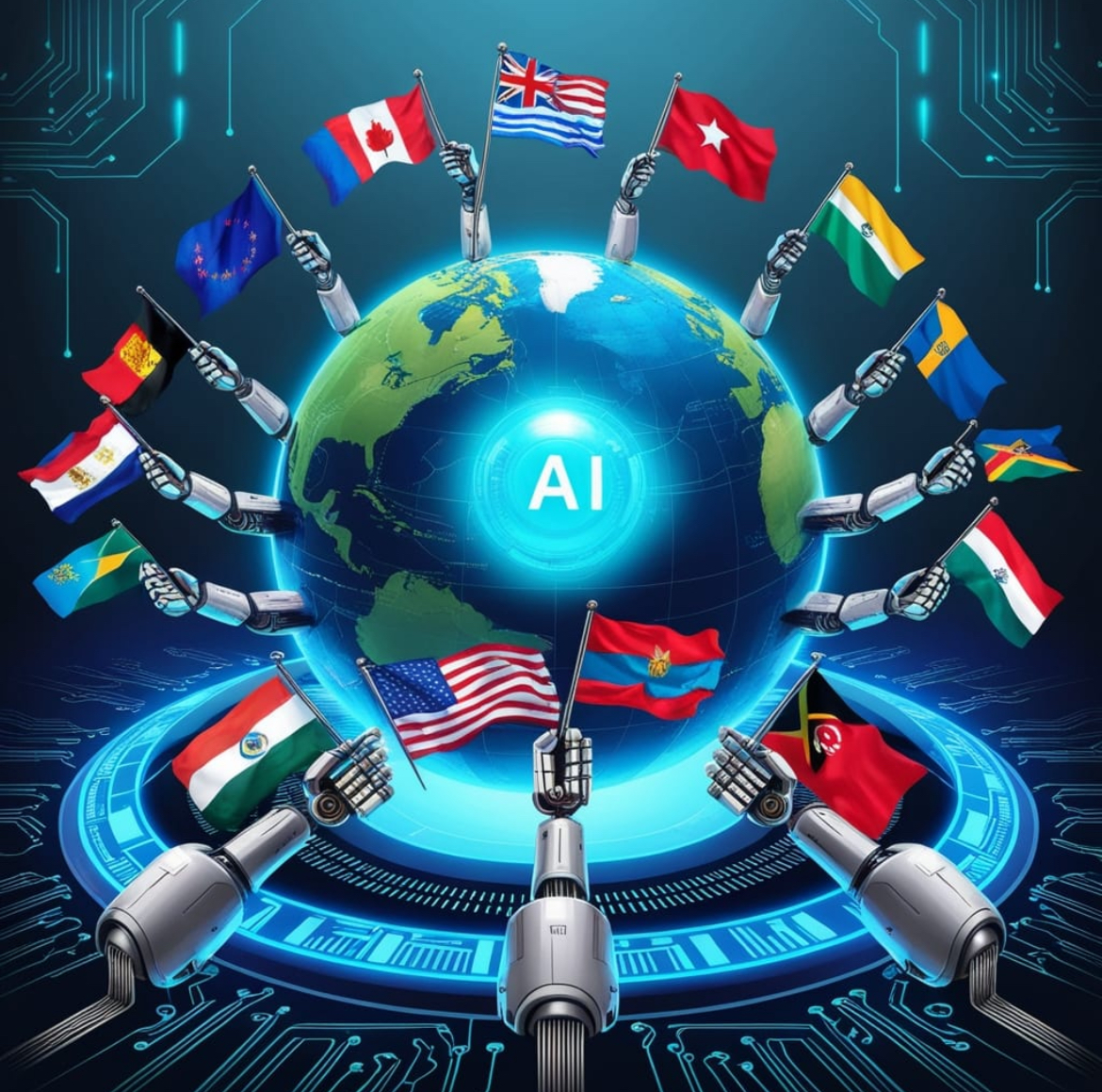
It would be a mistake to view artificial intelligence merely as another technological leap. History teaches us that major transformations don’t stay confined to laboratories — they end up redistributing power among nations and societies. What we’re witnessing today isn’t simply a race to build smarter software, but a race to redefine political influence, national sovereignty, and the ability to shape the international order.
Over past decades, power was measured by the size of an economy, the number of soldiers, industrial capacity, and control over energy sources. Today, a new element has entered the power equation: the ability to produce algorithmic knowledge, own data, and control digital infrastructure. In this new world, the algorithm may carry the same strategic weight that aircraft carriers or oil fields once held in the last century.
The competition between the United States and China is no longer just a trade or technology rivalry — it has become a contest over leadership of the coming era. Whichever side succeeds in building an integrated system spanning advanced chips, data centers, scientific talent, and language models won’t just achieve economic superiority; it will also shape the rules of global trade, cybersecurity, military capability, and even the global political discourse.
But AI’s deepest impact may not be on international relations — it may be on the nature of politics itself.
For the first time in history, governments have tools capable of analyzing the behavior of millions of citizens in real time, predicting social trends, and gauging public opinion with unprecedented precision. This promises more responsive public policy, but it also raises an unsettling question: what happens when algorithms shift from tools that assist decision-makers to tools that shape the decisions themselves?
The problem isn’t the technology — it’s who controls it. An algorithm isn’t an independent entity; it reflects the data it’s fed, the standards its developers set, and the goals of whoever owns it. So talk of AI “neutrality” in the political sphere remains contested, since any bias in data or design can turn into sweeping institutional bias.
This problem shows up clearly in modern democracies. AI can now segment voters with precision, analyze their behavioral patterns, and craft tailored political messages for each group, boosting campaign effectiveness. While some see this as a natural evolution in political communication tools, it raises questions about the limits of legitimate influence over public opinion — and whether electoral competition will still be about platforms and ideas, or will instead become a contest over who owns the data and algorithms.
This challenge deepens with advances in synthetic content generation, which now make it possible to fabricate images, audio recordings, or videos that the public can barely distinguish from reality. In a media environment defined by rapid spread, such content can erode trust in information, muddy public debate, and weaken citizens’ ability to make informed political decisions.
Yet the greater danger may not be disinformation itself, but the erosion of trust. When everything becomes questionable, truth loses its value as a foundation for democratic debate, polarization sharpens, and institutions become more vulnerable to losing their legitimacy.
At the same time, AI offers real opportunities to improve public administration — boosting the efficiency of government services, analyzing economic risks, advancing healthcare systems, improving city management, and supporting disaster response. But these benefits don’t remove the need for legal and institutional safeguards to ensure smart-governance tools don’t turn into instruments of mass surveillance or violations of basic rights.
The real challenge, then, isn’t developing AI — it’s developing the governance to regulate it. Just as the world needed rules to govern nuclear energy and international trade, it now needs legal and ethical frameworks to govern AI use, ensuring transparency and accountability, protecting privacy, and limiting its cross-border risks.
For developing countries, the question is no longer whether they will use AI, but whether they will take part in producing it. Merely consuming technologies developed by major powers risks creating long-term digital dependency and limiting the ability to make independent decisions in economics, security, and public policy. Without investment in education, scientific research, and digital infrastructure, the technological gap could turn into a political and strategic one.
AI has become one of the arenas reshaping the international order. The nations that will lead the future won’t necessarily be those with the largest armies, but those able to combine innovation, rule of law, democratic oversight, and rights protection.
Algorithms can help make decisions, but they can’t grant those decisions legitimacy. Data can predict behavior, but it can’t substitute for political will. Responsibility for shaping the future of societies will, in the end, remain a human responsibility — not a machine’s.
That’s why the central question of the coming decade won’t be: how much smarter will AI become? It will be: can political systems build institutions capable of steering this unprecedented power in ways that serve freedom, protect democracy, and strengthen international stability?