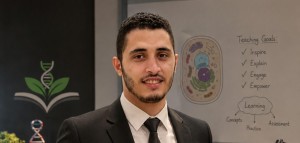
Moroccan Translator Mohamed Said
Raihani interviews Niels Hav about his latest achievements
Women of Copenhagen a poem by Niels Hav

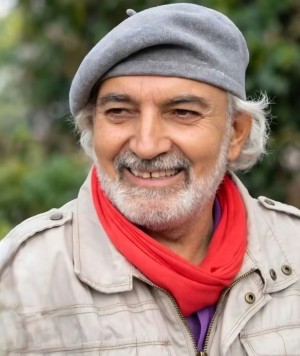
Niels Hav is a poet and short story writer, living in Copenhagen with
his wife, pianist Christina Bjørkøe. His work has been translated into
several languages, including English, Spanish, Portuguese, Turkish and
Italian.
His credits include five volumes of poetry and three short story
collections. He's also been the recipient of several national awards.
Mohamed
saïd Raïhani: When readers crowd around a poet to know much about
the content of a poem, they are advised them to read it themselves as
reading serves not only understanding the poem but also producing other
parallel texts by means of construction and deconstruction. Yet, when it
comes to excavating the career of the poet himself, readers will rub
their hands ready to enjoy the honour of listening to the poet, who will
have no chance of evasion, in introducing himself.
Niels Hav: This is in a humorous way a very sophisticated opening
question for an interview. My respect! I have been in this
writing-business for some years now and have almost forgotten the reason
why I started writing. Your question reminds me on the first reason why:
I began writing in order to introduce myself, to find out what’s going
on and tell it with my personal words. And this is still the deep and
restless ambition, to find the exact words, always a mystery of
happiness in the middle of the timetable, they call it inspiration.
So my answer to your question must be: My poems and stories are the only
truthful introduction I can offer.
Like anybody else I was born. I had a father and a mother, brothers and
sisters.
My career as a writer started as a career of a reader. I was digging my
way trough the classic Danish literature to find words for my feeling of
life.
Mohamed saïd Raïhani: Niels Hav has published three collections
of short stories and five collections of poems. How does Niels Hav the
poet see short story and how does Niels Hav the short-story writer see
poetry?
Niels Hav: For me there is no conflict. Poetry and prose are
different genres, well defined through a long history. It’s like
belonging to two families. In storytelling I belong to the Anton Chechov
family, in my poetry family there are uncles and elder brothers as
Czesław Miłosz, Les Murray in Australia and many others.
Mohamed saïd Raïhani: How can Niels Hav situate his poetic
experience within Danish literary product? And what most characterizes
Danish literature particularly and Scandinavian literature generally
from the remaining European literature?
Niels Hav: As you know Scandinavian writing has a tradition back
to the saga and songs written in Old Norse. Compared to the tradition in
Arab writing it’s a short history, I know, but still 8 or 900 years is a
long time. Some years ago a publisher asked me to do an anthology with
the most important Danish poems ever written, a poetry canon. The book
contains more than 100 poets and about 350 poems from 800 years of
Danish writing. It was a very interesting task to find out what is
important and original.
Denmark is a small nation, surrounded by water. People were farmers or
sailors, and the local poetry was expressing experiences from the field
or the sea in a religious vocabulary.
In contemporary Danish poetry there are at least two schools, one
relating itself to language poetry the American way or French
linguistic. The other school wants to get more involved with reality.
The miserable state of the world forces us into political reflections.
As I put it in a poem
“Once I wrote meticulous poems with a fountain pen
- pure poetry about purely nothing
- but now I like shit on my paper
- tears and snot.”
Mohamed saïd Raïhani: Your texts shows an overwhelming presence
of simple vocabulary, simple imagery, simple rhythm, simple ideas… Is it
an inclination towards "Simplicity" as a horizontal communicative choice
or is it a tendency towards "Simplification" as vertical communicative
background?
Niels Hav: I admire simplicity, what’s the bottom in me is the
bottom in you. We are all walking on the same Earth, we have same
archetypical questions to deal with trough life. In common we have the
language, the simple words for the most important experiences in a human
life. In my poems I don’t want to swim away in the sky, I want to stay
close to reality.
“The task is for us to decipher our common experiences;
the horror and the misery that surround us, cling
to our clothes and seep into all of our bodies.
To notice what’s going on, and if possible
to say things as they are.”
Mohamed saïd Raïhani: He who studies carefully poems will no
doubt pay attention to the omnipresence of irony in your texts. Why
irony?
Niels Hav: Who can stand life without humor and irony. I admit;
where the military tanks are driving in and human flesh and blod are
dripping from the trees, that’s not the place for irony. But it is a sad
an ironical fact: we are now 6 billion people - alone at home here on
this planet - and if we want to we can arrange a fairly good life for
all of us. But still we don’t do this, we put up borders between
nations, religions, races. It’s more and more absurd. Self-irony is
needed.
It’s too early to give up. I’m affiliated with the naïve who mosey on
and want the impossible.
Mohamed saïd Raïhani: In times of cultural and civilizational
convergence between the peoples, have you invested this historic gain to
read Arabic literature, the literature that has given birth to "The One
Thousand And One night" called also "The Arabian Nights" and regarded as
the first novel in the history of human literature? Or Naguib Mahfouz,
Nobel-Prize winner? Or Tahar Ben jelloun and Nabil Maalouf, French
Goncours-Prize winners? Or Mohamed Choukri read in more than twenty-four
living languages? Or Adonis? Or Mahmud Derwish?...
Niels Hav: We have a fine Norwegian edition of "The One Thousand And
One nights" in our home. This Arab tradition puts up a high standard for
all storytelling. We know of course Naguib Mahfouz, Tahar Ben Jelloun
and a few others. The important thing about cultural exchange is
translations, we need more translations. The Arab writers have an
amazing capital of wisdom and beauty to offer the rest of the world.
My dear friend Salim Abdali is now translating the poetry of Adonis into
Danish, we are looking forward to read this translation and to learn
more about modern Arab poetry.
Mohamed saïd Raïhani: After the first translations of your two
poems into Arabic, you have personally remarked the warm welcome that
has accompanied their release. In three days, your first poem, "In
Defense of Poets", was published on more than twenty Arabic cultural
websites. Even this interview is done to the wish of Arab readers who
contacted us insisting on knowing much more about the newly-translated
Danish poet. What can be the motive behind that, in your opinion?
Niels Hav: I don’t know. I’m glad to hear this, but I can’t answer
the question. I’m surprised how well informed and interested readers you
have.
Mohamed saïd Raïhani: Danish literature is Scandinavian readers'
gateway in the south. Is there any rising trend among Danish
Intelligentsia to support the very few attempts, mainly by Arab
community in Denmark, to translate Arabic works into Danish? Or is
geographic distance a pretext for cultural divergence?
Niels Hav: I’m glad to say there are some efforts to support more
translations. But it is small editions. Imigration through the last
quarter of a century has supplied the Scandinavian countries with people
from all parts of the world. I myself live with my family in Norrebro,
the part of Copenhagen with most etnic diversity. Every day in the
streets and the shops we meet people born far away in Pakistan, Somalia,
Iraq, India, Morocco or Turkey – now they are all Danes - some of them
are our good friends - and there appearance has for ever changed the
Danish culture. In the near future we have to redefine the meaning of
the word “Danish”. How long time does it take a pizza, a sharwarma or an
iskender kebab to become “Danish”? Just a few years. The Scandinavian
falafel is a mixture of many cultures, and same thing is happening with
Danish art and literature, it’s already going on in front of our eyes.
We live in interesting times.
Mohamed saïd Raïhani: You know that literary translation is not
open to everyone mastering a couple of languages: the source language
and the target language. Translations of this kind are usually
"translations of the vocabulary of the poem". Whereas translations
supervised by creators regarded as "translations of the power of the
text" being performed by a creator who is no foreigner on the literary
field. Have you thought of choosing your future translators from
creators?
Niels Hav: My new collection of poetry “We Are Here” is just
published in Toronto
This book it translated from the Danish by P.K. Brask and Patrick
Friesen, both of them good writers. In Istanbul I’m lucky to have some
of my poems translated by Kemal Özer, a very fine poet. In Morocco my
works benefit from your work, I’m proud of that. Regarding translations
I generally prefer concise and pithy compositions for the more florid.
My works depend on the exact idiom, the precise word. So I can’t give in
on either “the vocabulary of the poem” or “the power of the text".
As poems and stories are the only articles I have in my
shop, it’s essential for me not to have these objects spoiled in
translation. I’m sure you are right: a skilled poet is always the best
to translate poetry. But let’s never forget; inside many scientists or
civil readers there is a hidden poet, waiting for the right moment to
blossom.
Mohamed saïd Raïhani: A free word to conclude this interview?
Niels Hav: Then I want to say: Thank you! It’s a pleasure to
exchange words with you. I hope the future will establish new
institutions for cultural exchange between our two countries. New
generations will look at this confused epoch with a smile. Empires and
political systems last for only a time, invincible is the marrow which
every morning lifts us all out of sleep, each with our own flopping
catch of joy and hope.
Women of Copenhagen
By Niels Hav
I have once again fallen in love
this time with five different women during a ride
on the number 40 bus from Njalsgade to Østerbro.
How is one to gain control of one's life under such conditions?
One wore a fur coat, another red wellingtons.
One of them was reading a newspaper, the other Heidegger
--and the streets were flooded with rain.
At Amager Boulevard a drenched princess entered,
euphoric and furious, and I fell for her utterly.
But she jumped off at the police station
and was replaced by two queens with flaming kerchiefs,
who spoke shrilly with each other in Pakistani
all the way to the Municipal Hospital while the bus boiled
in poetry. They were sisters and equally beautiful,
so I lost my heart to both of them and immediately planned
a new life in a village near Rawalpindi
where children grow up in the scent of hibiscus
while their desperate mothers sing heartbreaking songs
as dusk settles over the Pakistani plains.
But they didn't see me!
And the one wearing a fur coat cried beneath
her glove when she got off at Farimagsgade.
The girl reading Heidegger suddenly shut her book
and looked directly at me with a dirisive smile,
as if she'd suddenly caught a glimpse of Mr. Nobody
in his very own insignificance.
And that's how my heart broke for the fifth time,
when she got up and left the bus with all the others.
Life is so brutal!
I continued for two more stops before giving up.
It always ends like that: You stand alone
on the kerb, sucking on a cigarette,
wound up and mildly unhappy.
.”