By Hani M. Bathish
The Daily Star, February 26, 2008
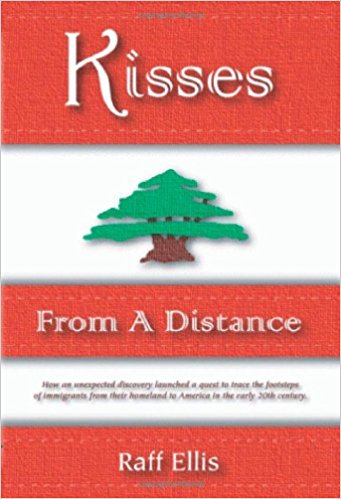
Raff Ellis' 'Kisses from a Distance' delves into the lure of migration, a subject that resonates deeply for nearly every Lebanese family today
BEIRUT: Lebanese-American author Raff Ellis' "Kisses from a Distance" unfolds like a quintessential immigrant's tale. It follows a Lebanese story that is as relevant and familiar to today's Levantine audience as it would have been 100 years ago. Over the book's 311 pages, which are peppered with relevant and exhaustively researched history, Ellis tugs readers along on a journey down the snow-capped mountains of Lebanon, over land, across seas and oceans and into many strange and distant ports. The story anchors in New York and allows readers to experience the anxious excitement of the wide-eyed immigrant as he steps off the boat and sets foot in a new country for the first time.
In "Kisses from a Distance," Ellis chronicles a very intimate family history - his parents' marriage and migration to the United States and their struggle to raise a family and make ends meet in the small town of Carthage, New York, during the Great Depression. Ellis also gives readers a glimpse of Lebanon ravaged by war, famine and disease. But he also reveals the ways in which the country encompasses boundless hope and countless tales of courage, triumph and success.
That success, in particular, reflects the dogged determination of Lebanese immigrants to persevere against all odds, an attribute which continues to serve their adopted homelands well. The author's story is just one of innumerable ordinary, untold epics, a highly personal account of a sad history, presenting a proud and fiercely independent people who are all too often caught up in the region's tectonic political shifts.
The genesis of Ellis' family epic came after the death of his mother, when he discovered more than 200 letters among her personal affects. The letters from friends and family span 60 years, starting in 1925. They begin with traditional Lebanese greetings, and many kisses: "Kisses from a distance ... We kiss your cheeks ... I kiss you many times from this distance," thus inspiring the title of the book.
As Lebanese autonomy in Mount Lebanon was suspended during World War I and the Ottomans began inflicting ever greater hardships on the population, not least by confiscating vital food and grain stores to feed their troops, the trickle of migration from Lebanon that began in the late 1800s turned into a flood.
Amreeka (as the locals pronounced America) was the Holy Grail for many Lebanese, including peasant sharecroppers and notables alike. Motivated by great need, many Lebanese journeyed to the new world in search of work in order to earn enough money to send home to their families. Expatriate remittances remain a vital life line for many Lebanese families today. But for Lebanese families circa World War I, a few dollars from Amreeka made the difference between scraping by and starvation, as the author points out.
Ellis' story begins in 1895 with the "forced marriage" of his maternal grandmother, Adela el-Khazen, a postulant nun, to a suitor from the Hobeiche clan. The arrangement was deemed a good match by her family, and served more as a union between two notable clans than two people. Women back then were rarely involved in intricate marriage negotiations, and they usually acquiesced to their families' choice of husband.
Ellis' maternal grandfather, Namatallah Hobeiche, despite being a sheikh, was one of many who migrated to the US before WWI, but who never realized the promise of prosperity there. He died penniless in a strange land, leaving his wife and children to struggle on in the old country.
In desperate times, wealthy expatriate suitors were seen as ideal by many Lebanese families regardless of class and social station, which led the author's mother Angele and her family to accept Toufic Kmeid, the author's father, as an ideal match.
Toufic, who changed his family name to Ellis (after his grandfather Elias) upon arrival in the US like so many immigrants before and since, had come back to Lebanon to choose a bride. Toufic was the son of a stone mason from the village of Bqaatouta in Kesrouan, where as a young man he worked in the region's quarries.
In the new world, he started out as a traveling peddler and, after making enough money, he bought his own store. The ravages of war served to tear down many feudal class barriers as the acute need for money superseded all other considerations. "Kisses from a Distance" offers rare insight into a world churning with upheavals, as wars and political ruptures transformed countless lives - some for the better but others less so.
Angele, a prolific letter writer and a proficient linguist, corresponded regularly with her family in Lebanon, mostly with her brothers Youssef and Khalil, her sister Miriam and her mother Adela. Through their letters back to Angele, readers of Ellis' account learn of her frustration with her new life in America, her pining for Lebanon and her unhappiness in marriage. The letters also peel back layers of her personality and in particular her religious fervor, which was a great source of comfort for her in the many family arguments that erupted over money and property.
Through her correspondence with her family, Angele learns of their struggles and frustrations, too. She learns of her sister Miriam's untimely death from a burst appendix, her younger brother Khalil's passing and her mother's worsening health until her ultimate demise. Angele watches from a distance as one after another of her loved ones perish.
The real-life dramas unfolding between the pages of these letters, especially in the last half of Ellis' book, make for a very compelling read, turning "Kisses from a Distance" into a veritable page-turner.
The author's visits to Lebanon, his meticulous research and his tenacious quest to trace his family's roots - and those of all the characters involved in this complex story - further enrich the narrative. The well laid-out book, which is Ellis' first full-length effort, is divided into 41 chapters ranging from four to 12 pages.
The story eventually comes full circle when the hard-working immigrant returns to his ancestral homeland one last time. In Toufic's case, the journey home was disappointing.
"I hope God helps whoever lives and returns to this beautiful country for it is a bastard nation where the child does not know his father or his brother," Toufic laments from Lebanon, in a letter to his wife dated 1965. "I do not feel sorry for any of my relatives or your relatives even if they die from hunger because they expect a person to give them everything he has."
For the young and intrepid immigrant who left Lebanon behind to toil in a foreign land, Toufic must have found the attitude of his relatives entirely foreign to his temperament.
In assessing "Kisses from a Distance," however, one ought to note the author's penchant for using unnecessarily complicated terms to convey simple meanings. Having a dictionary close at hand helps, but the effort isn't entirely rewarding. The book could have also benefited from a judicious edit to tighten up the language and eliminate the handful of typographic and grammatical errors. But minor defects such as these do not detract from the overall experience of the book.
As expressed in "Kisses from a Distance," the subject of migration resonates deeply for nearly every Lebanese family today, more so than at any time since WWI. Once again, many of Lebanon's youth are seeking work in foreign lands to escape the instability and uncertainty in their home country. And one suspects that when and if they return, they too, like Toufic, will be both disappointed and dismissive.
Raff Ellis' "Kisses from a Distance" is published by Cune Press, distributed in Lebanon by Levant, and available now in major bookshops
Use this link to buy from UK
Kisses from a Distance: An Immigrant Family Experience