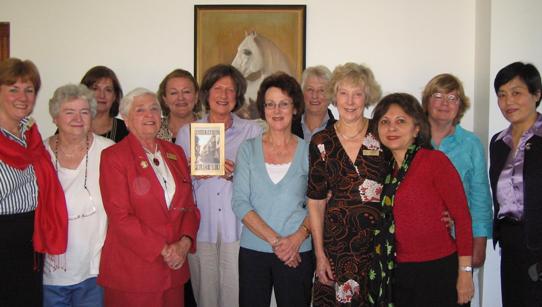
On November 8, a Canberra based Book Group met at the residence of Her Excellency Ms. Amira KAPETANOVIC the ambassador of Bosnia and Herzegovina to discuss their last book selection of the year, Naguib Mahfouz's Palace Walk. It was a great privilege to be invited to this interesting discussion by this very special group of ladies living in Canberra, Australia's capital city.
The discussion was spirited; a most enriching experience, not only because they were discussing one good book but rather for the fact that this was the groups' last book for the year. Their enthusiasm , care about detail and the many questions they posed were a reflection of the cultural journey each member of the group has taken throughout the year. It further proved how literature can ever so easily bring people together.
Here's a brief summary of the main points raised during the discussion:
All agreed that the failings (of the men in particular) were universal, and that some Western women were not very liberated at this time either. One member, was particularly indignant at the treatment and description of women (esp. Yasin). Everyone identified with Amina especially and wanted only the best for her.
Some thought the novel was too 'wordy' and wondered how much the translation was to blame for this.
"Pinpoints" of humor throughout the book and the feeling that one was "right there" in Cairo were immensely appreciated. e.g. P409 "… nothing strange about a man casting out a pair of shoes, but shoes were not supposed to throw away their owner".
Most wanted to read Vols 2&3 to continue the story to find out what happens next.
The group were most interested to hear personal observations from an Egyptian and had many questions about life to-day in Egypt.
Some of the individual comments:
" Wonderful writing. His characters are beautifully drawn making it easy to observe the life of Al-Sayyid Ahmad's family. As an Australian citizen, I was somewhat taken aback by the references to our soldiers but have to admit a group of "Aussie" men can be very raucous and their love of beer is legendary. They are also, however, generally kind and generous - I would hope some of those characteristics shone through. Most of them went on to die in Gallipoli.”
“I believe that indeed there is one God who is there for every believer. How we reach God is each person's choice and one religion should not condemn another. Sadly religion has been the basis of most conflicts be it Christian or Islamic. Ireland, the Inquisition, the Crusades - its unending. Al-Sayyid's family is reminiscent of Victorian England when women were often housebound. Is the way of life depicted Islamic or cultural? I have often read that Mohammed advocated equality of the sexes so one must assume that male dominance has chosen to misinterpret his words. What qualifies a man to be a mufti? Cannot a woman do the same?”
“There are many phrases in Palace Walk which I found delightful: "....the glance of his eyes, lying in wait above his huge nose." and "Death was roaming the streets of Cairo and dancing along its arcades". Beautifully evocative.”
“Loved the book. It was a pleasure to read."
" I found the book interesting as a picture of a Muslim family living in Egypt in the 1920s, however, I cannot say I enjoyed it. I found the writing too dense and verbose, and I regularly skipped half pages in order to keep up the interest. The father figure was suffocatingly oppressive towards his wife and children, who were completely terrified of him. The fact that he kept the women submissive prisoners within their home while he lived a life of womanising, drink and debauchery until the wee small hours really upset me. His two-faced arrogance I found hard to take. Someone in our group noted that many families in Victorian England lived similarly, but I cannot agree with that. The father of the house may have been a disciplinarian, but Victorian women were allowed to leave the home and meet with their women friends."
"Mahfouz gave us very real characters. Amina was a strong mother figure and kept firm control of her family with a very loving touch. I think she was my favourite character. I thought her coffee hours with her children little gems - she seemed to know how to handlethem all in her gentle way. Her two daughters, who were so submissive to their father, seemed to have a much more liberated life once they married and in the home of their in-laws, which showed the reader that not all Muslim Egyptian families were as restricted as that of al-Sayyid Ahmad. The sons surprised me in that, even as adults, they were terrified of their father, but they surreptitiously managed to conduct their own lives: Yasmin following in his father's footsteps with a complete disregard for the feelings of his young wife, and even of the poor household servant; Fahmy at least stood up for his principles against his father's orders and fought for the freedom of Egypt, and little Kamal was a breath of fresh air in such a controlled household managing to behave like a fairly normal little boy, enjoying the freedom of his sisters' households and fun with the British soldiers."
" The story, I found, moved very slowly, but maybe that is what happens in a trilogy.”
The group’s Previous Reading Selections:
Circle the Sea by John Banville (winner of the Booker Prize), We Need to Talk about Kevin by Lionel Shriver (winner of the Orange Prize for fiction), Suite Francaise by Irene Nemirovsky, The Kite Runner by Khaled Hosseini, Never Let me Go by Kazuo Ishiguro, Lily Bret’s You Gotta Have Balls, Ian Mcewans’s Saturday, and Zadie Smith’s Beauty.