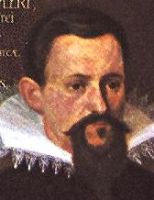
Johannes Kepler, 1571-1630, German astronomer, professor of mathematics at Graz (1593-98) and assistant to Tycho Brahe, court mathematician to Holy Roman Emperor Rudolf II - formulated three Laws of planetary motion that remain undisputed to this day.
Our priority (as we trace the wisdom of his time back to original source documents) - will be to demonstrate that the mathematics and sciences for Kepler's Laws of Planetary Motion, were all in place prior to 100 B.C., some will date as long ago as 3000 B.C. It only took the extraordinary genius of Kepler to put it all together.
Of particular interest is Kepler's 2nd Law, as it's the primary element in the development of the other two:
If an imaginary line is drawn from the sun to the planet, the line will sweep out equal areas in space - in equal periods of time - for all points in the orbit.
 Following are the scientific principles required of the 2nd Law, followed, in turn, by the original source document, and the statement therein, that establishes the existence of the requisite science prior to c100 B.C., and as long ago as 3000 B.C.
1. The Principle or Law} - for the Conservation of Momentum.
Modernly this principle is stated in this fashion: (physics) Conservation of momentum means that the total momentum of the system before an event (will equal) the total momentum after the event.
The principle expressed as the conservation of angular momentum .. is the key ingredient in chartering Kepler's 2nd law, because, in accordance with this principle, as an orbiting body extends it's radius (in navigating an ellipical orbit) it must accelerate and the change of velocity is observable against the background of the stars.
1-a. Discovery} The first known recorded instance of the principle of momentum is in Chapter 41 of The Book of Enoch.1, 4, 5 It is stated in this fashion:
And I saw the chambers of the moon .. and it's stately orbit, and how it does not leave that orbit .. and it adds nothing to it .. nor takes anything from it .. and it keeps faith .. in accordance with the oath by which it is bound
2. The Principle or Law} - that states that the planets orbit the sun, and the moons orbit their host planets.
Modernly this principle is known as heliocentrism which means (for a planet) a sun centered orbital system.
2-a. Discovery} The first known recorded instance of this principle, where it is said the moon orbits the earth, is also in Chapter 41 of The Book of Enoch.1, 4, 5 It is stated in this fashion:
And after that I saw the hidden and the visible path of the moon, and she accomplishes the course of her path in that place by day and by night - the one holding a position opposite to the other.
3. The Mathematics} that led to the definition and dimensional characteristics of planetary (and lunar) elliptical orbits.2
3-a. Discovery} There are multiple pre-current-era sources.
The first (whose name we find in Kepler's biography) is the Greek mathematician Apollonius of Perga (c262 B.C. - c190 B.C.) and who's book Conics introduced the terms and mathematics for the parabola, ellipse and hyperbola.
The second (attributed to the pyramid age), is the Rhind Mathematical Papyrus,3 and while it does not discuss conics it does contain mathematical solutions for circles, squares, and pyramidal shapes. It is also known that the origins of calculus date back to the early Greek and Egyptians.
4. A recognized system} for the measurement of angles and arcs.
4-a. Discovery} The first known recorded instance of the measurement and the use of angles is again the pyramid age Rhind Mathematical Papyrus.
Although Gay Robins & Charles Shute3 mention the Moscow Mathematical Papyrus (p 49) in the same regard.
On-line widipedia confirms these findings in stating: "The earliest recorded beginnings of geometry can be traced to ancient Egypt, the ancient Indus Valley, and ancient Babylonia from around 3000 B.C."
5. A recognized system} for the measurement of time and the timing of the movement of planetary and lunar objects.
5-a. Discovery} While accounts of the accuracy of ancient clocks vary, there is complete agreement on the exactness of calenders in use prior to 3000 B.C.
The Ancient Egyptian calendar, for instance, followed the Sothic year, and was measured in accordance with the heliacal rising of the star Sirius (or Sothis as it was commonly known) and is accepted modernly as having been 365.25 days in length.
The most useful of the ancient wisdoms, and the one most necessary in formulating the 2nd Law is the Sothic number, 1461. Modernly the concept is tied up in mysticisms that relate it to a period of 1461 years. But in actuality, the Sothic number is the measure (in minutes) of the time it takes the earth to travel through one degree of arc in it's orbital circuit of the sun. By this definition each planet would have a unique Sothic number. It is calculated in this manner:
1.} Calculate the number of minutes in a calender year:
(365.25 days x 24 hours x 60 minutes) = 525960 minutes / year. (Note: This number is also the circumference of the orbital circle in minutes of time.
2.} Divide the number of minutes per year, by the number of degrees in a circle:
(525960 minutes / year) / (360 degrees in a circle) = 1461; this is the Sothic number in (time) minutes per degree of arc
The Sothic number of Mars (2747.92, timed in earth years) was determined from measurements acquired by Danish nobleman and data quantitative genius Tycho Brahe (1546-1601), in studies of the orbital characteristics of the planets.
6. Getting from the Sothic number to defining the elliptic orbits of the planets, using 16th century technology and the ancient sciences} still requires that the eccentricity of an orbit (ellipse) be determined. This is done as follows:
6-a. Discovery} The relationship between the ecliptic and the equator, or earth's rotational axis, was well established by 3000 B.C. The evidence for this comes from the Pyramid Texts and The Celestial Science of the Ancient Egyptians.
The eccentricity of an orbit can be observed from earth by carefully recording the movements of a planet against the known location of the ecliptic in the night skies. This diligence is what Tycho Brahe was known for .. however, should there have been an instrument of sufficient complexity that it would have rendered the job easier - we should look at it's mechanism carefully.
Relative to such an instrument, and admitting to pure speculation, we should consider this: (Quote)
In 1901 divers working off the isle of Antikythera found the remains of a clocklike mechanism 2,000 years old. The mechanism now appears to have been a device for calculating the motions of stars and planets. Article by Derek J. de Solla Price From June 1959 Scientific American p. 60-7
The Antikythera Mechanism, as it's now called, dates back to the first century B.C., however, there can be no certainty that similar instruments were not available and in use in Kepler's time.
It has been the intent of this article to show that the sciences and the mathematics required for Kepler to have formulated the Laws of Planetary motion were all in place by 100 B.C. (some dating from 3000 B.C.). Whether he used all the sources referenced herein would be speculation - but certainly the prior discovery would have influenced the content of the books of his day
EPILOGUE
We are obsessed with the need to separate Church and State, Religion from Science, and Faith from Enterprise, telling ourselves that they are separate and discrete. But in the ancient world the blend of science and divinity was complete and the Cultural elements of each were inseparable one from the other. It's in our refusal to accept this in our own culture, that we haven't the means to understand it in theirs.
REFERENCES:
NOTES:
1.} In the quest for original source we're obliged to search for the first instance a subject theme is recorded. More important - we must find the document where it was recorded with supporting statements that confirm the original intent. Hence it is that we can use the Book of Enoch as original source, as it states both (that the moon orbited the earth, and a statement concerning Conservation of Momentum).
2.} Kepler's first law states that the shape of each planet's orbit is an ellipse with the sun at one focus.
3.} Gay Robins & Charles Shute, The Rhind Mathematical Papyrus, British Museum Press, 1998, ISBN 0 7141 0944 (p 44, 47)
4.} The Book of Enoch, c100 - 160 B.C., is accepted as Scripture by some groups, while it is not considered same by others. Whether it is or not, however, is not relevant to this study as the Book was clearly in publication c100 B.C., and as assistant to Tycho Brahe, court mathematician to Holy Roman Emperor Rudolf II, Kepler would have had ready access to it.
5.} We can say with some certainty (based on the wording of the following paraphrased paragraph from Chapter 41) that the Book of Enoch was written sometime during the time of Aristotle, c384-322 B.C., when the celestial (geocentric) model (as originally proposed by Aristotle) perceived the Sun orbiting the earth.
And I saw the chambers of the Sun ... whence (it) proceed and whither (it) come again (and it's) glorious return, and how ... superior (it is in it's) stately orbit.
The source of Kepler's wisdom! An original treatise by james bowles September 18, 2006-Copyright JamesBowlesMay2006, all rights reserved and all use without specific permission is strictly prohibited.