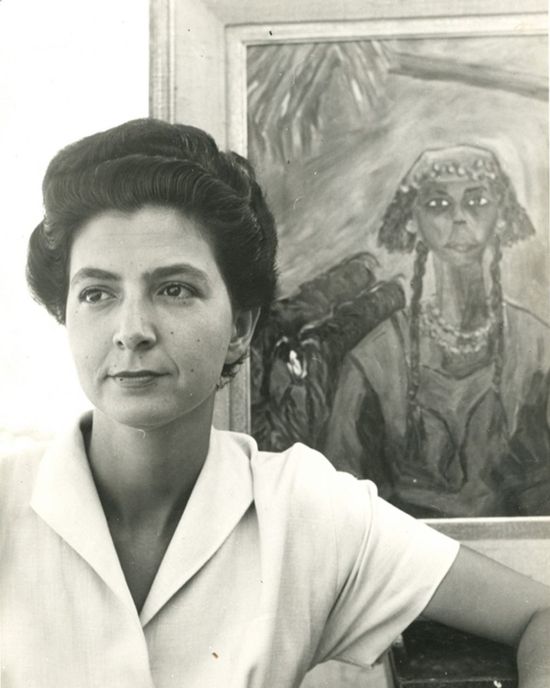
Inji Efflatoun also written Injy Afflatoun (1924-1989): The Revolutionary Artist Who Blended Art with Political and Intellectual Struggle
When Inji Efflatoun is mentioned, she cannot be simply described as a prominent Egyptian visual artist. She was a symbol of the struggle for freedom and social justice, and a powerful voice for the oppressed women in her society.
Born in Cairo to a distinguished aristocratic family, Inji's childhood, despite her affluent upbringing, was marked by intellectual challenges. She confronted societal restrictions on women and its rigid class system, which instilled in her an early awareness of the inevitability of change.
Inji began her artistic journey early, influenced by her teacher, Kamel El-Telmisani, who introduced her to the world of Surrealism. Her early paintings adopted a symbolic and surrealist approach, reflecting issues of personal freedom and intellectual liberation. Her artwork was not merely a reflection of beauty, but a powerful expression of her rebellion against patriarchal authority and society, as seen in her famous painting "The Flying Beast."
Despite the aesthetics of Surrealism, which influenced her, Ingi felt that art alone was insufficient to achieve the change she aspired to. This led her to delve deeper into the issues of her society and engage in political struggle.
With her joining the Egyptian Communist Party in the 1940s, Ingy's artistic and intellectual trajectory shifted. She adopted socialist realism as her artistic approach and began documenting the suffering of workers, peasants, and marginalized women in her works. Paintings like "The Cotton Harvest" and "The Fisherman" became living testaments to class struggle and harsh working conditions, transforming her brush into a weapon in the battle for social liberation.
Ingy was not just a revolutionary artist; she was a courageous political activist. She joined the ranks of the labor and women's movements and helped organize demonstrations and strikes demanding national independence and social justice. Her political activism led to her arrest during the reign of King Farouk, and later under President Gamal Abdel Nasser during the crackdown on communists in the 1950s.
Prison did not break her spirit; rather, it strengthened her resolve. She spent her time in prison painting and writing her renowned memoirs, "Inji Efflatoun: From Childhood to Prison," first published in 1993, a powerful human and political document reflecting her free spirit and profound intellect.
Inji was known for using art as a means of expressing the concerns of marginalized groups. Her paintings were a direct reflection of reality, as she focused on documenting the lives of peasants in the Egyptian countryside, working women, and factory workers. She believed that art was not a luxury, but a tool for shaping public consciousness and bringing about change.
Ingy presented paintings such as "The Black Garden" (1942), "We Will Not Forget" (1951), which depicts the martyrs of the Suez Canal protests, and "You Are Divorced" (1952). Also in 1951, she held her first solo exhibition, characterized by its social realism. Her international renown was further enhanced when, between 1953 and 1954, she exhibited two of her most prominent works, "The Descendants of Hatshepsut" and "Portrait of a Nubian Girl," at the São Paulo Biennale.
Ingy published three books with a profound feminist and political character: "80 Million Women with Us" (1948), with a foreword by the dean of Arabic literature, Taha Hussein; "We Are the Women of Egypt" (1950); and "Peace and Evacuation" (1951), with forewords by Abdel Rahman al-Rifai and Aziz Fahmy. These books reflected her commitment to women's issues and the national struggle, establishing her as one of the most prominent feminist voices in Egypt. Despite her opposition to the political regime at various times, Ingy's work garnered significant local and international acclaim. She participated in international exhibitions in Paris, Vienna, and Prague, where her paintings were praised by critics for their ability to convey the spirit of Egyptian society through a profound artistic and humanistic vision.
Ingy Efflatoun passed away on April 17, 1989, the day after her 65th birthday, leaving behind a rich artistic and intellectual legacy. Her work represents an inspiring model for the fusion of art and political and social struggle. She redefined the role of the artist, not only as a creator of beauty but also as an agent of change and a voice for the marginalized. Ingy remains a living symbol of the woman who fought for her own liberation and that of her community, and an inspiration to all who strive to make the world a more just and humane place.