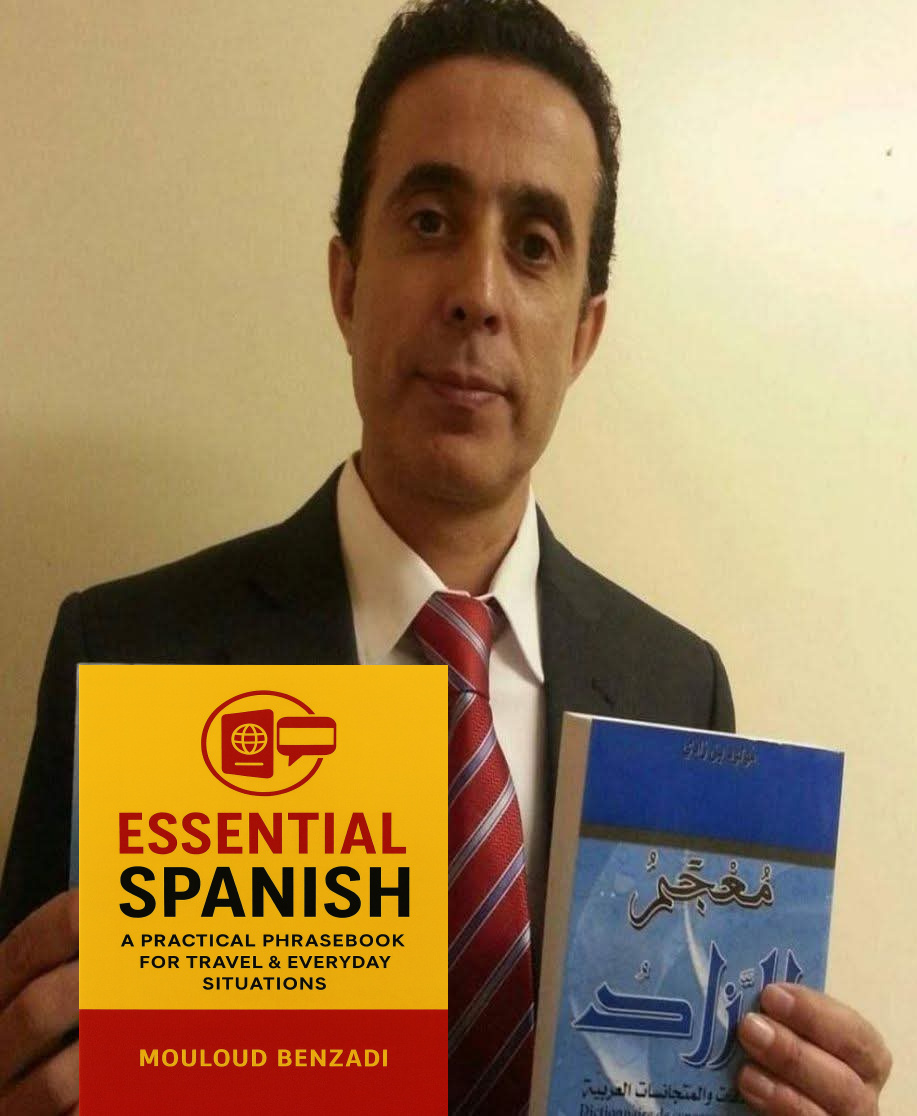
Interview with Writer, Lexicographer and Researcher Mouloud Benzadi
Writer, lexicographer, and researcher Mouloud Benzadi returns to publishing after a thirteen‑year break, marking this new phase of his work with the release of his latest phrasebook, Spanish for Real Life in Spain: The Essential Reference & Phrasebook for Travelers, Learners, and Residents. In this interview, we speak with him about the motivations behind his return, the evolution of his linguistic interests, and the broader ideas shaping his approach to language, translation, and cultural expression.
Q: It has been thirteen years since the publication of your "Dictionary of Arabic Synonyms and Homonyms". What has changed in your understanding of lexicography and linguistic research that led you to return with this new work?
A: Writing a dictionary is a huge task that demands long hours and relentless focus. My Dictionary of Arabic Synonyms and Homonyms took years of work, often day and night, and at times it became so overwhelming that I almost gave up. When I finally completed it, I felt I had reached the end of my journey in lexicography and moved on to other projects. I wrote two novels in Arabic, then finished my forthcoming English‑language debut novel, which is ready but still unpublished. I also wrote articles in Arabic and English and worked on a new non‑fiction book that required significant time and effort. Even though I had stepped away from lexicography, my connection to language never disappeared. Through my articles, I kept exploring and redefining ideas such as global fame and the meaning of authorship in the digital age. Over time, I realised that my experience with languages still had something valuable to offer, and after thirteen years I felt the urge to write again, which eventually led me to my new phrasebook Spanish for Real Life in Spain: The Essential Reference & Phrasebook for Travelers, Learners, and Residents.
Q: Your book presents itself as a phrasebook, yet the market is full of Spanish phrasebooks of all kinds. From your perspective, what sets yours apart?
A: My phrasebook is different because it goes far beyond the very concise format of most Spanish phrasebooks, which usually cover only basic topics such as greetings, restaurants, and simple travel situations. This book aims to include as many real‑life topics and situations as possible. For example, you will not find a typical phrasebook that gives you the vocabulary needed for dental treatment — words related to braces, implants, or specific procedures — nor one that helps you navigate job‑seeking vocabulary or the terminology required when applying for a residence permit in Spain. This one does. It is designed for people who need practical, everyday language for real living, not just tourism, offering clear and useful phrases for situations that other phrasebooks simply do not cover.
Q: You began your career writing in Arabic, and you now write in English as well. One might expect your next publication to be in Arabic, or perhaps in French, which you also studied. Why, then, did you choose Spanish?
A: You won’t believe it, but the decision came purely from necessity. After Brexit I applied for residency in Spain, and the process was far from simple. Communicating in English wasn’t always possible, and I often found myself unable to express what I needed. The phrasebooks available were extremely basic, little more than travel and shopping phrases, and they were useless for real situations like dealing with administration or speaking with officials. To manage, I had to search for the vocabulary I needed, write it down, and use it in conversations. Over time I filled pages with notes, and that’s when the idea came to me. I realised there was no book that covered the real‑life situations people face when living in Spain, so I decided to create something new — a reference that sits between a simple phrasebook and an advanced language‑learning book, practical enough for everyday use but wide in scope. The need to communicate in Spanish during that period is ultimately what led me to choose Spanish for the first book I wrote after thirteen years.
Q: Do you see this new book as a continuation of an earlier intellectual project, or the beginning of a new phase in your scholarly development?
A: Both, in fact. This book grows naturally out of the work I have done in the past, but it also marks the beginning of something new. My earlier projects were concerned with language, meaning, and practical usage, and in that sense this phrasebook continues that intellectual thread. At the same time, it introduces an approach that did not previously exist — a reference positioned between a simple phrasebook and a full language course, dedicated to real‑life situations that people face when they live abroad. I consider this the first step in a wider initiative, and I hope to develop similar works in the future.
Q: What did those thirteen years away from academic publishing add to your perspective as a researcher?
A: Thirteen years away from academic publishing broadened my perspective in ways that now shape my work. Those years deepened my experience, expanded my knowledge, and gave me stronger research tools. Unlike many of my Arab colleagues, who often work mainly within an Arabic‑language research environment, I now conduct research in Arabic, French, and especially English, which allows me to access global sources far beyond a single linguistic sphere.
This multilingual reach has strengthened the depth and precision of my articles. Critics often describe my work as detailed and rigorous, and that comes from the effort I devote to gathering evidence, comparing viewpoints, and supporting my arguments thoroughly. My perspective is also enriched by living in British society, where daily interactions with people from different cultures give my writing a broader and more international dimension.
Another key element is the diversity of the media I follow. While many Arab colleagues rely primarily on Arabic newspapers, I read British and American press as well as English‑language publications from countries as varied as Indonesia, Japan, and Israel. This access helps me compare narratives and understand issues from multiple cultural angles.
In this way, the thirteen‑year break was not a withdrawal but an expansion. It gave me wider horizons, richer sources, and a more global awareness that now supports my work as a researcher.
Q: Why did you choose English as the base language for your Spanish phrasebook? Why write a book for English‑speaking travellers and residents using Spanish, rather than producing one for Arabic speakers in the Arab world?
A: I chose English as the base language for two reasons. First, the idea came directly from my own experience. I was in Spain as an English‑speaking resident, struggling to communicate with the administration, and the notes I wrote were created for myself as an English speaker. They naturally developed into a guide for English‑speaking travellers and residents facing the same situations. Second, this project coincided with my transition towards writing in English, which has become an increasingly central part of my work.
Q: But why transition into English?
English is a choice, and at the same time it is not a choice. It is a choice because, if I must choose one language in which to publish — even over my native language — I will choose English for a practical reason: it allows me to reach global readers. I have always wanted to write beyond geographical and cultural borders, and this ambition has already shown results. Quotations from my unpublished English‑language novel have gone viral on social‑media platforms and are now appearing in blogs, articles, and even books. This has been very encouraging.
And yet English is also not a choice, because after so many years living in the UK I now think in English and even dream in English. It is the language in which ideas come to me most naturally, and the one in which I can write with the greatest ease. Most of the resources I use in my research are in English, and writing in Arabic would mean having to translate all those English‑language sources into Arabic afterward, which adds an unnecessary extra step. For all these reasons, English has become both the practical and the instinctive language of my work.
Q: In your recent articles, you issued strong criticism of translation — a stance that may surprise some, given your own work as a translator in the UK. How do you explain this position?
A: My position on translation and language comes from this same experience. It is true that I earn my living as a translator, but that does not stop me from pointing out the truth, which is the downside of translation itself. In countries like Britain, and many others around the world, vast amounts of money and effort are spent simply to help people communicate with one another through translation and interpreting. But we should ask a simple question: what for? Do we really need thousands of languages and complicated dialects separating us? Could we not adopt one common language and express ourselves freely without constant mediation?
My work in translation has taught me that nothing is more practical or more unifying than a global language. It would save resources, time, and energy. More importantly, it would reduce barriers between people, bring cultures closer together, and help us move towards a shared way of thinking that might lessen misunderstandings and divisions. For this reason, I will be among the first linguists to predict the eventual death of translation. Yes, translation will disappear at some point in the future, once humanity shifts to a global language. This is not a fantasy; it is a likely outcome of the direction the world is already heading in.
Q: If perfect fidelity in translation is impossible, are we ultimately producing new works rather than true translations?
A: My job has also taught me that fidelity in translation is impossible, especially in literary work, where meaning depends on rhythm, tone, cultural context, and the emotional weight carried by the original language. What strikes me most is the double standard in how translated literature is treated. For more than a century, translated books have been praised, celebrated, and even awarded major prizes, even when the final text reflects the translator’s voice more than the author’s. A well‑known example is the Rubáiyát of Omar Khayyam, which in its most influential English version was shaped so heavily by its translator that it reads more like his own work than Khayyam’s. Yet these versions are accepted without hesitation. Meanwhile, if an author today uses AI simply to proofread or polish their own writing, the reaction is often exaggerated, as though the integrity of literature were suddenly at risk. That contradiction reveals how uneven our expectations truly are.
My second point is that a work belongs to the language that created it. Every language carries its own cultural weight, rhythm, and emotional tone, and these qualities cannot be transferred intact. The moment a work moves into another language, it becomes something different, no matter how skilled the translator is. László Krasznahorkai, the recent Hungarian Nobel Prize laureate, makes this clear. In Hungarian, a single sentence can run for several pages, but in English the translator has to break it into short sentences. That shift changes the pace, the movement, and the entire experience of the text. The English version may read well, but it follows the logic of English, not Hungarian. What emerges is essentially a new work shaped by the translator’s choices rather than the author’s original style, and Krasznahorkai himself has criticised how translation can distort the essence of his writing.
Instead of saying that translation reproduces the meaning and beauty of the original, it is more accurate to say that the best it can carry across linguistic borders are the ideas and the meaning. And if translation communicates ideas through a rewritten and refined form that often differs significantly from the original, then we should accept a simple truth: in writing, what matters most are ideas, not stylistic ornament. If this logic holds for human translation, then it should also hold for AI, which can likewise refine and rewrite text to help international writers express their ideas more clearly to a global audience.
Q: In your articles, you’ve mentioned that the concept of ‘global literature’ has often been misunderstood, and that as a lexicographer, you could help redefine it. What prompted you to do this, and what is your view on the current definition?
A: The reason that prompted me to address the concept of ‘global literature’ comes from the widespread misunderstanding and misuse of the term, especially in the Arab World, where I come from. There, the situation goes beyond misunderstanding: any established writer is often called a ‘global author,’ and anyone who wins a literary award—reflecting the tastes of a few panel members rather than a broad readership—is automatically considered global.
The irony is that this occurs at a time when Arabic literature is far from achieving global recognition and, on the international stage, is at most barely visible. The current definition of global literature, in my view, is therefore misleading and overly generalized. As a lexicographer, I aim to clarify and redefine the term, taking into account broader readership, cultural impact, and genuine international resonance rather than isolated accolades or reputation. In a future article, I will provide a detailed analysis and propose a more precise definition of global literature.
But books are already being translated, including many from the Arab world, to reach a global audience — are you suggesting that translation alone is not enough for a work to achieve global fame?
A: Absolutely! I can give you a very clear example. Think of how many books have been translated from Arabic into English over the past century — dozens, even hundreds — yet how many of them have genuinely captured global attention or become true international bestsellers? With the exception of Gibran Khalil Gibran, there is hardly a single Arabic work that has reached that level of universal recognition.
And even in Gibran’s case, The Prophet is an exception for a very specific reason: although rooted in his philosophy and worldview, it was written in English and then heavily shaped by Mary Haskell. The result is a book that blends Gibran’s ideas with a linguistic and stylistic form that resonates across cultures. That is why it feels timeless, and that is why it continues to reach readers around the world. I am actually writing a new article at the moment about precisely why The Prophet endures in this way.
Translation alone, unfortunately, does not create this effect. In many cases, translation today is used more as a promotional tool — a way to claim international reach, to generate attention, or to ride the temporary wave that often follows a literary prize. This creates noise, but not the kind of deep, lasting cultural impact that makes a book timeless. Much of this is happening in the Arab world as well: books are translated, marketed loudly, celebrated briefly, and then disappear from global awareness.
I also strongly believe that one of the essential elements for reaching global readers is to think and write beyond geographical and cultural boundaries. This is exactly what I have been trying to do, and the results are remarkable. My quotes translated from Arabic attracted very little attention, whereas my English quotes — written directly in English, from my unpublished book, and conceived while thinking in English — have gained recognition around the world. This difference shows that global resonance is not created by translation alone; it comes from writing in a voice that naturally moves beyond national frames, speaks to universal experience, and connects instantly with readers wherever they are.
Q: How do you view the relationship between literary prizes and global recognition? Do prizes create a global author, or merely reveal one?
A: In the past, writers focused on expressing true feelings, emotions, and personal experiences. Today, especially in the Arab world where I come from, there is more emphasis on winning prizes than on touching the hearts of readers. Writers often prioritize pleasing a handful of panel members rather than meeting the expectations of millions of readers across generations.
I ask again: can you name a single work that has won a prestigious literary award and become timeless? Literary prizes can draw attention to an author and their books, offering instant recognition and success, but they cannot guarantee that a writer’s name will endure or that their works will remain relevant for future generations. True global recognition comes from writing that resonates broadly and deeply, beyond the temporary spotlight of awards, and beyond geographical and cultural boundaries.
Q: What were the main challenges you encountered when publishing this book in digital format?
A: The biggest challenge I faced was figuring out how to publish my book on platforms like Amazon. I reached out on social media, even contacting writers who had published digitally, but no one seemed willing or able to provide useful guidance. That was truly frustrating. Ultimately, the help I needed didn’t come from humans—it came from machines. AI was available 24/7, guiding me step by step through the entire process.
The second major hurdle was formatting the book. Platforms like Amazon have strict formatting requirements, and I initially considered hiring professional formatters. To my surprise, some working from home in countries like India were asking $800 to $1,000 just to format the book. I turned to AI for guidance, but the instructions were not straightforward, especially since much of the work had to be done manually in Microsoft Word. In the end, I managed to format the book successfully with AI’s support and the help of my daughter, who has a good knowledge of Word.
Q: In your view, does digital publishing liberate the writer, or does it introduce stricter standards?
A: Absolutely. I’ve dealt with publishers in the Arab World before, and I wasted hundreds of pounds with little transparency—there was no way to know how many copies my book had actually sold. Digital publishing platforms solve this problem: publishing is free, they take only a small fraction of your income, and your book becomes visible to readers around the world. Unlike traditional publishers, paper copies are produced on demand, saving resources.
Another crucial point is that working through literary agents often means giving up a significant portion of your earnings. Traditional publishers can reject a book simply because they don’t like it, making subjective decisions, and sometimes even pressure authors to alter their work to suit the publisher’s preferences. With digital platforms, none of this applies: authors enjoy far more freedom, can access their book anytime, and make changes whenever they wish.
Q: In your articles, you’ve advocated for a universal, shared literary language. How do you see this idea working in practice, while still preserving a writer’s unique stylistic identity?
A: I strongly believe that writers should write in a common global language. I was the first writer in the history of the Arab World to invite Arab writers to switch to writing in English—a bold step, since writers naturally defend their native languages. I may even be the first in the world to make such a proposal. This call is not based on fantasy; it is grounded in practical skills and experience as a lexicographer and translator.
Writing in a global language allows us to reach readers everywhere and facilitates understanding across cultures. At the same time, this does not prevent us from continuing to write in our native languages. I maintain the principle that we should distinguish between local literature, written in local languages and dialects, and global literature, which is written solely in a global language. Writing in local languages enables writers to preserve subtle cultural characteristics, whereas writing in a global language allows them to communicate their thoughts more clearly and connect with a global audience.
Q: In a recent article, you mentioned that the world is moving towards a global writing style. Don’t you think that standardizing language in literature risks diminishing the richness and stylistic depth found in national languages?
A: If we consider that translation rarely preserves the original style and often produces a new work that reflects the translator’s choices rather than the author’s, the question arises: are we really serious about style when it comes to global literature? The loss of stylistic beauty in translation is enough to suggest that what truly matters in literature is the ideas, not the style.
This is why I advocate for the use of a global literary style, a position I have documented extensively in my articles. I predict that the world is moving towards a global style in writing, and I support this development, as it allows all authors, including non-native speakers, to share ideas and interconnect without linguistic barriers. I also strongly believe that AI can play a significant role in shaping and supporting this global writing style.
As I have said before, no one is prevented from writing in their native language and style for their own people. But when it comes to reaching global readers, we need to be practical: we must communicate in a language and style they can truly understand.
Q: what projects are you currently working on, and where do you see your linguistic research heading in the coming years?
A: I have already completed my debut English novel, though I have decided to delay its publication for personal reasons. Currently, I am working on a non-fiction book that is due to be published within weeks. I am also considering additional language-focused projects, though much depends on the time I have available.
I feel I have so much to share with the world, and I am committed to contributing to global literature and culture as an international voice. One thing is certain: I will not write for a nation, a region, or a panel of judges. I will write beyond borders and address humanity. If I cannot exist as a global writer and contribute to world culture, then my words have no place in this world, and I would rather fade into silence, leaving no trace for future generations.
Q: Finally, how would you like to be remembered by future generations?
A: I would like to be remembered as the first writer in the history of Arabic literature to publicly withdraw from the Arabic literary scene, challenging the monopoly of established writers and the obsession with literary awards. I hope to be remembered not only as the first to make the bold transition to writing in English, but also as someone who called on other writers to follow suit.
I would like to be seen as a pioneer in embracing AI in writing, showing how it can support authors while maintaining collaboration with human editors. I hope to be remembered as a lexicographer and linguist who contributed to redefining key concepts, including authorship and global literature—definitions that are documented in my articles and in my forthcoming non-fiction book, which I plan to publish in the coming weeks. I would also like to be remembered as a lexicographer who initiated a new approach to the use of language, creating a reference framework that covers real-life linguistic situations and provides practical guidance for writers and speakers.
I would also like to be remembered as someone who fiercely criticized the literary awards system, insisting that writers should focus on reaching millions of readers rather than pleasing a handful of judges.
Finally, I hope to be remembered as the most quoted author in English in the Arab World during my time, surpassing many established authors whose works have been translated into English. This, I believe, demonstrates that literary success and enduring popularity do not depend on prestigious awards, but on writing beyond geographical and cultural boundaries—in a global language that allows ideas to resonate worldwide.
Yusuf DeLorenzo - منذ 5 أشهر
With thanks to Ms. Dellal for the penetrating interview...
While Benzadi’s ideal of a universal language for the exchange of ideas is laudable, the notion of divesting a culture of literature in its own tongue is distressing and will, I imagine, bring about a torrent of criticism. To his credit, Benzadi does state: “…no one is prevented from writing in their native language style for their own people.”
When contemplating my place as a translator over the years, I have come to believe that language and culture are inseparable, though both are certainly subject to change, to the sorts of evolutionary processes pointed out by linguists and sociologists alike. Speakers of Arabic, perhaps more than speakers of any other language, may have a special appreciation for this matter. While Modern Standard Arabic may be the cement to hold Arabic readers and speakers together, no one can deny that the differing tenor of the local languages spoken by native Arabic speakers goes part and parcel with differences in native cultures. Even within relatively close geographical locations like North Africa or the Arabian Gulf or the so-called Levant… or even the Arabic penninsula itself… the cultures and the languages are so distinctive and unique as to challenge the notion that they share, and are derived from, a single linguistic model. Admittedly, it is problematic in the extreme to point to a single source language when the classical Arabic tongue was itself constituted from a collection of tribal dialects. But such has been the consensus, or should I say the ‘synthesis’ over the centuries. It occurs to me that the storied travelers in Arabic history— Ibn Batuta, Ibn Hawqal, Ibn Fadlan, Ahmad ibn Majid— those motivated by trade, pilgrimage, and scholarly pursuits— took up the pen to record their experiences precisely for the reason that they encountered cultures and dialects so similar to their own and yet so novel. I imagine that they sensed their readers, their own people, would be as amazed as they had been themselves at what they had encountered.
But in support of Benzadi’s thesis, I think of the examples of the literally hundreds of local and provincial languages in the Indian subcontinent where, indeed, the universal language of thought and ideas (and in many cases of officialdom) was taken from the colonial English occupiers. I cite the success of the diaspora of English-speaking intellectuals and professionals from that part of the world. At the same time, the native languages and dialects continue to flourish, enriching the particular cultures of each. Indeed, it is impossible to think of those cultures, and the various Arabic cultures, divested of their local languages and colloquialisms; all of which are bolstered by long literary traditions.
So, yes. Mouloud Benzadi is certainly on to something in his thesis. And he certainly possesses the qualifications to give voice to his thoughts on the matter. But I fear the criticism will weigh heavily on the side of righteous indignation, if not outrage.