• Though humility is not among the attributes of God, when man turns back and walks toward Him, the joy that fills the Divine makes it seem as if God was in need of man, not the reverse.
• Human beings feel estranged from God all their lives, believing they have been misunderstood. In truth, God’s love for man is the most misunderstood phenomenon on earth.
• One cannot understand God’s love without trusting His wisdom.
• When man believes that God is King but he himself is also someone, it is intellect. When he believes that God is everything and he is nothing, it is love.
• Many spend years lecturing on Rumi — yet if they were shown the path he walked, they would turn away.
• The question is not Who am I without my ego? The question is: When I am Him, whose ego is it anyway?
• Unrewarded virtue does not exist. Some are rewarded materially; others spiritually; and some in both ways. Some are rewarded immediately, others after a delay, and some in the hereafter. It is beneath God’s dignity to withhold recompense for virtue.
• Faith cannot reach certainty without passing through the valley of doubt.
• A book may teach you the theory of faith, but unless you have tasted it, it remains mere knowledge — not experience.
• Faith reaches conviction when intellect ripens into love.
• Many possess information; fewer, knowledge; fewer still, wisdom — and only a rare few are blessed with gnosis (marifah).
• A scholar without experience is like a swimming instructor who has never touched water.
• YouTube may provide authentic data, but the inner light within a teacher’s heart can only be transmitted through his presence.
• The difference between a man of the world and a man of God lies in the intention behind the act.
• If I were asked to choose one chapter from the entire religion of Islam, it would be the sincerity of intention.
• A profit–loss mindset can never comprehend one whose only motive is the pleasure of God.
• The struggle against the lower self lasts until the final breath, for the destination is unreachable — the purity of the Prophet ﷺ himself.
• When one escapes a web of the lower self, it spins another, finer one.
• Satan can beautify an act; the lower self can make you perform it.
• All fears vanish when one trusts the power of God.
• When one ceases to fear God, he is haunted by countless other fears.
• Trust God’s plan so deeply that even when you see a storm rising, you say, “There is no storm around.”
• Exercise free will — and the result is destiny.
• Free will is an asset for the disbeliever, a liability for the believer, and an illusion for the Sufi.
• You do not chase destiny; destiny chases you.
• How can one fear death when it is but a meeting with the Beloved?
• The Hereafter precedes this life, for Heaven and Hell were created before the world.
• It is against wisdom to trade eternal bliss for fleeting pleasure.
• Humility and pride, no matter how hidden, reveal themselves now and then.
• It is arrogance to be humble before God but proud before His creation.
• The summit of humility was seen when, after the conquest of Makkah, the Prophet ﷺ entered the city with his head bowed in awe of God. No conqueror has ever done that.
• Discontentment is the offspring of ingratitude; contentment is impossible without gratitude.
• To thank God after your desire is fulfilled is gratitude; to thank Him after your desire is denied is servitude.
• The Prophet ﷺ, whenever granted even the smallest bounty, would thank God as though he had received the greatest of gifts. True gratitude is born of the heart that says, “It was never my right to have this.”
• For a disbeliever, everything feels like an entitlement. For a believer, some things are favors and others entitlements. But for a Sufi—everything is a favor.
• Contemplation is silent remembrance.
• Remembrance is vocal contemplation.
• In a world deafened by noise and distraction, contemplation and remembrance are the Sufi’s weapons.
• Silence speaks when the heart becomes an ear.
• A teacher becomes a teacher only when the student truly becomes a student.
• He who deems no one wise enough to be his teacher is the most unwise of all.
• The modern world does honor teachers of worldly knowledge — but the spiritual world would not even exist without teachers.
• Often, the small acts of worship we forget outweigh the great deeds we take pride in.
• The greatest worship is the war against the lower self.
• Worship steeped in love is Sufism.
• The material world is reality for the disbeliever, distraction for the believer, and illusion for the Sufi.
• Why compete in a world where competition is not based on merit?
• If the world seems small in the presence of your teacher, your teacher is a righteous one.
• Suffering without faith weakens the soul; suffering with faith purifies it.
• With love, suffering transforms. Without love, it destroys.
• As I aged, I discovered that my wounds were love letters from God.
• Do not erase your scars in this life; for if, in the next, they outnumber your deeds, God’s mercy may make His reward outweigh them all.
• The journey is search, not research.
• Many begin the search for truth, but as the journey unfolds, intellects fall away and only lovers remain.
• I found more truth in the company of my teacher than in my entire life without him.
• Wahdat-ul-Wujood — the Unity of Being — is heresy to the scholar, but ultimate reality to the gnostic (arif).
• If the companions of the Prophet ﷺ taught one lesson to all generations, it was the Oneness of God.
• I found more Oneness of God in Iqbal’s poetry than in a thousand sermons.
• Teaching imparts knowledge; service wins hearts. A Sufi is a teacher who serves.
• A Sufi’s writings are not literature — they are acts of service to humanity.
• To serve creation is to justify the divine spark within you.
• Ghazali, Rumi, Ibn Arabi, Shah Waliullah, Iqbal, and Wasif Ali Wasif possessed both intellect and love — but if I were forced to choose one faculty alone, it would be love.
• In divine love, logic falters, rules dissolve, and norms are defied.
• The experience of divine love is not rare — but its expression reached perfection in Rumi.
• The literary gift of a Sufi is but a drop in the ocean.
• When you are willing to surrender your rights, you have entered the state of Ihsan—excellence in faith.
• To judge people by their attributes is intellect; to embrace them regardless of their attributes is love.
• It is the mark of arrogance to give reasons instead of an apology when wrong.
• Do not judge a Sufi by his appearance—his reality lies far deeper than that.
• Iqbal, Wasif, and my teacher proved that sainthood is possible without the uniform of a saint.
• People often question the need for a mentor when the perfect mentor—the Prophet ﷺ—has already set the example. Yet he departed from this world long ago. Human nature seeks a living example, someone who walks the path no one else dares tread, so that the path itself does not remain buried in books and memories. A mentor revives that path within you. He gives you the confidence that if he can walk it in this age, then so can you.
• Between the purity of intention and the manifestation of the deed lies a bridge of time and space — that bridge is called the Grace of God.
• While blessings will be questioned on the Day of Judgment, Divine favors will not — for favors are given out of love, not accountability.
• The Qur’an is a banquet spread where we are guests, not hosts. We have no right to decide who may sit and partake of the feast, and who may not.
• Intellect is a beautiful instrument when it battles the lower self, but a veil when it stands in the way of love.
• God lovingly awaits the repentance of a sinner, so that His mercy, compassion, and grace may reach their fullest radiance. He forgives the sinner so that His Beloved ﷺ may rejoice — for yet another soul from his Ummah has been saved from the fire.
• In the late hours of the night, when silence begins to speak, if you rise from your bed and stand in prayer, that single act outweighs a hundred sermons and publications — for in that moment, only God is your witness.
• Creation is a mirror reflecting the attributes of God; the Prophet ﷺ is the manifestation of His Being.
• The sinners thrive only because of the righteous — the day not a single heart remembers God, the world will come to an end.
• A saint does not rely on references to prove his truth, for he himself is a living reference of God.
• The intoxicated cannot speak of his intoxication; words belong to the one who witnesses it.
• An unfeeling heart can never belong to a Sufi.
• To truly understand Sufism, one needs the mind of a philosopher and the heart of a lover.
• The difference between Iqbal and Wasif is this: Wasif teaches how to purify the self, while Iqbal teaches what to do once it is purified.
• The beauty of Islam lies in its complete syllabus — one that conquers both realms: the inner self and the outer world.
• If you cannot acknowledge the greatness and contribution of a soul outside your own school of thought, you are not a Sufi.
• The splendor of a rainbow lies in its unity amid diversity; that is how God wishes to see the Ummah — one light, many colors.
• Death is the first meeting with your Beloved; await it with longing.
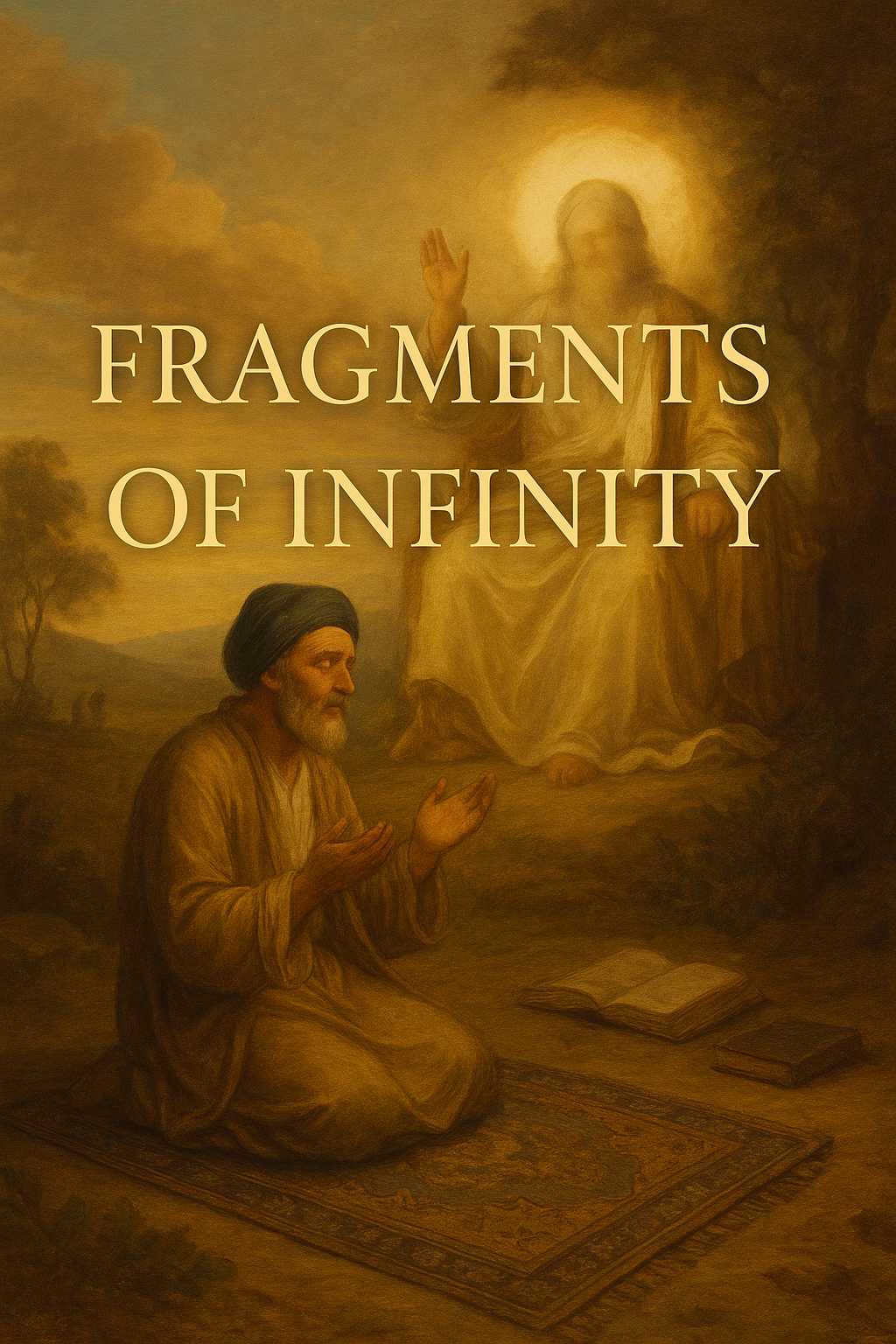
Fragments of Infinity
بقلم: عادل فاروق - في: الاثنين 27 إبريل 2026 - التصنيف: فلسفة وأديان
فعاليات

أسئلة حول الكتابة
سبتمبر 23, 2026
يدعوكم نادي القصة بأسيوط لحضور جلسة بعنوان "أ...

مناقشة رواية حبة قمح لنجوجي واثيونجو
أكتوبر 20, 2026
شاركنا في ندوة لمناقشة رواية حبة قمح عبر تطبيق ZOO...

الاعتبارات الأخلاقية للذكاء الاصطناعي
مايو 23, 2026
تمت هذه الندوة لعرض في 23 مايو 2026 وتستطيع...
من هو المثقف؟ ودور المصلح الثقافي في المجتمعات
إبريل 13 - 15, 2026
محاضرة يلقيها الفيلسوف والمفكر الإسلامي م.محم...