by Mennat-Allah El Dorry
The mere mention of Egypt conjures up an image of pyramids and mummies. Perhaps for many people, this is what Egypt is all about; the eternally preserved bodies of the dead and the pyramids. These are also the two biggest secrets of ancient Egypt, how did they mummify the dead, and how did they build the pyramids. For now we will talk about mummies, saving the talk of aliens and pyramids for another time!
I will talk about mummies in three installments, the first one about the how, and the why of mummification. The second installment will be about the obsession with mummies that arose during the mediaeval times to the turn of last century. The third instalment will be about modern mummies. Yes, there are modern mummies!!
The ancient mummified their deceased because they believed in an afterlife, where one would rise again and live an eternal life. Mummification was integral to their resurrection, so the ‘ka’ (soul or spirit) of the deceased would be able to recognise the body and re-enter it. Should the body be damaged, a statue of the deceased would suffice, or even the name of the deceased would be enough to endure their eternality. In Egypt, people will wish that “God will keep your image in the world” which is basically a carry over from ancient Egypt. The funerary rituals and traditions in ancient Egypt are many. One of the most important of these is the judgement. The Judgment of the Dead is known mostly from new Kingdom tombs, but probably a standardised belief was present throughout most of the history of Egypt. The dead would appear in front of a tribunal of judges, and would recite the negative confession. This confession would be negating all the evils that one can do in life, excerpts from the negative confession include:
I have not oppressed the members of my family.
I have not wrought evil in the place of right and truth.
I have had no knowledge of useless men.
I have brought about no evil.
I did not rise in the morning and expect more than was due to me.
I have not brought my name forward to be praised.
I have not oppressed servants.
I have not scorned any god.
I have not defrauded the poor of their property.
I have not done what the gods abominate.
I have not cause harm to be done to a servant by his master.
I have not caused pain.
I have caused no man to hunger.
I have made no one weep.
I have not killed.
I have not given the order to kill.
I have not inflicted pain on anyone.
I have not stolen the drink left for the gods in the temples.
I have not stolen the cakes left for the gods in the temples.
I have not stolen the cakes left for the dead in the temples.
I have not fornicated.
I have not polluted myself.
I have not diminished the bushel when I've sold it.
I have not added to or stolen land.
I have not encroached on the land of others.
I have not added weights to the scales to cheat buyers.
I have not misread the scales to cheat buyers.
I have not stolen milk from the mouths of children.
I have not driven cattle from their pastures.
I have not captured the birds of the preserves of the gods.
I have not caught fish with bait made of like fish.
I have not held back the water when it should flow.
I have not diverted the running water in a canal.
I have not put out a fire when it should burn.
I have not violated the times when meat should be offered to the gods.
I have not driven off the cattle from the property of the gods.
I have not stopped a god in his procession through the temple
I am pure.
I am pure.
I am pure.
I am pure.
This spell presents a wonderful example of the morals and ethics that was expected on the ancient Egyptians. After this, the heart of the deceased would be measured against the feather of Maat, the feather of truth. If the heart is lighter than the feather, welcome to the afterworld. If the heart is heavier, you are in trouble. One of the biggest fears of the ancient Egyptians was the fear of nothingness and oblivion, the fear of not existing anymore, and this is what happened to those with hearts heavier than the feathers. Their hearts were devoured by the half crocodile half hippopotamus Ammet monster, reducing them to oblivion.
ربنا يخلي صورتك في الدنيا
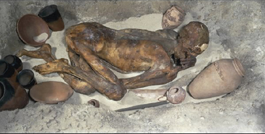
The earliest known ‘mummy’ dates to approximately 3000 BC. Nicknamed as “Ginger” because of his red hair, this mummy was not embalmed in the traditional way that is know to us, but was rather dried up in a hole in the desert. Some pots were placed in this basic burial, which would have contained food and drink to sustain him in the afterworld. He is on display at the British Museum in London in a lovely display that resembles his original location.
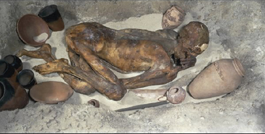
Figure 1: The mummy of Ginger , displayed in a reconstruction of its orogibcal situation (image from website of the British Musuem.
Mummies were initially thought to have been covered with bitumen, or tar, because of their blackened color. The English word mummy is derived from the Latin word mumia, which comes from the Arabic word mumyah, which is again borrowed from the Persian word for bitumen, Persian mumiya.
Unfortunately there is very little written material explaining to us the art of mummification. These sources are papyri dating to the 1st century AD. They give spells that are to be recited whilst the mummies are being bandaged, or instructions on the order of which the limbs are to be wrapped and the amulets and spells associated with each stage. The clearest textual evidence about mummification comes from Herodotus’ Histories dating to the fifth century BC, and from the accounts of Diodorus Siculus (circa 80 BC) and Porphyry (circa 300 AD). These have provided the basis for our knowledge of mummification. As a foreigner, Herodotus’’ accounts were very useful, citing details and observations that were otherwise common knowledge between the Egyptians who would not have made the effort to write them down. He talked about three types of mummification, sort of three different services offered by the embalmers at the House of the Dead (an equivalent of a funeral home), mostly depending on the finicanial ability of the family of the deceased.
The premium service started with the pulling of the brain via the nostrils with an iron hook, and that which remains is washed out with drugs (more on pulling of the brain out of the nose will come in the third installment about modern mummies). An incision would be made in the stomach and the contents of the stomach would be removed. From the mummies that have been scientifically studied we can notice a change in the location of this incisions though time, or depending on the rank of the deceased. The cavity in the stomach would be rinsed out with myrrh, wine and spices. Some bags of natron would be left inside the cavity to suck up the moisture from inside. Natron is a mix of various salts (Sodim carbonate, sodium sulphate, and sodium chloride) which is still found in modern day Wadi el-Natroun in the western desert of Egypt. The lakes of Wadi el-Natroun would have a hard crust of salt on its shores during the hot summer months, which were used to suck up the moisture from the bodies, preventing it from decaying. The body would be left in natron, which would have occasionally changed, for seventy days. After the drying, the body is wrapped in linen, each finger individually wrapped. Different Amulets were placed in between the layers of wrapping to provide different kinds of protection. The lesser types of mummification would not include an incision, but rather cedar oil would have been inject into the body through the anus and plugged, and the body would be left in natron. After an amount the body would be drained from the cedar oil. No wrapping seems to have been provided with this level of service. The third level includes only washing the insides with water, and leaving the body in natron for seventy days before being returned to the family.
The entrails of the body would be preserved for the afterlife. The liver, the lungs, the stomach and the intestines were removed and dried in natron separately, and placed in canopic jars. These jars were usually made of alabaster, and each one had a different head of a deity to protect its contents. The human-headed Imseti guarded the liver, the baboon-header Hapi guarded the lungs, the jackal-headed, Dua-mutef guarded the stomach, and finally the falcon-dead Qebeh-senuef who guarded the intestines.
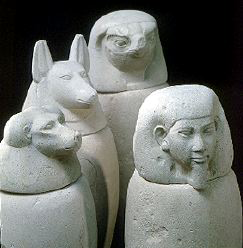
Figure 2: Canopic jars. Clockwise from left, the baboon-header Hapi (lungs), the jackal-headed, Dua-mutef (stomach), the falcon-hedead Qebeh-senuef (intestines) and the human-headed Imseti (liver).