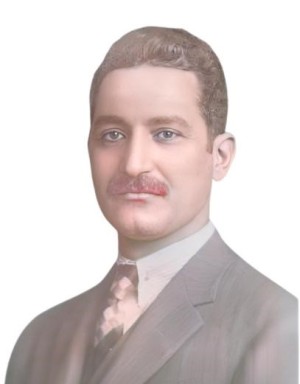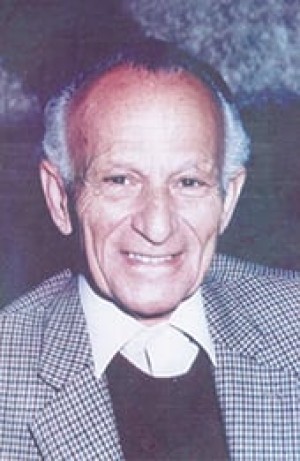
Dean of contemporary Arabic literature and a pioneer of enlightenment, Taha Hussein was
born in AI-Minya province, Upper Egypt, on November 14th, 1889 and grew up, the seventh of
thirteen children, in a lower middle-class family. At a very early age, he contracted a
simple eye infection and, due to faulty treatment by an unskilled local practitioner, was
blinded, at the age of three.
He was placed in a kuttab (a school where children learn Quran and reading and writing)
and was later sent to Al-Azhar University, where he acquired a thorough knowledge of
religion and Arabic literature in the traditional manner. He felt deep discontent with the
narrow thinking and conservatism of his tutors.
In 1908, he learned of the founding of a new, secular university as part of a national
effort to promote education in Egypt under British occupation, and was very keen to enter
it. He was blind and poor, but overcoming many obstacles, he was accepted in that
university. He later stated, in Al-Ayyam (The Days) that the doors of knowledge were from
that day opened wide for him.
In 1914, he was the first graduate of this university to receive a Ph.D with his thesis on
the skeptic poet and philosopher Abu-Alalaa AI-Ma'arri.
Again with much trouble, he was sent to study in France on the university's educational
mission. His blindness caused him continuing pains, aggravated by a careless brother,
presumably sent to take care of him. It was in France that he met his sweet
voice, Suzanne, who came to read to him since not all the references needed were
available in braille. She later became his wife, his mentor, advisor, assistant, mother to
his children, great love and best friend. He states that since he first heard that 'sweet
voice', anguish never entered his heart."
After his death, Suzanne wrote Ma'ak (With You), published in Arabic; a touching
remembrance of their life together.
His doctoral dissertation, written in 1917, was on lbn Khaldun, the fourteenth century
Arab historian, the founder of sociology.
In 1918 he obtained his second PhD in Social Philosophy from the Sorbonne, Paris.
In 1919 he received a diploma in post-graduate studies in the Roman Civil Code from the
same university.
He was granted honorary doctorates from the universities of Oxford, Madrid, and Rome.
In 1919 he was appointed a professor of history at the Egyptian University. He did not
confine himself to political and constituational history but transferred to his students
his knowledge of Greek drama such as Sophocles and Aeschylus.
When he assumed office as Minister of Education in 1950, he managed to put his motto,
"Education is like water we drink and the air we breath," into practice.
He succeeded in making all elementary and secondary education.
Millions of Egyptians owe their literacy to Taha Hussein
His Work
The greater part of Taha Husseins canon is basically influenced by Greek culture. He
issued "Selected Pages" from Greek Dramatic poetry (1920), "The Athenian
System" in 1921, and "Leaders of Thought" in 1925. Thus, the link between
his Arabic culture with that of Greece was a turning point as thinker.
The first book was an incomplete attempt at an expose of Greek poets and their works. The
second book was a meticulous translation of one of the most important texts of Greek
history of civilization. He deals with the religious impact on thought in the Middle Ages,
then moves on to the Modern Ages of multi influences.
Thus,Taha Hussein was not merely influenced by Greek thought in his literary work but also
in his books on politics and civilization. The books he issued following his return from
Paris greatly influenced modern Arabic classical literature.
He waged many battles for enlightenment, the respect of reason and thought, and
womens emancipation. The first of these was in 1926 when he issued "Pre-Islamic
Poetry", which was highly controversial in both politically and literary circles. It
aroused widescale front page arguments in newspapers between supporters and opposers. In
self defence he argued that he adopted a scientific method of approach in his treatise on
Pre-Islamic poetry. That method, he said, was adopted by western philosopher scientists
and men of letters who followed the French philosopher Descartes in his reasoning in
search of the truth of beginning. It rennovated science and philosophy and changed the
outlook of men of letters and artists in the West.
Taha Hussein's works can be divided into three categories: scientific study of Arabic
literature and Islamic history; creative literary works with social content combating
poverty & ignorance, and political articles. The latter he published in the two papers
of which he was editor-in-chief, after being expelled from his post as professor of
Classical Arabic literature at the Egyptian University. His expulsion came as a result of
public reaction to his book 'On Pre-lslamic Poetry'.
In his novels, he expresses an astounding sensitivity, insight and compassion in that age
for a person with his background.
His arguments for justice and equality are supported by deep and honest understanding of
Islam. Equally remarkable are his sympathy with his downtrodden compatriots and his
understanding of the deepest emotions and thoughts of woman as girl, lover, wife and
mother
His type of literature became an independent form and readers competed in it passionately,
reading and interpreting, discussing analyses, and extracting clear meanings from
ambiguous allusions ... Looking at his publications, one will find allusions to phenomena
that one abhorred and could not speak of openly during those dismal days. We preferred
ambiguity to clarity, symbols and riddles to declaration, allusion and insinuation to
calling things by their names.
The government of that era and its controllers would read and not understand. Thus, he
defeated the oppression of tyrants and escaped the censorship of censors and manage to
record the injustices of the unjust and the corruption of corruptors.
Taha Hussein, who had to bear the brunt of conservative attacks and confront enemies of
his reforms, enjoyed affection of his pupils & colleagues. During his life time, he
was elected member of many educational academies in Arab countries, and was honored by
many international institutions. The American University in Cairo paid no heed to Egyptian
Premier Isma'il Sidqi, when he warned against offering employment to Taha Hussein. Its
Ewart Hall, where AUC holds its extra-curricular activities, was teeming in the 1930s with
listeners eager to hear him and to declare him Dean of Arabic Literature.
President Gamal Abd AI-Nasser bestowed on him the highest Egyptian decoration, normally,
reserved for heads of state. In 1973, he received the United Nations Human Rights Award.
Taha Husein died in October 1973, immediately after witnessing his country's victory in
its last war against Israel.
He died in his home, alone with his "sweet voice"; Suzanne.
She wrote: "We were together, alone, close to an extent beyond description. I was not
crying - the tears came later. Each of us was before the other; unknown & united as we
had been at the beginning of our journey. In this last unity, in the midst of this very
close familiarity, I talked to him, kissing that forehead that was so noble and handsome,
on which age and pain had not succeeded to carve any wrinkles, and no adversity had
managed to cause to frown - a forehead that still emanated light.
Authors AtoZ
Home Bookstore Top