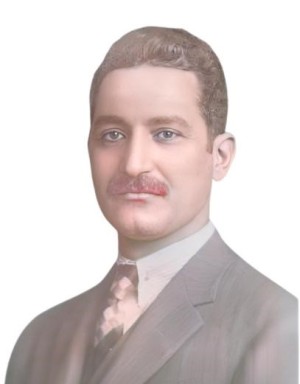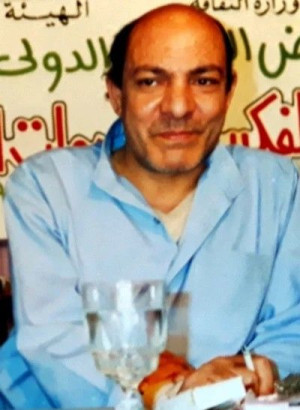
Mahfouz was born in an old quarter of Cairo (Gamaliya) in 1911 and lived
there until the age of 12, when his parents moved to a newer suburb;
however, he achieved fame as the chronicler of the old neighborhoods of
Cairo, and has credited the Cairene world as his inspiration. He was the
youngest of seven children, but at 10 years younger than his next-older
brother really had no sibling relationship; instead, he emphasized
friendships outside of the house. Politics and religion were evidently
important topics of conversation in his home, although Mahfouz has remained
relatively silent about his family.
Mahfouz began his education at the kuttab (Qur’an school), where the
emphasis was on Islamic religion and basic literacy, then went on to
primary school. When he was 7, Egypt was caught up in a revolution
against British rule, the memory of which continues to dominate his
political awareness; images of the revolution recur in many of his
novels. He read historical and adventure novels, specifically citing Sir
Walter Scott and H. Rider Haggard, but also read widely in both
classical and contemporary Arabic literature. (In various statements
after he achieved fame as a writer, he specifically mentioned a wide
variety of Western writers, most notably Tolstoy, Proust, and Mann.) He
then attended King Fu’ad I University, graduating with a degree in
philosophy in 1934. As he matured, he gravitated toward a socialist
worldview and became increasingly critical of “Islamist” politics.
He began to study toward an M.A. while occupying various bureaucratic
positions from 1934 until 1971, when he became affiliated with the daily
newspaper Al-Ahram. In his entire life, he was out of Egypt only twice;
he even turned down the opportunity to travel to Stockholm to receive
the Nobel Prize for Literature in 1988. Prior to this award, few in the
West knew of him; at that point, he had written 38 novels or novellas
and 12 collections of short stories and plays, and had received several
awards in the Arabic world. His added prominence came with a price,
however, as strict Islamic fundamentalists have suggested that a fatwa
should have been declared on him after he wrote Children of the Alley,
as it would have prevented Salman Rushdie’s subsequent writing of The
Satanic Verses. In October of 1994, he was attacked and stabbed on a
Cairo street, evidently by a fundamentalist.
His early writings included translations from English and stories about
ancient Egypt; but his most significant early novels trace changes in
the lives of Cairo's petty bourgeoisie as a national consciousness
emerged after the 1919 Revolution. He has been compared to Zola, Balzac,
and Dickens, although most critics emphasize his independent Arabic
nature. However, after receiving the Nobel Prize, Mahfouz himself said
that his work upholds principles widely associated with European
civilization - but he has also argued that these principles can be found
in Islam as well.
Mahfouz was part of a generation of Egyptian writers who emerged during
the 1940s and '50s calling for the reform of Egyptian society. During
the 1940s, Egyptian society experienced a major shift as poor workers
began moving into the cities seeking employment; under the stress of the
changing society, some affiliated with the socialists or communists and
others with the Muslim Brotherhood . There was also a great increase in
the number of novels published, both because of the increasing
respectability of the genre among Arab readers and the foundation of new
publishing. Mahfouz, who took part in this explosion of the Egyptian
novel, is “the most significant” contributor to the Arab novel in the
20th century, surpassing any rivals in terms of volume and variety of
literary output, originality, and seriousness .
In his earlier, realistic novels, Mahfouz clearly seems to favor
“secularist socialism,” aligned with modern science, over “revivalist
(fundamentalist) Islamism,” as is shown by his presentation of
characters espousing each perspective. According to Trevor Le Gassick,
“Mahfouz saw his stories as a means to bring enlightenment and reform to
his society.” Mahfouz's Cairo Trilogy (published 1957) in particular
contributed to both radicalism and social realism in Egyptian
literature, but all of his novels up to at least 1957 strive to give a
realistic view of life in the old part of Cairo - many of these novels
were named for streets or neighborhoods in the old city. Somekh argues
that one important ingredient in Mahfouz's work is the complete
identification with the plight of Egyptian masses - in other words, his
sympathy is with the downtrodden. These are the novels that the Nobel
Committee specifically cited in awarding the Prize.
He stopped writing for five years after the 1952 revolution (which also
coincided with the completion of his Cairo Trilogy). In Children of the
Alley (1959) , he introduces a warning recognition that science, too,
may be misused, as the magician’s invention of a powerful explosive
weapon is appropriated by the forces of tyranny, not those of liberation
(Beginning with Children of the Alley and The Thief and the Dogs
in 1962, Mahfouz seemed to move away from his realistic style to a more
inner-directed narrative of character's thoughts. Novels of this period
tend to be more focused on individuals than the earlier works, but
Somekh (perhaps the most expert writer on Mahfouz in English) suggests
these works are "neo-realistic" in that they avoid detailed description
of setting and psychology but nonetheless present an accurate picture of
realistic Egyptian society.
Mahfouz again wrote no novels for several years after Egypt’s defeat in
the Six Days War . Following the hiatus in literary production following
the 1967 Egyptian defeat, his work has been even more experimental,
using a wide variety of forms
* * * * * * * * * * **
Mahfouz claims that all of his books are political in some way, and that
his work revolves around the three poles of politics, faith and love -
but politics "is by all odds the most essential". Mahfouz is highly
sensitive to political events; e.g., he used the 1919 Egyptian
revolution as the background for his Cairo Trilogy, and exhibited
prolonged periods of creative stasis followed by new writing directions
after both the 1952 revolution and the 1967 loss to Israel in the
Six-Day War . His politics became a source of controversy in 1979 when
his public support of Sadat's treaty with Israel brought denunciations
from Islamic fundamentalists and a ban on his works in some Arab
countries.
While his works are often realistic, characters and events often have a
further significance, which Somekh says is not quite mystic symbolism
but may approach it. For instance, the family is often both a family and
a condensed version of Egypt as a whole.
Some of his works translated into English
Palace Walk (Book 1 of
the Cairo Trilogy) (originally published in Arabic 1956)
Palace of Desire (Book 2 of the Cairo Trilogy) (originally published in
Arabic 1957)
Sugar Street (Book 3 of the Cairo Trilogy) (originally published in
Arabic 1957)
Children of Gebelawi (originally published in Arabic 1959)
The Beginning and the End (originally published in Arabic 1956)
Adrift on the Nile (originally published in Arabic 1966)
The Journey of Ibn Fattouma (originally published in Arabic 1983)
Midaq Alley (originally published in Arabic 1947)
The Harafish (originally published in Arabic 1977)
The Beggar (originally published in Arabic 1965)
The Thief and the Dogs (originally published in Arabic 1961)
Autumn Quail (originally published in Arabic 1962)
Wedding Song (originally published in Arabic 1981)
The Search (originally published in Arabic 1964)
Fountain and Tomb (originally published in Arabic 1975)
Miramar (originally published in Arabic 1967)
The Time and the Place and other stories
Respected Sir (originally published in Arabic 1975)
Arabian Nights and Days (originally published in Arabic 1982)
Authors AtoZ
Home
Bookstore
Top
© Arab World Books