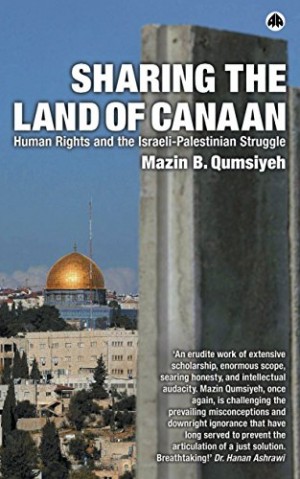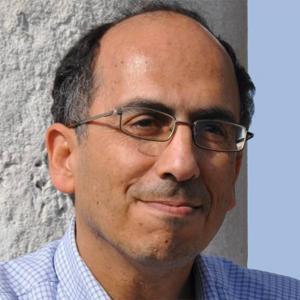
Professor Mazin Qumsiyeh teaches and does research at Bethlehem and Birzeit Universities. He previously served on the faculties of the University of Tennessee, Duke, and Yale Universities. He and his wife returned to Palestine in 2008 starting a number of institutions and projects such as a clinical genetics laboratory that serves cancer and other patients. They founded (initial personal donation of $250,000) and run (as full time volunteers) the Palestine Institute for Biodiversity and Sustainability (PIBS) at Bethlehem University. Qumsiyeh published over 140 scientific papers on topics ranging from cultural heritage to biodiversity to cancer. His many published books include “Bats of Egypt”, "Mammals of the Holy Land", "Sharing the Land of Canaan: Human rights and the Israeli/Palestinian Struggle" and "Popular Resistance in Palestine: A History of Hope and Empowerment". He also published hundreds of articles and letters to the editor and has an activism book published electronically (see http://qumsiyeh.org). He gave hundreds of talks in 45 countries around the world. He especially believes in youth empowerment towards social and environmental causes. The programs he & his wife created impacted thousands. He also serves on the board of a number of Palestinian youth and service organizations. PIBS-BU has become a “Mecca” for visitors to Palestine from around the world. Qumsiyeh was harassed and arrested for non-violent actions but also received a number of prestigious awards for these same actions. He and his wife and dozens of other volunteers and staff at PIBS continue to have “Joyful participation in the sorrows of this world” and make a real difference for sustainability of nature and human communities.
Recipient of the 2011 Social Courage Award from the Peace and Justice Studies Association at the Joint Conference of PJSA and the Gandhi King Conference in October, 2011 at the Christian Brothers University in Memphis, Tennessee.
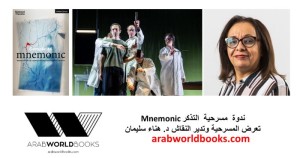
Selected in March 2008 to be honored among "the writers who have enriched our pages with their creative writings and enlightened us with their progressive thinking" by Arab World Books.
Other Honors received:
- American Arab Anti-discrimination Committee (ADC) Alex Odeh award
- Recognized by the American Friends Service Committee AFSC Connecticut chapter on June 10, 2004
Selected Positions held/projects coordinated:
- Board member, Peace Action Education Fund http://www.peace-action.org/(2008-2009)
- Board of Trustees, Siraj Center http://www.sirajcenter.org
- Steering Committee Member of the US Campaign to End the Occupation (2005-07)
- Board Member, Association for One Democratic State in Israel/Palestine (2005-early 2007)
- Executive Committee Member, Palestinian American Congress
- Advisory Board, Sommerville Divestment Project (2006 - date)
- Advisory Board, Olympia-Rafah Sister City Project
- Media Coordinator, Palestinian American Congress, CT Chapter
- Ex-President of the Middle East Genetics Association http://info.med.yale.edu/genetics/clinical/lab_services/mega
- Media Coordinator, Arab American Anti-Discrimination Committee in North Carolina, Won the Jallow activism award from ADC national in 1998
- Co-founder and ex-national treasurer and ex-media coordinator of Al-Awda, the Palestine Right to Return Coalition (2000-04)
- Co-founder of the http://AcademicsFor Justice.org and http://BoycottIsraeliGoods.org campaigns.
- Organizer (current) and ex-treasurer (2001-2004) for the Wheels of Justice Tour http://justicewheels.org
- Vice President of the Middle East Crisis Committee http://TheStruggle.org (2003-date)
- Founder and president of the Holy Land Conservation Foundation
- Coordinator with others for the Oral History Project http://www.palestineremembered.com/oralhistory/
- Advisor, American Council on Middle East Policy
- Advisor, National Council of Churches of Christ, USA
- Board Member, Palestine Freedom Project (PFP)
- Member of a number of human rights groups (Amnesty, Peace action, Human Rights Watch, ACLU etc.).
Who Is Mazin Qumsiyeh?
I was born and raised in Beit Sahour, the biblical Shepherds' Field just on the outskirts of Bethlehem. My first hand experiences as a Palestinian Christian and my educational background in universities both in the Middle East and the US helped shape my evolving world views. I was raised under Israeli occupation and my large family still resides in the area.
My memories include vivid recollections of pastoral farm life, urban education, cultural events, and an overall mosaic of people of varied religions and backgrounds. They include a rich International coterie of friends and relatives visiting from Europe, Jordan, Saudi Arabia, and the US. As for Israelis, my interactions included not only Israeli soldiers and settlers/colonists but also average Israelis from all walks of life and all stripes.
My bachelor degree in Jordan included the close interaction with Palestinian refugee community in Jordan (Jordan has over 2 million Palestinian refugees). I got my Masters degree at the University of Connecticut, a Ph.D. at Texas Tech University and postdoctoral training at St. Jude Children Research Hospital and the University of Tennessee (included Clinical Fellowship). I was extremely lucky that my research and career turns necessitated extensive travels in Jordan, Israel/Palestine, North Africa, East Africa, Europe, and America. The advantage of the scientific work was accompanied with the advantage of meeting people of all walks of life. Thus visiting universities for their scientific collections or to get educated provided quite a different experience than trapping animals near rural isolated communities in the Middle of the Sahara desert or in the African savanna. This allowed me an understanding of societies not available to tourists.
I became active more directly in social and political causes about 15 years ago but never belonged to one of the many Palestinian liberation movements. My interests continued to evolve as I read more and had a chance to learn from my interactions with the thousands of people I met during my frequent travels. The educational resources available at the Universities I affiliated with allowed me to pursue activism in new directions. This included our abilities to quickly use the internet and web and email as tools for activism.
I was co-founder of a number of organizations and groups: The Triangle Middle East Dialogue, the Carolina Middle East Association, the Holy Land Conservation Foundation, the Middle East Genetics Association, the Palestine Right to Return Coalition (http://al-awda.org), Academics For Justice (http://AcademicsForJustice.org), among others.
I published over 120 scientific papers in areas ranging from Zoology to Genetics. My later training was in genetics and I served as Associate Professor of Genetics and director of cytogenetic services both at Duke University and Yale University. I also published two books: Mammals of the Holy Land and Bats of Egypt. This book is the first I write on the Palestine question. However, I have published extensively on these issues including over 100 letters to the editor and over 30 op-ed pieces. I am also interviewed regularly on TV and radio (local, national and international). Appearances in national media included the Washington Post, New York Times, Boston Globe, CNBC, C-Span, and ABC, among others.
I share this rather complex background so that you the reader understand more about how I came to understand the importance and the centrality of a pluralistic solution to the simmering conflict in the Land of Canaan.