By Justine Mccabe
Published on 5/29/2005, The Day, New London
Justine McCabe, Ph.D., is a cultural anthropologist and clinical psychologist who lives in New Milford.
The Photo Above:
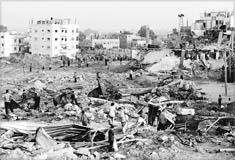
Palestinians salvage belongings in the rubble of destroyed buildings and houses in the Jebaliya refugee camp, northern Gaza Strip, in Oct. 16, 2004 file photo.
Amnesty International on Wednesday, May 25, 2005 accused Israeli soldiers operating in the Palestinian territories of committing war crimes, including unlawful killings, torture, destruction of property and targeting medical personnel.
The London-based human right's group's report for 2004 also condemned the deliberate targeting of Israeli civilians by Palestinian militants as a crime against humanity.
Controversy over Indian rights in Connecticut recently intensified when the federal government reversed its recognition of Stonington's Eastern Pequots and Kent-based Schaghticoke tribes. Overall, officials and the public appear pleased. Attorney General Richard Blumenthal said, “One reason this is so historic is because no positive recognition decision has been reversed before. This is a first for the nation, which makes it all the more significant and satisfying,” according to The Litchfield County Times.
Clearly, it's not satisfying for Connecticut's indigenous peoples as their rights and attachment to the land continue to be challenged even centuries after first contact with European settlers.
Due-process arguments put into high relief the irony experienced by America's native peoples in obtaining recognition: they must prove they exist. They must demonstrate that their people and cultures actually survived government intentions to eradicate them and seize land on which survival depended.
Meanwhile, the original injustice is submerged in a bureaucratic system organized to disavow it: even applying for BIA recognition costs millions, encouraging many tribes to resort to casino investors despite their corruption of traditional native values. Indian participation (let alone success) in this admittedly suspect process arouses only insecurity and hostility among my non-Indian Kent neighbors. Tellingly, references to original dispossession and the enduring traumatic impact of European contact are circumvented. Expressions of collective responsibility or apologies are absent.
Most Americans experience a kind of collective denial about our shameful history. Yet its legacy lives dangerously on — not just at home but also in our foreign policy.
As Attorney General Blumenthal began challenging Schaghticoke recognition, then-Palestinian presidential candidate Mahmoud Abbas was visiting some of the 400,000 Palestinian refugees in camps in Lebanon, reassuring them that their right to return to their homes in what is now Israel would not be abandoned in future negotiations.
There are more than 6 million Palestinian refugees who have been waiting to go home since the 1947-49 Naqba(“catastrophe”). Most refugees live within 60 miles of their former homes, some close enough to see and weep for lost orchards and fields.
Like America's native peoples, Palestinians bear the burden of proof of their existence and right to their ancestral lands.
Possession of keys and deeds, or official registration as refugees with the U.N. haven't succeeded. Neither has international law. In fact, in keeping with several bodies of law, the U.N. explicitly conditioned Israel's 1949 U.N. admittance on its implementation of Resolution 194 affirming Palestinians' inalienable right to return home. Despite this, Israel has refused to allow its native peoples to return. The U.S. has implicitly supported this since the Truman administration.
Indeed, American Indian dispossession is older than that of the Palestinians. But the same national formative act — and its denial — constitute a significant component of the “special relationship” touted between the U.S. and Israel. This denial begs attention to fully explicate the complacency of American foreign policy in the face of undeniable antipathy toward the U.S. that has only grown since the invasion and occupation of Iraq.
Like Americans, Israelis “know” what their own historians have amply documented: Palestinian dispossession is the foundation of their state. Between 1947 and 1949, more than 75 percent of the native population was expelled by Zionist forces that seized their lands for exclusive Jewish-Israeli use. Then, in 1967, 35 percent of the population of Palestinian Gaza and the West Bank were forced out, some made refugees twice in a generation.
But for Palestinians and Israelis, this colonial past is present.
Every day since 1967, the 3.3 million Palestinians in the Occupied Territories continue to experience the post-modern version of manifest destiny: 400,000 Jewish settlers facilitate an ongoing Israeli land grab — 200,000 during the Oslo “peace” period. In the past four years alone, Israel confiscated over 56,000 acres of Palestinian land, razed another 18,000 acres of farmland, uprooted over 1.1 million trees. Over 250 miles of Israeli-only bypass roads and hundreds of checkpoints have created more than 200 disconnected Palestinian reservations. Even if Israel evacuates Gaza, Prime Minister Sharon insists that the huge (illegal) West Bank settlements will stay. His intention is underscored by the soon-to-be-completed “separation” wall, which will seize another 15 percent of West Bank land and leave 600,000 Palestinians in an open-air prison between it and the Green Line.
Meanwhile, Israel's non-Jewish citizens cannot rent, own or live on “state” lands reserved exclusively for Jews — 93 percent of the country. Under Israel's Law of Return, any Jew born anywhere can immigrate to Israel and become a citizen, yet indigenous refugees cannot go home.
Why does Israel continue violating international law? Its answer embraces that historically familiar — but no less ethnocentric — assertion: to maintain its “Jewish” character. Yet even within the Green Line, Israel is now, and has always been, a multicultural land where about 28 percent of its citizens are non-Jews, including at least 20 percent who are Palestinian.
But to the world's formerly colonized people — the vast majority of the world's population—there's strong identification with the injustice to Palestinians that sustains hostility toward Israel and the U.S., and threatens the security of Americans as well as Israelis. At the deepest psychological level, American Indians and Palestinians bear witness to the fact that human attachment to home and land can neither be dismissed nor divided by politicians with impunity.
But it's not too late. Israel has not reached the entrenched U.S. condition that reduced American Indians to less than 1 percent of our population (about a third of whom live on reservations to which they were confined over a century ago). Instead, 78 percent of Jewish-Israelis occupy only 15 percent of the country, making it feasible for Palestinian refugees to return to largely unoccupied land with little displacement of Israelis living there now. Sharing the land is a matter of fairness and international will, not viability.
Like the European colonization of America, the colonization of Palestine began with the imperial mindset that particularly flourished in the 19th century. We give Israel billions of dollars annually in aid, weapons and political support to underwrite those 19th-century colonial practices for which, surely, most 21st century Americans and Europeans are ashamed, however much they may want to forget.
We cannot return to colonial America to undo the degradation of our own native peoples. But we can act to make sure ethnic cleansing doesn't continue in Palestine, now, in our names and with our money.
Justine McCabe, Ph.D., is a cultural anthropologist and clinical psychologist who lives in New Milford.