Interview with the Latin patriarch of Jerusalem Michel Sabbah
By Alessandra Borghese Newsweek International - December 2003
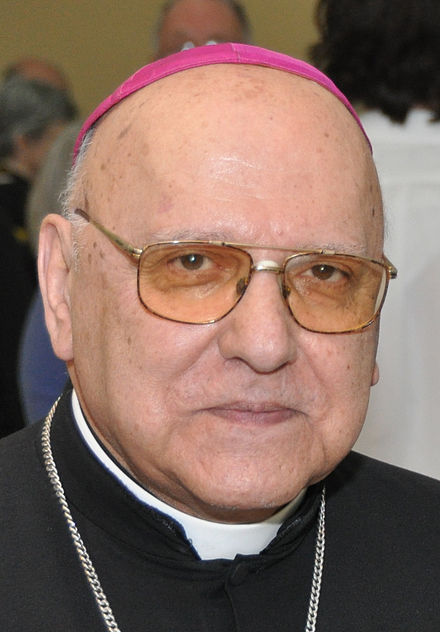
Dec. 23 issue ' When Pope John Paul II appointed Michel Sabbah as the Latin patriarch of Jerusalem in 1988, it was the first time the Holy Land's indigenous Roman Catholics were led by a fellow Palestinian. Previously, Rome had always sent an Italian to fill the sensitive post.
SOME 20 PERCENT of Palestinians are Christians, including Yasir Arafat's wife, Suha, who was born into a Christian family before converting. On a recent visit to Rome, Patriarch Sabbah spoke to NEWSWEEK's Alessandra Borghese at the Vatican about where Christians stand in an atmosphere of conflict between Muslims and Jews. Excerpts:
BORGHESE: Is it difficult to be a Christian in Israel, and are people heeding the Holy Father's call for Christians not to leave the Holy Land?
SABBAH: Christians live like others. They're Palestinians, and as a result life is hard and they suffer; their liberty of movement is limited. They're humiliated and reduced to begging for their daily bread. Some have left, especially those who are economically able to do so. Others remain by principle, and because they want to stay faithful to their homeland and to the church.
How do you feel about the efforts of the Vatican to negotiate between the Palestinians and the Israelis, and the effort to win recognition for Israel by the Vatican?
There's a much greater presence of the church, and much greater efforts to facilitate action in the Holy Land and dialogue with the two authorities. However, until now all these efforts have not produced much. For example, we have problems renewing visas even for clergy.
Is it difficult being a Christian Palestinian in a predominantly Muslim and Jewish land?
Christians are part of Palestinian society, and the Palestinians are Christians and Muslims. No one is going to flee because of Islamic influence, but because of the lack of work, or the political tension provoked by the curfew. But there is no Muslim persecution of Christians, and in fact they share the same hope of one day having an independent state.
Don't you see a desire on the part of Muslims to dominate and convert other faiths?
Just a moment. This isn't easily understood in the West. We Palestinians know how to live together and how to understand this relationship. We are one people, even if there are some difficulties.
But aren't you isolating the case of the Palestinians? This isn't a relationship that is easily exported. To find Christians who are persecuted it's enough just to look at Vatican reports. Think of Pakistan, Afghanistan, Indonesia, Iraq.
In Arab countries there is no persecution of Christians. I don't speak of Pakistan, but in Egypt, Syria, Iraq, Lebanon'no. Historically there have been some massacres, beginning when Europe entered the Mideast.
Not even any effort at the conversion of Christians?
There's always that, but much of it is social pressure, that's all. Nowadays we cannot say there is persecution. There are problems of the majority and minority, disputes of a social nature. These governments are very vigilant about relations between Muslims and Christians. There's a lot of propaganda in the West; I don't know why. Let us live in peace and don't foment fear, it's fear that weakens us. Our vocation is to live among Muslims and to give testimony to Jesus in a Muslim society. It's difficult, but we accept it.
What kind of Christmas will this one be in Bethlehem's Church of the Nativity?
A Christmas of prayer, calling on God to have pity on this land. We will pray for peace and if there is not peace, the siege will continue.
Do you see suicide bombers as true martyrs?
According to Islam, they are. It's necessary to treat each one according to his own principles. As Muslims see it, suicide bombers are giving their lives for their country, to gain their liberty. As a Christian, suicide is not permissible in any case, even for your country. You may not kill yourself.
The Israelis, too, are under attack. They are being overwhelmed with continuing acts of terrorism.
Under attack, by whom? Israel occupies and attacks someone else's land and finds resistance. Israel is not being attacked. When Israel ceases to attack and to occupy [the Palestinian territories], they won't suffer any further counterattacks. If Israel wants to end violence, it only needs to end occupation. I'm 200 percent certain of this, and I've said it many times.
Do you feel January's elections in Israel will do any good?
Nothing will change. The majority in Israel is for [Ariel] Sharon and [Benjamin] Netanyahu. They're for the same political line.
What has given you the most comfort in this past year, with so much desperation?
The patience of the people and their hope in the midst of continuous war.
A Christian in the Holy Land Interview with Michel Sabbah
By: Editor - on: Tuesday 30 December 2003 - Genre: Palestine File
Upcoming Events
Artificial Intelligence: Ethical Concerns
May 23, 2026
This presentation took place on May 23rd, 2026. Yo...
?Who is the intellectual? And what is the role of the cultural reformer in societies
April 13 - 15, 2026
محاضرة يلقيها الفيلسوف والمفكر الإسلامي م.محم...
Mnemonic the Play, A Presentation and Discussion
January 24, 2026
This presentation and discussion of Mnemonic the P...
Sufism between deconstruction and theory
September 11, 2025
A religious and scientific dialogue on Sufism, i...