"99 Names" by Suzanne Klotz
Mulham Assir
Suzanne Klotz is the creator of Thy Kingdom Come: Pocket Guide to the Holy Land, a vividly coloured book of captioned drawings that portray Israeli-occupied Palestine as she saw it between 1990 and 1995.
To describe this work is in a sense to add a fourth lens to the view of the Israeli occupation and the associated war crimes being committed to perpetuate it, because the book is the artist's vision of images seen through the naive eyes of an imaginary American tourist woman and her little daughter who arrive in the "Holy Land" excited to explore it. Therefore it is (1) fact (amply documented by the captions) filtered through (2) "innocent" observers' perception, (3) illustrated by the artist. Yet, for all the distillation, the images in the guide pack a staggering punch.
The guide consists of 44 pages, each a separate vignette, all forming a condensed pictorial "zioclopaedia" that is, as the artist puts it, "geared to educate the readers in one brief 'reading' about two paramount issues: the American citizens role in the destruction of Palestine, and Israel avowed and false identification of Zionism with Judaism and its spurious claim of representing all worldwide Jews."
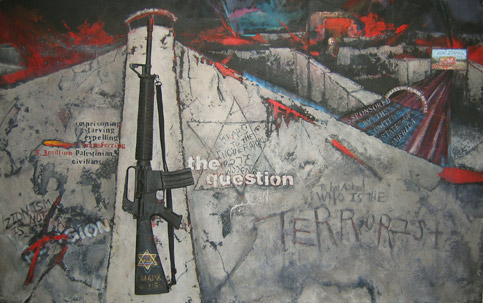
"The Question" by Suzanne Klotz
Perhaps to define the guide it is best to start with what it is not. It is not a comic book in the traditional form of a segmented epical narrative. Each page can be torn from the book to stand on its own like a fractal containing the features of the whole, spelling "Occupation." What the American woman and her daughter see is shown in a series of pictorial snapshots, each of which contradicts the sanitized and sloganized concept of the "Holy Land" -- "a land without people for a people without land" -- a Zionist lie pervasively promoted in the American mass media.
The device of the presentation through innocent eyes, reminiscent of Salingers approach in Catcher in the Rye, serves to obscure the artist's editorializing voice and at the same time revs up the shock of "discovery" by the "innocents". It also prompts the viewer to wonder "But how can they not know what is being done in their name, with their tax dollars? How can anyone not know all this?"
It is not an allegorical comic book in the manner of Spiegelman's Maus, in which the predatory cats represent the Germans, the ruthless, greedy pigs stand for the Polish people and the defenceless mice for the Jews. Klotz's guide does not indict any ethnic or religious group as a whole, but it forcefully and clearly blames an ideology: Zionism, which breeds, in a state arrogantly self-proclaimed as a "Light Unto Nations," a culture of hatred. Legislated hatred and racism are epitomized by Israeli top leaders calling the Palestinians cockroaches, and by current leaders calling for their expulsion, a "final solution" to their desired aim of making Israel a state "for Jews only." The artist sees Zionism as a misrepresentation of Judaic values.
The guide is not, although it has that effect, a sarcastic travel brochure depicting highlights of the Zionist military occupation of Palestine any more than The Inferno is Dante's tourist guide for Hell, although it would help a first-time visitor to cut through the miasma of propaganda down to the truth of Israel's apartheid, occupation and war crimes.
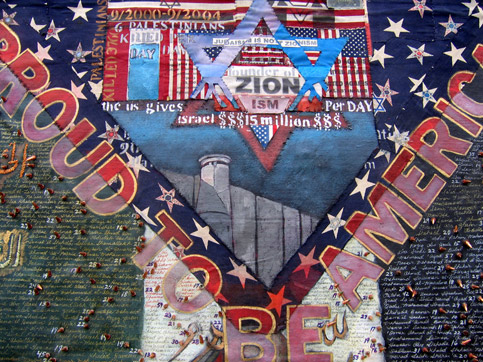
Detail from "Shuhada" by Suzanne Klotz
Finally, despite the numerous captions encapsulating data and facts of Israel's systematic and ongoing land grab, ethnic cleansing and brutal oppression of the Palestinians as well as verifiable facts and figures related to the unlimited and unconditional American support (financial, military and diplomatic) of Israel, the book is not an illustrated pamphlet. Word and image are fused, whether the words are external captions or graffiti integrated within the image, into a visual whole. Nevertheless, Klotz herself considers the images simply as illustrations of what she saw with her own eyes over several years of close observation of life in occupied (and/or under siege) Palestine.
In a sense the artist herself was at one time as an American visiting Israel for the first time. As a guest artist in residence at Mishkenot Shaananim -- a non-governmental, non-political, international multicultural centre in Jerusalem -- she first saw the realities on the ground in 1990. She returned many times for extended stays over the next five years, creating art programs, often in collaboration with Palestinian artists, and became familiar with the horror of Palestinian life under Israeli occupation only a street away ("just across Jaffa Street"), yet a world away from the relaxed and comfortable surroundings of Israeli life. She observed the moral compromise of many Israelis who had internalized the dichotomy of privately disagreeing with the government policies infringing on the Palestinians' basic human rights without publicly opposing them.
An advocate of human rights long before her Jerusalem epiphany, Klotz had spent time in Australia, deeply touched by the plight of the Australian aborigines. Ironically, when she left Australia to go to Israel for the first time, many of the aboriginal artists asked her for a great favour. Forcefully alienated from their ancestral culture, the Christianized Aborigines with no hope for redress in this life cling to the hope of help from their masters' gods. They asked her to stick their written prayer in the Wailing Wall when she got to Jerusalem, which of course she did. Long after this memorable incident Klotz created a Portable Prayer Wall (marked Guaranteed and Made in the USA). As a way of making prayer intercession available to all, wherever they are, including those unable to reach the city now being cleansed, the Portable Prayer Wall has about it the inventive practicality as well as the wry irony of something that Mark Twain (one of the earliest anti-colonialism voices in America) might have come up with.
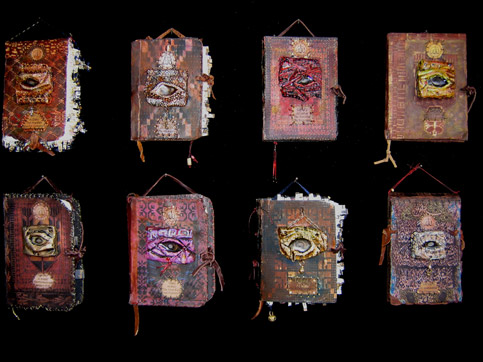
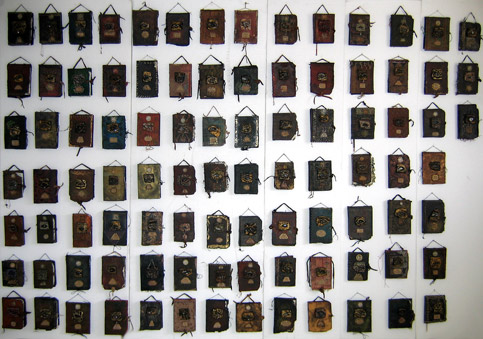
Detail from "99 Names"
Suzanne Klotz has an impressive body of work dedicated to the Palestinian tragedy and the destruction of Palestinian society and culture. The reason why Thy Kingdom Come deserves more space is not only because it is highly comprehensive and representative of her vision and talent, but also because she has been unable to publish it in the US. A digital documentary introduction to it, called The Other Side of the Holy Land, which she created in a college workshop, was attacked in the local press in her city (Sedona, Arizona) by the leadership of the City Arts and Culture Commission and described as anti-Semitic in a front-page article in the local paper. Equivalent to a persona non grata branding, this type of accusation creates an atmosphere in which an artist sees previous commitments reneged on by galleries and exhibit organizers, fails to find a willing publisher, and finds it increasingly harder to show and sell ones work. This is not surprising: after all, Americans now live in the time of the Patriot Act, and Israel's perceived enemies are America's enemies.
A recipient of numerous prestigious grants, scholarships and awards previously, especially when her work and interest were captured by "safe" (lobby-less) causes like the plight of Australian aborigines, Klotz found that her guide attracted the FBI rather than accolades. The newspaper article culminated with a call from an FBI agent who claimed she was being investigated following a denunciation of being an Israeli agent. Under this pretext she was subjected to an interrogation related to her travels and activities, which made her feel as if she were in an Israeli airport rather than in her own home. Undaunted, Klotz participated in the College Art Association Democracy Wall exhibit in Atlanta in February 2005, where she showed images from the guide stamped CENSORED, together with enlarged quotes from the slanderous article that had described her work as anti-Semitic. She explains her persistence thus: "It is not about me. It is about the fate of 5.4 million Palestinian people and about our tax dollars that finance these crimes against humanity."
Her commitment to the Palestinian cause is above all else spiritual. A deeply compassionate and genuine humanist, Klotz believes that the spiritual teachings of all major religions are the same. She also believes that Zionism has not only perverted and misrepresented Judaism to both Jews and Christians but is also misrepresenting and demonizing Muslims and Islam to the world.
Her current work is a collection of 99 books she is creating, each representing one of God's attributes. As she is working on them, she says that each day she selects one attribute to meditate on to achieve a deeper understanding of the virtue and apply it during the day. One of her dreams is one day to be able to create an art salon in southern Lebanon where she could meet with women to create artworks that incorporate traditional techniques, crafts and calligraphy.
The salon would ensure the preservation of traditional arts and culture and the art would further the understanding that whether one says Allah, God, or Dios, the meaning is the same. Our moral obligation is to all people, because we are children of the same God.
Until then, underemployed and over censored, she continues to work with imagination, talent and an apparently inexhaustible reservoir of compassion, endurance and hope. A telling example of her vision, talent and resourcefulness was seeing a house under demolition in her hometown one day and realizing that it would make the perfect medium for her installation -- a life-size depiction of a destroyed Palestinian home (or for that matter, Lebanese or Iraqi). Judging by the photographs, the installation, especially given the mountainous landscape of Sedona, so similar to many places in hilly Palestine, was eerily evocative and strongly moving.
Mulham Assir is a Lebanese writer based in Beirut and Madrid.