The ringing of the phone came like a sharp slap. I woke up. “Who is it?”
“I’m Tony,” a man’s voice said. “I’m very sorry to wake you up at this time.” I looked at the bedside clock. It was 4:40 A.M. My sleepiness instantly evaporated.
“I couldn’t find someone else at this time who could speak Arabic. It’s a tragedy. Police station 111, south of Chicago, off I-94, two blocks to your right. Is it far?”
“Yes, but that’s okay.”
“The roads are empty at this time. Please hurry up.”
I sprang up from bed. I didn’t wash my face. I donned my clothes with all haste. The freezing wind of Chicago slammed against my face. The blizzard had dropped one foot of snow on the city, but it will end soon. Only a few snowflakes are coming down. The soft snow will surely turn icy from the cold wind. I had to warm up the engine for at least five minutes, but I didn’t. The car is colder than ice and quietly crawled forward. I should be careful, there are several layers of ice on the backstreets and any sharp stop will make the car skid. The snow has shrouded everything with a thick white blanket, concealing their identity. “The temperature is twenty five below,” the announcer’s voice drifted by. They are broadcasting updated weather conditions every five minutes to warn motorists. I am used to the metric system. The Americans have inherited from the Brits this complicated scale – the Fahrenheit. What a cold night! It is about thirty five degrees Celsius below. Had this happened back home, the Tiger and Euphrates would have frozen and children would have played on them. But here they don’t allow anyone to play, walk or skate on the icy lake – permanent watch even in bitter cold like this one. How repulsive are the streets in such weather! The snow has piled up in ruts of brown slush from road salt and vehicles. Few motorists are stranded on both sides of the road. Who knows what could happen to this cold piece of metal and her poor driver in such cold.
I know the police station, but I have not been inside. I greeted a black big-bellied policewoman, eyelids heavy from needed sleep. She didn’t smile. “This way,” she moaned. “An Iraqi; she refuses to talk.”
I followed her. How did they know she was Iraqi if she refused to talk? And why wouldn’t she talk? Every Iraqi has become subject of interest nowadays – the news of Fallujah, sectarian killing, kidnapping and bomb blasts. Everything spreads terror. Who would imagine it! She is Iraqi and I am Iraqi! My heart winced.
It is hot inside the station. I took off my gloves, my coat and my hat. The room’s door was open, the light was comfortably abundant. A single bed was there in the middle of the room, on whose side sat a frightened girl. She’s four, is she the one concerned? She was gasping, eyes filled with tears while a two-year old boy, was sleeping on his right side behind her. I couldn’t see his features – black hair, a small palm holding a pistachio green plastic teether. The girl’s skin was olive and kept its freshness despite tears. Maybe the presence of the policewoman with me added to her fear, she almost exploded, sobbing even harder. I stared at the policewoman; she stepped out. I threw my stuff on a chair. I crouched before her. She recoiled back from me and screamed, frightened.
“Don’t be scared sweetheart, come,” I said quietly.
I held out my hand to her. I don’t know how the words in Iraqi accent worked a sort of magic on her. She jumped and wrapped her little arms around my neck. She started to cry and called out aloud, “Mama, Baba.” She remained like that for a few seconds, crying and repeating ‘Mama, Baba’. I stroked her hair until she calmed down. I put her in my lap. Her hair was jet black, straight, soft like silk, reminiscent of that of Orientals from Japan, China, Thailand, etc. I caressed her hair once more; a purple flower was pinned at the base of her pony tail. I began to wipe her tears. On the bed, was a white coat on which were some drops of blood. Whose blood is it? Her mother’s? Her Father’s?
I pointed to the cup of water on the nightstand. “Do you want to drink?” I asked. She nodded a ‘No’. She was still weeping. I wetted the tissue and wiped her pure olive face. “Mama, Baba,” she repeated.
“Enough, sweetheart. What about them?” I asked.
She drowned in tears. “Please don’t cry. Tell me, are you hungry?” She nodded in affirmation. I carried her in my arms, her white dress was damp from behind; she might have lost control from the shock of the accident and wet herself. I got up and she was still against my chest. No sooner had I reached the door that she turned to the boy and screamed ‘Hashem’, trying to let go of me.
“Okay, sweetheart, we’ll not go out.” I stepped back and placed her back on the bed. “Calm down. We’ll not leave him,” I said, smiling. I stuck my head out the door. “Mam?” I screamed.
“Ye…s,” the sleepy policewoman’s voice came back. Seconds later, her big body filled the doorway. “What?”
“Is it possible to get them breakfast?” I asked.
“We have everything here; there is a lunch room.”
“But she refuses to leave her brother behind.”
“Fine, I’ll bring her everything she needs.”
I held her in my lap. I patted her long hair once more and went on, “How beautiful is your hair!” She leaned her head on my chest, her breathing uneven with tears that dampened my shirt. I wiped her eyes once more.
“What’s your name, pretty girl?” I asked.
“Joud,” she mumbled.
“What a beautiful name! Your brother is Hashem. Isn’t it?”
“Yes.”
The policewoman said, as she was placing the breakfast tray: “Her father was driving from Indiana, and a truck didn’t heed an intersection’s red light and hit their car and ran. One of the pedestrians saw the accident and took down the truck’s license plate number. The driver has been arrested. What a dreadful accident! The car turned into an iron ball. They needed a blow torch to open the door. It’s a miracle the two kids survived, the seat belts saved them.”
I advised the officials to take the children to a nursery ran by Dr. Nancy. She speaks Arabic at least – a kind Egyptian, a real person. I didn’t have the address on me, but I described the location – North, on Lawrence and Campbell, one block west of the train station, across from a supermarket. They agreed immediately – a strike of luck that I didn’t expect. I was thrilled. Joud wouldn’t leave me – she clung to my neck while sitting in the car to my left, her brother Hashem to the right, sleeping. We arrived at the nursery at 7:00 A.M. Nancy is an elegant brunette, slender, with typical Egyptian features, sweet tongued and warm-hearted. She welcomed us with smiles and chuckles. “Welcome, they will be in safe hands,” she assured. There was no one in the nursery. We were early; the children will start to show up soon. Joud and Hashem yielded to her and we entered a small room – two small beds on each side of a window overlooking a small garden covered with snow. There was between the two beds, against the wall,: Bears, monkeys, dogs, cats, etc. There was a train on an oval track at the left side on a night stand. Hashem ran to it and I don’t know how he managed to turn it on. The train began to move and whistle, sending its particular warning while I had to keep talking to Joud so that she might overcome the shock of the accident. The arrival of the children gave me a big relief. I didn’t leave the nursery until I saw Joud and Hashem get along with the children, playing freely in a big room packed with oodles of toys.
From the documents the authorities had at hand, they learned the father was a karate trainer. He was laid off two weeks ago. Luckily, there were documents for the entire family, American passports, titles of a house and a car in Indiana, employment and service termination documents in several places over the past twelve years, two bank statements, one of them in the name of Jalal and the other Housn. They provided me with all the information they extracted from the papers and asked me to find their relatives here, in the US, or in their country of origin, with the hopes of finding someone who could adopt the children. The father was an Iraqi from Bagdad, the mother Syrian from Aleppo. I didn’t get lucky finding any clue that would lead me to them. I couldn’t find anything that would prove their belonging to one area in the homeland – no picture IDs, passports, work contracts, or graduation certificates. I couldn’t trace their roots. I am not sure until now about their full names. I guessed them, after I solicited more than one opinion. ‘Jalal’ is written from Arabic into English without any confusion, very clearly, but the family name of the father is written in English as KAFF which is not possible in Iraqi society. That is why I thought the father’s family name could be Abdul-Kaffi. When they applied for the American citizenship they had the option to change their names. Jalal’s choice was a good one. He got rid of the word ‘Abdul’, averting racial harassment, and secondly it was easily pronounced by most Americans who like abbreviated and non complicated names. Kaff is a nice shortened word, easily pronounced. As to his wife’s name it was written in English as ‘Husson Hassan’. This is confusing too. It could be pronounced in Arabic as two different full names. And since we don’t have any functioning Iraqi consulate or embassy in the US, I resorted to inquire about them among the well known figures of the Iraqi community in both Chicago and Indiana, but in vain. A few days later I had to go their house in Indiana. It is located on a beautiful street in the suburbs, overlooking from the rear a small artificial lake, and in the background a landscape of green slopes rising to a hill where upscale homes are perched and seem hanging in the sky, except for a lush forest that keep them from falling. The house façade look similar to those of other houses along the street, with a front door garage. Four cedar trees distinguish the house from the others and seem not to exceed four years of age, separating the front window from beds of myrtle and roses. I learned indirectly from their Mexican neighbor who didn’t speak English, and through her eight-year old son who made the translations, that Jalal bought the house through a real estate agency and didn’t know its previous owner. The rest of the neighbors are non-Arabs; they remember Jalal and Housn but don’t know if they had any relatives. It seems they didn’t mix much with their neighbors even with the Indian family that resided across from their house. The limping Indian neighbor answered the door, followed by his wife. His wife wouldn’t answer my questions. I turned to him and he asked me about Jalal. But when he saw the patrol car that accompanied me, he went back inside, not listening to my answer. My heart wrenched with pain. Here, nobody notices the disappearance of the other; no one cares about the fate of the other. In addition, the Syrian embassy couldn’t fill us with any piece of information on Housn or any Syrian citizen married to Jalal Abdul-Kaffi or Kaff. The employee at the Syrian embassy wouldn’t talk to me directly, rather she asked the legal official who was assisting me to give her his name and rank. And before he could answer her, she asked for a full description of the tragedy. I saw a look of dismay on his face and great effort to keep his calm – he handed the phone to me. She surprised me when she asked among other questions for my name and the reason I’m involved with the children! I think she was typing every word I said on the computer, because she made me pause a few seconds after each sentence; at times I thought she hung up on me, and I would ask her ‘are you with me’ and she would say ‘yes, sir’. Then suddenly, for unknown reasons, she became very respectful and diplomatic with me and promised to send a fax within one hour or so. The second day a fax came back – an apology; there is no Syrian lady under this name in Indiana or any other place on the American territory. Nothing. Did the two emerge alone, and as strangers, from the bottom of the earth to go back to it alone?
I stayed with the children for a long while. Shortly after I had left the nursery, Nancy called me. It was around 4 P.M., and she asked me, in her sweet proper way, to go back. The problem is the two children are alone after business hours. It seems she found herself in deep trouble; I have to stay with them.
“A big problem, only you can help me,” she said apologetically.
Joud ran to me. She hugged me. Hashem was reserved. He ignored seeing me. “If I were not around, you would have taken them home with you,” I said.
“I’m responsible for them,” she replied, “but I saw how much the little girl loves you, that’s why I ask you to stay with them. It’s against the law, but to the children’s best interest. I don’t think they can be comfortable at my place. My house will be crowded soon. My sister, her husband and children will arrive from Los Angeles tonight at eight. They never saw the snow before; they want to see it in the city. I’m embarrassed. I don’t have enough time to call the officials to find a family for them to spend the night with.” She checked her watch. “I have to be home. My children will be back from school in half an hour. Do you agree or not?”
Her frankness startled me. “Does the law allow me to take them out to the nearby supermarket?”
She nodded. “Unfortunately no. But why? The fridge is full – Nestle, fruits, drinks. Everything. But if you want to go out don’t tell anybody and don’t stay out late. I’ll be in ruins if someone knows they’re not at my place. Come; let me show you what you might need at night.”
She showed me around – telephone, TV, VCR, microwave, keys…etc.
The nursery sounds like a jail after the business hours – heavy sadness that lays its weight across the body. I am an adult and feel this way, how about these children? After a while and with the beginning of the night’s darkness, Hashem began to cry, maybe he remembered his parents; “Mama, Baba…” he repeated. The train and toys had lost their effect on him. Nothing would quiet him. I crouched before him. I asked him if he would come with me to the supermarket and nodded his head in agreement. I carried him, but he wanted to walk. We crossed the street, our hands interlaced. The minute Hashem saw the shopping carts, he grabbed one and looked at me, mumbling some words that I didn’t understand. “Put him in the cart,” Joud screamed to me.
He stood inside the cart, the teether in his right hand that holds on to it, and left hand in his pocket. Then he pointed to me to stop at the cookies section. He put his both hands along with the teether in his pockets. He stared at the cookies.
“Lata,” he said. There were loads of brands. I didn’t know what he meant. “Chocolatta, chocolate covered cookies” Joud translated.
During the brief time I had spent with them, I understood his language – ‘peps’ means Pepsi; ‘gager’ means hamburger. He acts like a king. He slides his hands inside his pockets, gazes at the stuff, and repeats few letters that we’re supposed to understand and give him what he wants. Then he will move the teether to his left hand and insists on taking the money in his right hand to pay the cashier. He takes the change from the cashier and places it inside his pocket, while Joud would scream, “No, return the money to uncle.” But he is like any king, he doesn’t care for others. Afterwards, we played in the main room and built a house from wooden cubes. Around 10 P.M. I read to them the story of the pretty mouse who loves her neighbor and whose parents refuse to marry her to him. Their eyes were twinkling with joy and compassion. Hashem fell asleep in his place, the teether in his hand. Joud began to yawn. She stared at my eyes and surprised me saying, “Where did the children go?”
“Home,” I replied.
“And will we go home?”
My eyes teared. I might be the most stupid person – I didn’t ask Nancy what I should say in such a situation. The truth is painful, hard to describe. Lying is painful too. What should I say then? I hugged her and caressed her silky hair.
“How beautiful is your hair!” I said.
“My mother says the same; when do we go home?” she asked.
I changed the subject. I expected she might have met a new child. “What’s the name of your friend?” I asked her.
“She’s a girl, not a boy, and her name is Aisha, from India.”
I had noticed several children with Indian features in the nursery. “Do you like her?” I asked.
“Yes. Aisha went home, when will we go home too?”
“Did you hear what happened to the flying turtle?”
She opened her eyes wide, nodding her head, “No.”
“Do you want me to tell you the story?”
She nodded and pressed on my hand. I began to read to her. She slept while I was just at the beginning. When I turned off the light, I was deeply stirred. I let my tears flow; I haven’t cried in years, why do I do that now?
I didn’t leave the nursery the next morning when Dr. Nancy arrived around seven o’clock. I had waited until the children streamed in, and for Joud and Hashem go mingle with their likes.
A few days went by in this way; I was able to bring them to my small apartment several times and we even slept there together. I let them have my bed and I slept on a blanket beside it. And then one afternoon I left them with Nancy. I went back to my apartment to take a shower, change and go back to the nursery by four in the afternoon. This is how the circumstances controlled my time schedule. I have to work around it. I decided to run some errands on this day. I wrote my rent check, but I didn’t mail it. I prepared the clothes to take to a nearby dry cleaner, at the intersection of Ceramic and Daymon. I have to do some shopping too, The electricity, gas and telephone bills, shopping, a selection of children’s stories.
but as soon as I stepped out of the shower, Nancy surprised me on the telephone line, “Hurry up, someone came to adopt Hashem.” I was appalled. Ahh, that fast? I didn’t know what to do. I went out without putting on my coat. The cold air slapped me. I didn’t care. I opened the car’s door and realized I forgot my gloves. My fingers will freeze. I went back to the apartment and I found out that I forgot my key chain in the car. I went back to the car. I didn’t find the keys. Where did they go? I was confused. What shall I do? I calmed myself down. Five minutes went by, thinking and searching, until I finally found them between the seat and the door. I resisted speeding, fearing something would happen and delay me.
“You’re late,” Nancy said, “I thought you were not coming.”
My heart fell to my toes. “Did they take him?”
“No, he’s with her in the other room.”
In Nancy’s office was a very tall, bald man with thin features. He is very elegant and wears a blue suit and a blue-striped shirt. He was signing attentively the papers that Nancy was handing to him. He smiles, no, actually he is utterly happy. He signs as if he’s practicing a fun hobby! He must be one of the spouses. I darted to the other room and found a tall woman in her thirties – around six feet, light chestnut hair, slender, beautiful voice. She was seated on the floor before Hashem. She piled the toys she had brought him, showing them to him one by one. He was excited and laughing: Before him was an iron armed soldier, walking, making different sounds, producing repetitive shots and colored light from his machine gun; a dog that walks, rolls over, and barks; a naked newborn that cries and giggles; and other toys. I thanked God that the toys had got all his attention. I motioned to Nancy to talk to her privately. I asked her to mention in the contract that he could see his sister every once in a while, and to keep his address. “There is a clause in the law that allows for that,” she replied. “As to the address we have it. Don’t worry.”
When the couple left, Hashem was playing with the naked newborn, held against the woman’s chest, and the husband carrying the rest of the toys. I went down the stairs after them – long stairway, more than twenty steps. I was equally happy and sad. Happy because I expect his foster parents will make him happy. Sad because he lost his entire family and doesn’t know that. A taxi cab was waiting for them. I knew later that they were from Florida.
I went back to Nancy, feeling crushed to the bone. My expressions might have revealed my sadness. “Don’t be sad,” Nancy said, placing her hand on my shoulder. “The world is filled with such incidents.” I smiled. It is nice for the person to learn from the younger ones. I spent the whole day preparing for the moment I would see Joud alone. What shall I tell her? I forgot once more to ask Nancy to teach me what to say.
Around four in the afternoon, the expected happened. “Where is Hashem?” Joud asked. She went around the building searching for him frantically, like a possessed soul, his teether in her right hand. She ran from one place to another screaming ‘Hashem, Hashem’. She would bang on the restrooms door with her both hands, crying out his name, the madness of his loss haunting her. Then she broke into long sobs. She threw herself onto my chest. “Where is Hashem? Where is Hashem?” she implored, waving his small green teether. Her little mind couldn’t assimilate the idea of him going somewhere without his teether. “Hashem, Hashem,” she repeated, her voice raspy. I washed her face from the traces of tears. “Do you want to go eat hamburger?” I suggested.
That was the harshest night of endurance since that of the accident. She couldn’t forget Hashem at all. I distract her for half an hour, only to go back to square one. She weeps. She screams ‘Where is Hashem? Where is Hashem?’. She refused to eat. She refused to play. She refused to listen to any story. She cried herself to sleep. In the morning she walked to the play area weary, breaking the heart of everyone there. She didn’t play. She was screaming ‘Hashem’ until she fell asleep. I was worried she was not getting enough nutrition. She woke up at night and began searching anew for Hashem. As to me, I was living the non-time. I forgot whether today was Wednesday or Thursday, Sunday or Monday. I forgot the date – the ninth or nineteenth. The tragedy sucked me in and consumed me. The liquid tranquilizer that the doctor prescribed her was the only thing that calmed her down. It made her almost drugged up the whole next day, even when she woke up the third day she seemed tired and exhausted, but she ate avidly. Then, a big slam came, blowing my mind completely – a surprise. The nursery is closed on the weekend. It means I will go crazy. I will stay with her alone – no group play, no children during the day or at night. I have to manage alone; yes…me alone. I learned about that accidentally, it never occurred to me.
“And what about you, what did you plan for the weekend?” Nancy asked before she left. “How are you going to spend it with Joud, alone in the nursery?” She laughed when she saw me surprised.
I tried to collect my composure. “What would you do if you were in my shoes?” I said.
She chuckled. “But I’m not in your shoes. I don’t know. Think about something.” She bid me good bye and disappeared.
The empty nursery started to weigh down on my chest. “We’ll go out,” I said to Joud as soon as Nancy left. “Okay, come on,” she answered, grinning. I had Nancy’s mobile number and I called her to get information on cartoons show times and theaters location. “I am in the car right now. I’ll call you as soon as I get home,” she replied. She got back to me within thirty minutes and gave me the address of a movie theater in the suburbs. The movie starts at 8 P.M. I put Joud in the back seat and fastened her seat belt. We got there two hours early. The movie theater was in a big plaza filled with big retail stores. We dallied around, checking out the stores. The first thing Joud did was buying stationary. She would look at me before she picks out something. “Do we buy something for Hashem?” she asked. She flipped the coloring books. She didn’t like any. She led me to the shoes section. She took a pair of shoes out of their box. She tried them on, checking in the mirror. She didn’t like anything. She took it off. She tried another pair. She didn’t like it either. “How do you like this skirt?” I asked. She tried several pieces of clothing. She liked only the pink silk hat, laced with a blue ribbon, with two pearls on the front. She wore it before we left the store, with the tag hanging over her forehead, trying hard to remove it. We sat twice in the stores cafeterias; the first time for dinner and the second for ice cream. We bought popcorn in the movie theater’s lounge. She held the popcorn tub, but she had only few pieces, Hashem strongly present with us. When the lights went out, she got frightened. She almost cried, she pressed on my hand. That was her first time to the theater. The cartoon was famous, about the queen ant, she liked it a lot. She felt sleepy in the car, but we didn’t go to the nursery, instead we spent the night in my apartment, not heeding the laws. She took my bed and I slept on the floor. Saturday morning I fixed her lentil soup and helped her comb her hair. That was Nancy’s mission, and then mine, but an easy one since her hair is silky soft.
Afterwards we went to the zoo. We had a bag filled with sandwiches, refreshments and Nestle’. We raced in the zoo, she beat me several times. I was panting while she was laughing at me. She hurled snow balls at me, and I ran away from her in vain, my face covered with the cold snow. And when she saw from a distance a little boy strolling with his parents, she screamed ‘Hashem’ and sprinted to him, coming back crying. But I surprised her with an instant camera. We took dozens of pictures. She would look at the picture and keep the one she liked, dumping the ones she disliked in the trash bin. The peacock mesmerized her with the beauty of its feathers. She sat to walk like a gorilla. I imitated the braying of a donkey, the mooing of a cow, and the screeches of monkeys. When she saw the American lion pace around agitated in his cage, she said, “He’s hungry.”
Despite remembering her parents several times, my strategy – to wear her down with non-stop activities – had worked. I did the same on Sunday. We went to the play land. She tried all of the low intensity rides. We had enjoyable time. She surprised me in her happiest moments, mentioning on multiple occasions her mother, father, Hashem and his teether.
Nancy had called me several times, reminding me to return to the nursery Monday morning by eight, fearing the possible arrival of inspectors. That was utterly difficult, especially since I had to carry Joud while asleep after I wrapped her in a blanket. She woke up in the car. I removed the blanket. “Am I going to see Aisha today?” she asked.
“Why not?” I answered.
“I say: will I see her today?” she pressed, as she shook my shoulder.
I laughed. “Of course.”
“I’m hungry.”
“We’ll get there soon.”
I arrived before Nancy did. I left the nursery’s door open. I began to fix Joud breakfast while she was jumping around me. She was helping me set the table. “Why didn’t the children come yet?” she asked several times despite my assurances. Then she remembered the hat and insisted on wearing it. I was trying to remember where I had put it since I don’t recall taking it to my apartment. It must be in the car. I promised her to bring the hat before she finishes her breakfast. Then we heard Nancy’s chuckles as she stormed into the room.
“Where is my sweet, pretty one?” she asked. There was something over exaggerated in her gestures as though she was hiding something.
“Did you see the peacock?” Joud asked, as she threw herself into Nancy’s lap.
Nancy mulled over her words for a few seconds and laughed. She put her down to the floor. “Is he the one who walks like this?” she said.
Joud giggled. “No, Nancy. This is the gorilla. The peacock has nice feathers, he walks like that.” She started to walk like him, chest puffed out. I took this opportunity to go get the hat from the car. Meanwhile, the children began to stream in, preceded by their jubilant voices.
After I had fixed the hat on her head, with Aisha, the skinny Indian girl of similar age next to her, she insisted on checking herself out in the mirror of the big lavatories. She held Aisha’s hand, and both ran disappearing in the hallway. It dawned on me that I have a long day ahead to finish my postponed chores. I didn’t mail yet the rent check, I didn’t shop for groceries, I didn’t return the rented video tapes, I didn’t launder my clothes. I have to do all this today, but I was surprised at the arrival of a plump forty-year old woman, with a man of her age, slender, salt and pepper hair. They were dressed elegantly in black. The man’s face is familiar to me. Where did I see it? Where? Damn! The memory failed. How does it let me down in time of need? They both entered Nancy’s office. ‘The Paulers’, this is how they introduced themselves. My heart began to race. Nancy didn’t sound surprised at all. Ah! This is what she was hiding from me behind her unusual morning start off. I stopped. I didn’t enter the room, fearing to reveal my nervousness. His wife introduced him as the singer… Ah, I remember him now, a humble level singer. Robert Mohamad had invited me last summer to an open house in the town of Countryside. He was singing, and his wife was selling tickets sponsored by the town. They showed Nancy the legal adoption approval.
The singer’s wife, sat out to explain amicably, with heated compassionate expressions and hand gestures: “We didn’t want to have children when we first married. We wanted to enjoy life freely and stand on our feet. After we grew certain that we could provide our child with a decent life, we couldn’t bear children. Isn’t it a paradox! You know these things!”
Nancy concurred, “Of course, this happens often.” Then the Paulers got up and stood in the lounge’s door, Nancy in front of them.
“She’s the one who wears a pink hat,” Nancy said, pointing to Joud.
“Ah, she’s gorgeous,” the woman uttered, trying to control her excitement. “Oh my God, even if I had a baby, she wouldn’t be like her. O my God! Jesus!”
Her tears started to flow with joy while the singer managed to hide his admiration and glee with a wide smile. Then the singer’s wife turned to her husband, “Steven, honey, get the box from the car.” Nancy rushed bringing Joud into the office. Aisha wanted to follow her, but Nancy stopped her after she kissed her. She patted her on the head. The singer gave the box to his wife and worked with Nancy on signing the papers.
The woman’s genius is perfect when it comes to making seductions of all sorts. I don’t know how the lady managed to find a doll, of approximately Joud’s height, that dances, walks, bends, closes her eyes and jumps in the air to land on her feet with the help of a staff she always carries. She also makes more than ten moves, various sounds, speaks funny words, yells ‘stop’ and ‘shut up’, giggles, sings, etc. Joud broke away from us and came back bringing Aisha along. “Look… Look…” she screamed, elated. Then the children swarmed into the room, laughing, clapping and wanting to touch the doll, until the singer was done signing the papers and Nancy took the children back to the lounge. The singer’s wife held Joud in her arms, the doll in her hands, and went to the door. I don’t know how Joud realized she was leaving with them – she threw the doll on the floor and dropped from her arms, sprinting to me crying. I hugged her. I held her against my chest.
“Fine, I will come with you,” I told them, “I will drive after you.”
That was a middle solution suitable for all. “Would you allow me to come with you?” the singer’s wife asked.
“Of course,” I replied.
The road to the south-west suburbs is very long. During the one hour or more of travel, the singer’s wife was joking with Joud, tickling her, kissing her, imitating the voices of cartoon characters, to the extent Joud went inside the house, holding hands with the lady, all the way up to her room. I slid outside before Joud could notice.
“Would you allow me to see her from time to time?” I asked the singer.
“What about Friday afternoon?” he suggested, shaking my hand warmly. “Just give us a call so that we stay home.” He gave me his phone numbers. I hurried to my car, intensely wrought-up, my lungs almost burst.
It was Friday, and I had to wait seven long days, which felt like eternity. I felt crippled. I couldn’t leave my apartment. I didn’t do the laundry. I didn’t shave my beard. I couldn’t do what I intended to. My body felt too heavy to move, and I would eat only a few bites and flop down for hours before the television, flipping every single channel and watching all programs. I was brooding over the upcoming meeting with Joud. On Thursday, I needed to report to the police station that summoned the night of the accident. I had to finalize some paperwork that I didn’t get the chance to finish earlier. Before that, I decided to check the accident site. It was noontime, no snow coming down. The truck’s wheels had left apparent tracks on the street, thrusting the small car to more than sixty feet forward, and landing together thirty feet up the green divider. The tires plunged into the earth one foot, where the snow didn’t erase the groove but covered it with a thin layer. I could have found splinters of glass if it were summer, but this is hard with this scary snow.
I woke up early on Friday morning. I couldn’t stay in the apartment. I strolled around for a long time. I had breakfast at al-Bortokala restaurant, on Belmont and Clark. I had to kill time. I had waited around one hour in the line and another hour inside the restaurant. I left around ten and drove my car very slowly, imagining Joud. Did she get over the accident? Did she adjust to her new environment? Did she like the humble singer and his wife? How does she spend her time? Numerous questions had been crowding my head all week long. But what kind of gift should I get her? My mind had shut down, but I finally got her a coloring book with crayons. I stood at the door, the pinnacle of happiness filling up my soul. I pushed the ring button. Who is going to answer the door? Steven or his wife? I didn’t wait long. The door opened. Joud appeared radiant – the pink hat, long black pony tail, a white sleeveless dress with blue rim, white socks. She sprang on me and hugged me, wrapping her thin arms around my neck, the way she did during our first encounter. But things are different now. Today is hope, despair was then. Here is an abundant life, death was then.
“Come, come,” she said, pulling on my hand.
There must be something important. I walked after her while the Paulers stood watching and welcoming me. I shook hands with them and we followed Joud. It seemed she got adjusted to her new life. Her happiness crept into me; my soul soared across the vast skies. The Paulers’ footsteps behind me told about their happiness. She pulled her room’s door open. The Paulers had changed the colors of the furniture according to Joud’s wishes and painted the walls from pink to pistachio green. The room is packed with toys. I went with her inside and she stood by a chest and pulled the top drawer.
“Look, look,” she pointed with her small hand.
The drawer was filled with chocolate covered cookies, the kind Hashem loves. Then she turned to the bed and rolled her small pillow, revealing Hashem’s pistachio green teether.
“Look,” she said, head ducked in with holiness. Then she gazed at me intensely with her big, limpid eyes, “When will we go visit Hashem?”
2005The ringing of the phone came like a sharp slap. I woke up. “Who is it?” “I’m Tony,” a man’s voice said. “I’m very sorry to wake you up at this time.” I looked at the bedside clock. It was 4:40 A.M. My sleepiness instantly evaporated. “I couldn’t find someone else at this time who could speak Arabic. It’s a tragedy. Police station 111, south of Chicago, off I-94, two blocks to your right. Is it far?” “Yes, but that’s okay.” “The roads are empty at this time. Please hurry up.” I sprang up from bed. I didn’t wash my face. I donned my clothes with all haste. The freezing wind of Chicago slammed against my face. The blizzard had dropped one foot of snow on the city, but it will end soon. Only a few snowflakes are coming down. The soft snow will surely turn icy from the cold wind. I had to warm up the engine for at least five minutes, but I didn’t. The car is colder than ice and quietly crawled forward. I should be careful, there are several layers of ice on the backstreets and any sharp stop will make the car skid. The snow has shrouded everything with a thick white blanket, concealing their identity. “The temperature is twenty five below,” the announcer’s voice drifted by. They are broadcasting updated weather conditions every five minutes to warn motorists. I am used to the metric system. The Americans have inherited from the Brits this complicated scale – the Fahrenheit. What a cold night! It is about thirty five degrees Celsius below. Had this happened back home, the Tiger and Euphrates would have frozen and children would have played on them. But here they don’t allow anyone to play, walk or skate on the icy lake – permanent watch even in bitter cold like this one. How repulsive are the streets in such weather! The snow has piled up in ruts of brown slush from road salt and vehicles. Few motorists are stranded on both sides of the road. Who knows what could happen to this cold piece of metal and her poor driver in such cold. I know the police station, but I have not been inside. I greeted a black big-bellied policewoman, eyelids heavy from needed sleep. She didn’t smile. “This way,” she moaned. “An Iraqi; she refuses to talk.” I followed her. How did they know she was Iraqi if she refused to talk? And why wouldn’t she talk? Every Iraqi has become subject of interest nowadays – the news of Fallujah, sectarian killing, kidnapping and bomb blasts. Everything spreads terror. Who would imagine it! She is Iraqi and I am Iraqi! My heart winced. It is hot inside the station. I took off my gloves, my coat and my hat. The room’s door was open, the light was comfortably abundant. A single bed was there in the middle of the room, on whose side sat a frightened girl. She’s four, is she the one concerned? She was gasping, eyes filled with tears while a two-year old boy, was sleeping on his right side behind her. I couldn’t see his features – black hair, a small palm holding a pistachio green plastic teether. The girl’s skin was olive and kept its freshness despite tears. Maybe the presence of the policewoman with me added to her fear, she almost exploded, sobbing even harder. I stared at the policewoman; she stepped out. I threw my stuff on a chair. I crouched before her. She recoiled back from me and screamed, frightened. “Don’t be scared sweetheart, come,” I said quietly. I held out my hand to her. I don’t know how the words in Iraqi accent worked a sort of magic on her. She jumped and wrapped her little arms around my neck. She started to cry and called out aloud, “Mama, Baba.” She remained like that for a few seconds, crying and repeating ‘Mama, Baba’. I stroked her hair until she calmed down. I put her in my lap. Her hair was jet black, straight, soft like silk, reminiscent of that of Orientals from Japan, China, Thailand, etc. I caressed her hair once more; a purple flower was pinned at the base of her pony tail. I began to wipe her tears. On the bed, was a white coat on which were some drops of blood. Whose blood is it? Her mother’s? Her Father’s? I pointed to the cup of water on the nightstand. “Do you want to drink?” I asked. She nodded a ‘No’. She was still weeping. I wetted the tissue and wiped her pure olive face. “Mama, Baba,” she repeated. “Enough, sweetheart. What about them?” I asked. She drowned in tears. “Please don’t cry. Tell me, are you hungry?” She nodded in affirmation. I carried her in my arms, her white dress was damp from behind; she might have lost control from the shock of the accident and wet herself. I got up and she was still against my chest. No sooner had I reached the door that she turned to the boy and screamed ‘Hashem’, trying to let go of me. “Okay, sweetheart, we’ll not go out.” I stepped back and placed her back on the bed. “Calm down. We’ll not leave him,” I said, smiling. I stuck my head out the door. “Mam?” I screamed. “Ye…s,” the sleepy policewoman’s voice came back. Seconds later, her big body filled the doorway. “What?” “Is it possible to get them breakfast?” I asked. “We have everything here; there is a lunch room.” “But she refuses to leave her brother behind.” “Fine, I’ll bring her everything she needs.” I held her in my lap. I patted her long hair once more and went on, “How beautiful is your hair!” She leaned her head on my chest, her breathing uneven with tears that dampened my shirt. I wiped her eyes once more. “What’s your name, pretty girl?” I asked. “Joud,” she mumbled. “What a beautiful name! Your brother is Hashem. Isn’t it?” “Yes.” The policewoman said, as she was placing the breakfast tray: “Her father was driving from Indiana, and a truck didn’t heed an intersection’s red light and hit their car and ran. One of the pedestrians saw the accident and took down the truck’s license plate number. The driver has been arrested. What a dreadful accident! The car turned into an iron ball. They needed a blow torch to open the door. It’s a miracle the two kids survived, the seat belts saved them.” I advised the officials to take the children to a nursery ran by Dr. Nancy. She speaks Arabic at least – a kind Egyptian, a real person. I didn’t have the address on me, but I described the location – North, on Lawrence and Campbell, one block west of the train station, across from a supermarket. They agreed immediately – a strike of luck that I didn’t expect. I was thrilled. Joud wouldn’t leave me – she clung to my neck while sitting in the car to my left, her brother Hashem to the right, sleeping. We arrived at the nursery at 7:00 A.M. Nancy is an elegant brunette, slender, with typical Egyptian features, sweet tongued and warm-hearted. She welcomed us with smiles and chuckles. “Welcome, they will be in safe hands,” she assured. There was no one in the nursery. We were early; the children will start to show up soon. Joud and Hashem yielded to her and we entered a small room – two small beds on each side of a window overlooking a small garden covered with snow. There was between the two beds, against the wall,: Bears, monkeys, dogs, cats, etc. There was a train on an oval track at the left side on a night stand. Hashem ran to it and I don’t know how he managed to turn it on. The train began to move and whistle, sending its particular warning while I had to keep talking to Joud so that she might overcome the shock of the accident. The arrival of the children gave me a big relief. I didn’t leave the nursery until I saw Joud and Hashem get along with the children, playing freely in a big room packed with oodles of toys. From the documents the authorities had at hand, they learned the father was a karate trainer. He was laid off two weeks ago. Luckily, there were documents for the entire family, American passports, titles of a house and a car in Indiana, employment and service termination documents in several places over the past twelve years, two bank statements, one of them in the name of Jalal and the other Housn. They provided me with all the information they extracted from the papers and asked me to find their relatives here, in the US, or in their country of origin, with the hopes of finding someone who could adopt the children. The father was an Iraqi from Bagdad, the mother Syrian from Aleppo. I didn’t get lucky finding any clue that would lead me to them. I couldn’t find anything that would prove their belonging to one area in the homeland – no picture IDs, passports, work contracts, or graduation certificates. I couldn’t trace their roots. I am not sure until now about their full names. I guessed them, after I solicited more than one opinion. ‘Jalal’ is written from Arabic into English without any confusion, very clearly, but the family name of the father is written in English as KAFF which is not possible in Iraqi society. That is why I thought the father’s family name could be Abdul-Kaffi. When they applied for the American citizenship they had the option to change their names. Jalal’s choice was a good one. He got rid of the word ‘Abdul’, averting racial harassment, and secondly it was easily pronounced by most Americans who like abbreviated and non complicated names. Kaff is a nice shortened word, easily pronounced. As to his wife’s name it was written in English as ‘Husson Hassan’. This is confusing too. It could be pronounced in Arabic as two different full names. And since we don’t have any functioning Iraqi consulate or embassy in the US, I resorted to inquire about them among the well known figures of the Iraqi community in both Chicago and Indiana, but in vain. A few days later I had to go their house in Indiana. It is located on a beautiful street in the suburbs, overlooking from the rear a small artificial lake, and in the background a landscape of green slopes rising to a hill where upscale homes are perched and seem hanging in the sky, except for a lush forest that keep them from falling. The house façade look similar to those of other houses along the street, with a front door garage. Four cedar trees distinguish the house from the others and seem not to exceed four years of age, separating the front window from beds of myrtle and roses. I learned indirectly from their Mexican neighbor who didn’t speak English, and through her eight-year old son who made the translations, that Jalal bought the house through a real estate agency and didn’t know its previous owner. The rest of the neighbors are non-Arabs; they remember Jalal and Housn but don’t know if they had any relatives. It seems they didn’t mix much with their neighbors even with the Indian family that resided across from their house. The limping Indian neighbor answered the door, followed by his wife. His wife wouldn’t answer my questions. I turned to him and he asked me about Jalal. But when he saw the patrol car that accompanied me, he went back inside, not listening to my answer. My heart wrenched with pain. Here, nobody notices the disappearance of the other; no one cares about the fate of the other. In addition, the Syrian embassy couldn’t fill us with any piece of information on Housn or any Syrian citizen married to Jalal Abdul-Kaffi or Kaff. The employee at the Syrian embassy wouldn’t talk to me directly, rather she asked the legal official who was assisting me to give her his name and rank. And before he could answer her, she asked for a full description of the tragedy. I saw a look of dismay on his face and great effort to keep his calm – he handed the phone to me. She surprised me when she asked among other questions for my name and the reason I’m involved with the children! I think she was typing every word I said on the computer, because she made me pause a few seconds after each sentence; at times I thought she hung up on me, and I would ask her ‘are you with me’ and she would say ‘yes, sir’. Then suddenly, for unknown reasons, she became very respectful and diplomatic with me and promised to send a fax within one hour or so. The second day a fax came back – an apology; there is no Syrian lady under this name in Indiana or any other place on the American territory. Nothing. Did the two emerge alone, and as strangers, from the bottom of the earth to go back to it alone? I stayed with the children for a long while. Shortly after I had left the nursery, Nancy called me. It was around 4 P.M., and she asked me, in her sweet proper way, to go back. The problem is the two children are alone after business hours. It seems she found herself in deep trouble; I have to stay with them. “A big problem, only you can help me,” she said apologetically. Joud ran to me. She hugged me. Hashem was reserved. He ignored seeing me. “If I were not around, you would have taken them home with you,” I said. “I’m responsible for them,” she replied, “but I saw how much the little girl loves you, that’s why I ask you to stay with them. It’s against the law, but to the children’s best interest. I don’t think they can be comfortable at my place. My house will be crowded soon. My sister, her husband and children will arrive from Los Angeles tonight at eight. They never saw the snow before; they want to see it in the city. I’m embarrassed. I don’t have enough time to call the officials to find a family for them to spend the night with.” She checked her watch. “I have to be home. My children will be back from school in half an hour. Do you agree or not?” Her frankness startled me. “Does the law allow me to take them out to the nearby supermarket?” She nodded. “Unfortunately no. But why? The fridge is full – Nestle, fruits, drinks. Everything. But if you want to go out don’t tell anybody and don’t stay out late. I’ll be in ruins if someone knows they’re not at my place. Come; let me show you what you might need at night.” She showed me around – telephone, TV, VCR, microwave, keys…etc. The nursery sounds like a jail after the business hours – heavy sadness that lays its weight across the body. I am an adult and feel this way, how about these children? After a while and with the beginning of the night’s darkness, Hashem began to cry, maybe he remembered his parents; “Mama, Baba…” he repeated. The train and toys had lost their effect on him. Nothing would quiet him. I crouched before him. I asked him if he would come with me to the supermarket and nodded his head in agreement. I carried him, but he wanted to walk. We crossed the street, our hands interlaced. The minute Hashem saw the shopping carts, he grabbed one and looked at me, mumbling some words that I didn’t understand. “Put him in the cart,” Joud screamed to me. He stood inside the cart, the teether in his right hand that holds on to it, and left hand in his pocket. Then he pointed to me to stop at the cookies section. He put his both hands along with the teether in his pockets. He stared at the cookies. “Lata,” he said. There were loads of brands. I didn’t know what he meant. “Chocolatta, chocolate covered cookies” Joud translated. During the brief time I had spent with them, I understood his language – ‘peps’ means Pepsi; ‘gager’ means hamburger. He acts like a king. He slides his hands inside his pockets, gazes at the stuff, and repeats few letters that we’re supposed to understand and give him what he wants. Then he will move the teether to his left hand and insists on taking the money in his right hand to pay the cashier. He takes the change from the cashier and places it inside his pocket, while Joud would scream, “No, return the money to uncle.” But he is like any king, he doesn’t care for others. Afterwards, we played in the main room and built a house from wooden cubes. Around 10 P.M. I read to them the story of the pretty mouse who loves her neighbor and whose parents refuse to marry her to him. Their eyes were twinkling with joy and compassion. Hashem fell asleep in his place, the teether in his hand. Joud began to yawn. She stared at my eyes and surprised me saying, “Where did the children go?” “Home,” I replied. “And will we go home?” My eyes teared. I might be the most stupid person – I didn’t ask Nancy what I should say in such a situation. The truth is painful, hard to describe. Lying is painful too. What should I say then? I hugged her and caressed her silky hair. “How beautiful is your hair!” I said. “My mother says the same; when do we go home?” she asked. I changed the subject. I expected she might have met a new child. “What’s the name of your friend?” I asked her. “She’s a girl, not a boy, and her name is Aisha, from India.” I had noticed several children with Indian features in the nursery. “Do you like her?” I asked. “Yes. Aisha went home, when will we go home too?” “Did you hear what happened to the flying turtle?” She opened her eyes wide, nodding her head, “No.” “Do you want me to tell you the story?” She nodded and pressed on my hand. I began to read to her. She slept while I was just at the beginning. When I turned off the light, I was deeply stirred. I let my tears flow; I haven’t cried in years, why do I do that now? I didn’t leave the nursery the next morning when Dr. Nancy arrived around seven o’clock. I had waited until the children streamed in, and for Joud and Hashem go mingle with their likes. A few days went by in this way; I was able to bring them to my small apartment several times and we even slept there together. I let them have my bed and I slept on a blanket beside it. And then one afternoon I left them with Nancy. I went back to my apartment to take a shower, change and go back to the nursery by four in the afternoon. This is how the circumstances controlled my time schedule. I have to work around it. I decided to run some errands on this day. I wrote my rent check, but I didn’t mail it. I prepared the clothes to take to a nearby dry cleaner, at the intersection of Ceramic and Daymon. I have to do some shopping too, The electricity, gas and telephone bills, shopping, a selection of children’s stories. but as soon as I stepped out of the shower, Nancy surprised me on the telephone line, “Hurry up, someone came to adopt Hashem.” I was appalled. Ahh, that fast? I didn’t know what to do. I went out without putting on my coat. The cold air slapped me. I didn’t care. I opened the car’s door and realized I forgot my gloves. My fingers will freeze. I went back to the apartment and I found out that I forgot my key chain in the car. I went back to the car. I didn’t find the keys. Where did they go? I was confused. What shall I do? I calmed myself down. Five minutes went by, thinking and searching, until I finally found them between the seat and the door. I resisted speeding, fearing something would happen and delay me. “You’re late,” Nancy said, “I thought you were not coming.” My heart fell to my toes. “Did they take him?” “No, he’s with her in the other room.” In Nancy’s office was a very tall, bald man with thin features. He is very elegant and wears a blue suit and a blue-striped shirt. He was signing attentively the papers that Nancy was handing to him. He smiles, no, actually he is utterly happy. He signs as if he’s practicing a fun hobby! He must be one of the spouses. I darted to the other room and found a tall woman in her thirties – around six feet, light chestnut hair, slender, beautiful voice. She was seated on the floor before Hashem. She piled the toys she had brought him, showing them to him one by one. He was excited and laughing: Before him was an iron armed soldier, walking, making different sounds, producing repetitive shots and colored light from his machine gun; a dog that walks, rolls over, and barks; a naked newborn that cries and giggles; and other toys. I thanked God that the toys had got all his attention. I motioned to Nancy to talk to her privately. I asked her to mention in the contract that he could see his sister every once in a while, and to keep his address. “There is a clause in the law that allows for that,” she replied. “As to the address we have it. Don’t worry.” When the couple left, Hashem was playing with the naked newborn, held against the woman’s chest, and the husband carrying the rest of the toys. I went down the stairs after them – long stairway, more than twenty steps. I was equally happy and sad. Happy because I expect his foster parents will make him happy. Sad because he lost his entire family and doesn’t know that. A taxi cab was waiting for them. I knew later that they were from Florida. I went back to Nancy, feeling crushed to the bone. My expressions might have revealed my sadness. “Don’t be sad,” Nancy said, placing her hand on my shoulder. “The world is filled with such incidents.” I smiled. It is nice for the person to learn from the younger ones. I spent the whole day preparing for the moment I would see Joud alone. What shall I tell her? I forgot once more to ask Nancy to teach me what to say. Around four in the afternoon, the expected happened. “Where is Hashem?” Joud asked. She went around the building searching for him frantically, like a possessed soul, his teether in her right hand. She ran from one place to another screaming ‘Hashem, Hashem’. She would bang on the restrooms door with her both hands, crying out his name, the madness of his loss haunting her. Then she broke into long sobs. She threw herself onto my chest. “Where is Hashem? Where is Hashem?” she implored, waving his small green teether. Her little mind couldn’t assimilate the idea of him going somewhere without his teether. “Hashem, Hashem,” she repeated, her voice raspy. I washed her face from the traces of tears. “Do you want to go eat hamburger?” I suggested. That was the harshest night of endurance since that of the accident. She couldn’t forget Hashem at all. I distract her for half an hour, only to go back to square one. She weeps. She screams ‘Where is Hashem? Where is Hashem?’. She refused to eat. She refused to play. She refused to listen to any story. She cried herself to sleep. In the morning she walked to the play area weary, breaking the heart of everyone there. She didn’t play. She was screaming ‘Hashem’ until she fell asleep. I was worried she was not getting enough nutrition. She woke up at night and began searching anew for Hashem. As to me, I was living the non-time. I forgot whether today was Wednesday or Thursday, Sunday or Monday. I forgot the date – the ninth or nineteenth. The tragedy sucked me in and consumed me. The liquid tranquilizer that the doctor prescribed her was the only thing that calmed her down. It made her almost drugged up the whole next day, even when she woke up the third day she seemed tired and exhausted, but she ate avidly. Then, a big slam came, blowing my mind completely – a surprise. The nursery is closed on the weekend. It means I will go crazy. I will stay with her alone – no group play, no children during the day or at night. I have to manage alone; yes…me alone. I learned about that accidentally, it never occurred to me. “And what about you, what did you plan for the weekend?” Nancy asked before she left. “How are you going to spend it with Joud, alone in the nursery?” She laughed when she saw me surprised. I tried to collect my composure. “What would you do if you were in my shoes?” I said. She chuckled. “But I’m not in your shoes. I don’t know. Think about something.” She bid me good bye and disappeared. The empty nursery started to weigh down on my chest. “We’ll go out,” I said to Joud as soon as Nancy left. “Okay, come on,” she answered, grinning. I had Nancy’s mobile number and I called her to get information on cartoons show times and theaters location. “I am in the car right now. I’ll call you as soon as I get home,” she replied. She got back to me within thirty minutes and gave me the address of a movie theater in the suburbs. The movie starts at 8 P.M. I put Joud in the back seat and fastened her seat belt. We got there two hours early. The movie theater was in a big plaza filled with big retail stores. We dallied around, checking out the stores. The first thing Joud did was buying stationary. She would look at me before she picks out something. “Do we buy something for Hashem?” she asked. She flipped the coloring books. She didn’t like any. She led me to the shoes section. She took a pair of shoes out of their box. She tried them on, checking in the mirror. She didn’t like anything. She took it off. She tried another pair. She didn’t like it either. “How do you like this skirt?” I asked. She tried several pieces of clothing. She liked only the pink silk hat, laced with a blue ribbon, with two pearls on the front. She wore it before we left the store, with the tag hanging over her forehead, trying hard to remove it. We sat twice in the stores cafeterias; the first time for dinner and the second for ice cream. We bought popcorn in the movie theater&rsqu
Joud and Hashem
By: Mahmoud Saeed - on: Monday 23 October 2017 - Genre: Stories
Upcoming Events

Artificial Intelligence: Ethical Concerns
May 23, 2026
This presentation took place on May 23rd, 2026. Yo...
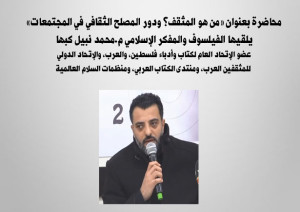
?Who is the intellectual? And what is the role of the cultural reformer in societies
April 13 - 15, 2026
محاضرة يلقيها الفيلسوف والمفكر الإسلامي م.محم...

Mnemonic the Play, A Presentation and Discussion
January 24, 2026
This presentation and discussion of Mnemonic the P...
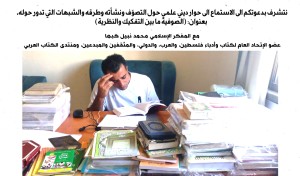
Sufism between deconstruction and theory
September 11, 2025
A religious and scientific dialogue on Sufism, i...