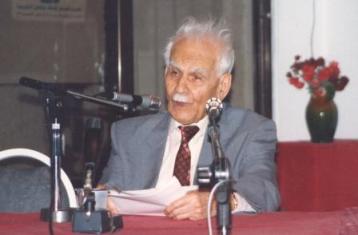
Today, and every time I pass his house in Amman, I think to myself, a great man used to live here! Sadly, and I don't want it to do that, his memory seems to fade further and further away every day that passes by.
Hassan Al Karmi was great fun to be with. He had a charming, lively, talkative, almost argumentative character based on reason, rational thinking and logic. You could sit for hours intently listening to his discourse on politics, philosophy, history and culture. He was such a literate man who talked on just about every single subject you could think of.
For your average Arab man in the street, it was very difficult to keep up with him. His friends, relatives and peers who would visit him regularly had a hard time keeping up with him. His train of thought was like a roller-coaster, never once flinching despite his great grand old age.
Virtually right up till the day he passed away in his home in Amman on that early May, his mind continued to be as sharp as a blade. Alas at last his mind gave way to his enfeebled body. It was as if the whole intellectual body of thinking ceased reverberating when his heart stopped beating.
I am proud to say I knew Hassan Al Karmi, the lexicographer, who over his life time, made the issue of making English-Arabic, Arabic-English dictionaries, his favorite past-time.
His intellect as in his dictionaries, his books and thoughts will continue to live on for many generations to come, influencing Arab as well as western intellectual thought for many generations to come. His dictionaries would continue to preserve an Arabic language and culture that has long been subjected to the whims of globalization and encroachment of an alien culture whose express purpose has been to mutilate our indigenous culture, traditions, ways of thinking and understanding.
Through his 14 Arabic-English, English-Arabic dictionaries, eight of which have been published and the rest still in manuscript form, Hassan Al Karmi steadied the Arabic language, putting it on a fixed course and protecting it from the onslaught of globalization and the foreign entry of new words that may have been deemed Arabic in origin, but had its fortunes in a coca-cola culture that developed in the United States and Europe.
His dictionaries, Al Mughni Al Akbar, (English-Arabic), Al Mughni Al Kbir (English-Arabic), Al Mughni (English-Arabic), Al Mughni Al Waseet (Arabic-English), Al Mughni Al Waseet (American English-Arabic, Al Mughni Al Wajeez (English-Arabic), Al Hadi for Arabic language, Al Hadi Al Waseet, Al Hadi for students) serve as a reference, a landmark to preserving Arab thought, system and language.
Hassan Al Karmi was born in Tulkarem, Palestine, either 1904 or 1907, but his father moved in what was then a borderless Fertile Crescent of Greater Syria between Amman, Damascus and Tulkarem and Jerusalem.
In the 1920s his father was a chief judge appointed by then Prince Abdallah in the Emirate of Trans-Jordan. However, most of his young adulthood was in Palestine, gaining his education in the Jerusalem-based Arab College and latter working as a schools inspector through out Palestine.
Despite his English education Al Karmi also worked as a math teacher for a short while which may explain the rigorous methodology he applied when he started manufacturing his dictionaries, an era in itself began in the 1950s and lasted till the last days of his life.
'He never interfered in the way we thought or the perspectives we adopted but always told us to think scientifically and rationally,' says his oldest daughter Siham Al Karmi who lives now in Amman, and has a brother and a sister who works in academia in London.
Like many Palestinians, his life appeared to have crumbled during 1948 when Israel was forcibly established on Palestine creating hundreds of thousands of refugees fleeing to the neighboring countries. After traveling to Syria, where his wife is from, Al Karmi managed to go to London where he got a job at the BBC Arabic Service as a language supervisor.
He remained there till 1968, but his program Qawl ala Qawl (Saying Upon Saying) which he presented continued tell the mid-1970s having begun in 1954. People today still remember that authoritative voice who for a long time struck every household in the Arab world.
At the end of his BBC service he had built up an authoritative library that reached to thousands of books in both English and Arabic, an impressive depository many of which were collected on his travels to the Arab world in the 1950s and 1960s in search of literature that would be used for his radio programs.
His love for literature, one friend said was manifested in the fact that every time you visited, there would be piles of books in every corner of the house, commenting fondly this was no home but a library of knowledge and culture.
His daughter Siham would latter say that as a little girl growing up in such a household, she would always remember herself carrying the odd book or dictionary in her little hand, for her father so he could continue to do his research.
'He would make us sit and utter specific words in English to see how many times they came up in different dictionaries, and so more generally, I grew up in a household that put a great stress on the value of reading that my father saw as crucial for our intellectual development and thought, and to keep us in touch with Arabic culture and heritage' she added.
Al Karmi belonged to a liberal intellectual tradition where he felt freedom of thought was paramount to political, economic and social development and that dogmatism and authoritarianism closes the mind and rigidifies the self, and thus was open to reading about other cultures because he felt they are sources of enrichment.
In the early stages of his life, especially when he started compiling his dictionaries, it was to words, semantics and even poetry that he immersed himself, seeking his intellectual enlightenment. He would always say that Arabic was a source of action, starting with a verb that was certainly not the case with other languages, especially European. The material he brought from the Arab world would be used first of all to accumulate his encyclopedic knowledge.
Also these were in turn used in his compilation of the multitude of dictionaries that took the best part of his time for the last 50 years. Hassan Al Karmi never gave away any of his recipes for making dictionaries.
He only give away morsels, stressing the fact compiling of words was an intensely private thing. He would first of all look at other dictionaries to compare and contrast and then would start inventing new words based on different factors related to language, grammar and context; however, he would never say how the actual step-by-step process took place.
He would put his hands up in the air and say it's a complicated, time-consuming process related to origins and inventions that must have logic and understanding of the language.
His daughter Siham says: 'He would never merely 'translate' a word into Arabic, as was the case with many other dictionaries, it was not on a one-to-one basis, but he would search for a meaning based on the actual cultural societal context of the word, and that required a great deal of soul-searching.'
By the time he came to settle in Amman in 1989, he had many dictionaries, under his belt, and many more were to be written but remain in manuscript form. However, the 1990s in Amman were to be another of his golden ages.
For this is the time that he started writing more books on the structure of language, an autobiography on his life in Palestine during the inter-war years of the 20th century, a book on his cat and a set of other books in English on Islam, its nature and relations with the West. He wrote many essays as well.
What was interesting about Abu Zeyad is every time you visited his house, he would reach out in one of his drawers and hand you a manuscript of a book that was waiting to be printed. He was always angry about the state of the Arab world; he felt it was a region that lost it campus and focus simply because people have started running after values that were manufactured outside the region.
Hassan Karmi seemed to have made a pact with himself never to stop writing and thinking. Retirement was not a luxury he can afford he used to say. This was as much a moral crusade as an intellectual one.
The Arabs have been defeated time and again, there is a new onslaught on Islam, and it is up to us to explain our point of view he used to say. And so despite the fact that he was inching towards his 100th birthday and moving toward 101, 102, 103 and so on, he would be bright and early at his desk, sometimes setting on a sofa with his papers next to him and with a pen and black ink on the table.
If it was not revising one of his dictionaries, he would be writing one of his books. In Jordan there are no real readers he would say. For each book he wrote Hassan Al Karmi wanted critics to see if the flow is at the right temperature, yet there was no critics found, there was no real input, manuscripts would be given for critique but they would be returned with an apology or an admiration.
Al Karmi would then shake his head as if to say in a resigned kind of way, 'it's ok, it's ok'. He lived a rich intellectual life, his name, no doubt contributing to culture of the Arab world in language and in thought. At the end of his life, there was so little time and this would upset him very much because he wanted to continue contributing.
*This is an edited version that was published in the June issue of Icelebrating Jordan, a monthly magazine published in Amman.
Hassan Karmi Passes Away but His Culture Lives On
By: Marwan Asmar - on: Sunday 19 November 2017 - Genre: Biography
Upcoming Events

Joseph Conrad's Heart of Darkness Discussion
April 27, 2024
Join us for a special discussion of Joseph Conrad&...

A writer, a vision, a journey: a conversation with Francis Boyle
February 24, 2024
This event took place on 24 February 2024 Yo...
Discussion of Fawzia Assaad’s An Egyptian Woman
November 25, 2023
In celebration of the life and outstanding achieve...
Toni Morrison's The Bluest Eye, A Presentation and Discussion
October 28, 2023
This presentation and discussion of Toni Morrison&...