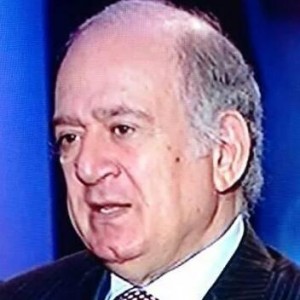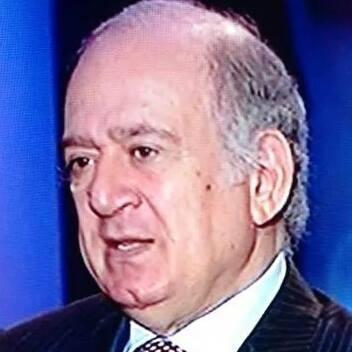
Tarek Heggy (born in Port Said – Egypt on 12th October,1950) : Political and socio-economic writer, Petroleum strategist, lecturer at a number Middle East, European and American Universities and a member of the Board of Trustees/Directors of some 30 leading Egyptian Community Service Societies.
For eight years (until 1979) Tarek Heggy was a lecturer at a number of North-African Universities (Algeria and Morocco).
In July 1979, Heggy joined “Shell International Petroleum Company” as Oil and Gas Attorney (1979-1985) and Deputy to the Chairman of Shell Egypt (1985-1988). In 1988 Heggy was the first Middle East person to be appointed as Chairman of Shell Companies in Egypt and an advisor to “Shell International” for the Major Resource Holders (MRH). After eight years of holding these positions, Heggy resigned from “Shell International” on 1st July 1996 to devote his efforts to a wide range of intellectual/cultural activities and in parallel to manage his private company “TANA Petroleum”.
Heggy is the author of many books. Between 1978 and 1983 his first three books were published comprising a comprehensive critique to the Marxist theories and practices. In 1986 his book “What is to be done?” was published starting his series of books that were published between 1986 and 1995 and focused on diagnosing the current political and socio-economic problems of Egypt. In 1998 his tenth book (In Arabic) “Critique of the Arab Mind” was published causing sizable anger for the openness and strong self-criticism it presented. In 1999 Heggy wrote and published several articles that mainly focused on the role of education and culture (together with political & economic reforms) in shaping a better future for Egypt (and the Middle East).
Several books and more than 100 articles were published about Tarek Heggy.
Tarek Heggy’s books:
In Arabic:
Marxist Ideas In Balance:1978.
Communism And Religion:1980.
My Experience With Marxism:1983.
What is to be done ?:1986.
The Four Idols:1988.
The Trinity of Destruction:1990.
Egypt between two Earthquakes:1991.
The Fateful Transformation:1993.
Reflections of Egypt’s Actuality:1995.
Critique of the Arab Mind:1998.
In English:
Egyptian Political Essays:1991.
On Management and Petroleum Industry:1991.
Egypt’s Contemporary Problems:1992.
Critique of Marxism.:1992.
In French:
L’ineluctable Transformation.:1991.
Examples from the many writings about Tarek Heggy:
* Tarek Heggy, the writer, intellectual and a leader of a large oil company in Egypt is the author of several books on this single subject i.e. managerial salvation of Egypt. He considers Egypt's problem is neither poverty, backwardness nor population congestion, but is primarily bad management. His books and observation are milestones on the road to this managerial reform which our rulers dream of. His books are the best aid in formulating the healing prescription for this malady. Let us, therefore, seek the medicament from those who possess the experience therein.
(Moustafa Mahmoud-Al Ahram daily, Saturday 4th December, 1993.)
* Tarek Heggy is a successful business leader and a sophisticated thinker who expresses profound ideas in the form of aphorisms, that is, he uses apparently simple sentences to convey complex truths.
(Anis Mansour-Al Ahram daily, Thursday 4th March, 1993.)
* Our paths crossed by chance ... I was struck by his versatility, by the convergence of so many different personalities and dimensions in one man: an encyclopedic reader in all fields of knowledge, a writer, intellectual and political analyst, a man of letters and an artist who has developed deeply into the vast seas of literature and art, an international petroleum expert and a politician who closely follows developments on the world stage.
(Kamal El Malakh-Al Ahram Al-Iktisady 28th September, 1987)
* I have followed with close attention the articles and books published by this author, who has managed to achieve in a few short years what other writers take decades to achieve: cogency of argument, clarity of style, depth of ideas, breadth of culture and sweep of vision. A prodigious amount of reading, daunting to any but the most steely-willed, has been instrumental in his rapid development. No branch of knowledge escapes his voracious appetite for reading. When it comes to economics, he is in full command of his subject, in law, he is highly knowledgeable, in literature, he is at one and the same time an amateur and a professional, blessed with a discerning taste. His post, as Chairman of the board of one of the largest International Oil Companies in Egypt, has never before been occupied by an Egyptian or an Arab. He is a man of profound vision, whose principal motivation is the good of his country. Thus he writes with the freedom of the scientist and the commitment of the true patriot.
(Sarwat Abaza-Al Ahram daily, Monday 29th April, 1991)
* Although the author comes from a generation not noted for its love of reading or its intellectual curiosity, he stands out as a singular exception to the rule, a widely-read man whose like we have not seen for many generations.
(Mohamed Mourad-Al Akhbar daily, Sunday 14th August, 1988)
* Tarrek Heggy's writings are not limited to expressing the author's opinion on a given subject, but extend to projecting a panoramic view of Egypt's predicament. The economy of his style does not detract from the clarity of the picture that emerges. When he moves on to propose solutions, he does so from the vantage point of one who is fully aware of the magnitude of the problems facing Egypt. To read some of this young author's works is to understand why one of the largest companies in the world should have chosen him to lead their operations in Egypt.
(Ahmed Abul Fatah-Al Wafd daily, Thursday 16th September, 1993)
* An association that springs to mind on reading the works of Tarek Heggy is Jean Jacques Rousseau, in the sense that both are intellectuals concerned with reforming and restructuring their societies. Heggy belongs to that rare breed of writers who dip their pens into their hearts. When he addresses his country's problems, he writes with the passion and honesty of a nationalistic Egyptian jealous of his heritage.
(Zahira El Beyally-October Magazine, Sunday 3rd September, 1990.)
* An important book by a distinguished author has appeared in Egypt: the book is published under the title, My Experience with Marxism, the author is Tarek Heggy.
(Ahmed Bahgat-Al Massa daily, 27th November, 1983)
* Tarek Heggy writes with the mentality of a scientist, the style of a man-of-letters man and the logic of a philosopher.
(Maamoun Ghareeb-Akher Saa Magazine, Wednesday 9th September, 1992)
* Those blessed with exceptional abilities usually distinguish themselves in their respective areas of expertise. But Tarek Heggy's talents shine in more than one firmament, he excels in more than one field.
(Adel El Bolok-Misr Tourism Magazine, Thursday 20th February, 1992.)
* Tarek Heggy, an intellectual who has declared war on totalitarianism, uses reason and logic to defend freedom and democracy in their western parliamentary sense, with all the implications this holds for economic freedom. He is an author concerned with the problems of his country and the cares of his countrymen. His books are quickly out of print, because they quench the thirst of the seekers after truth.
(Abbas El Tarabeely-Al Wafd daily, Monday 20th March, 1989
* All these writers were unanimous in acknowledging his encyclopedic knowledge and his profound original ideas.
(Faiza Saad-Rose Al Youssef Magazine, Monday 26th August, 1991)
* I urge young people to read this book and to emulate the author, Tarek Heggy, in broadening their cultural base.
(Abdel Moneim Kandil-Al Akhbar daily, Thursday 21st August, 1980.)
* Tarek Heggy takes us back to the golden age of the Arabic Language.
(Salah Labib - Al Ahram Al-Iktisady (the economist), Monday15th May, 1989)
* Tarek Heggy is an author and intellectual who stands out as a unique phenomenon among his contemporaries. When his first book, Marxist Ideas in the Balance, was published nearly ten years ago, I sent him a letter, in which I said: You have revived my faith in the youth of Egypt, on which I had firmly slammed a door that I never expected to open again. When his second book, Communism and Religion, appeared, I wrote in Al-Ahram of April 28, 1980: The book under review is by a young author who displays a degree of insight and erudition that is startlingly precocious in one so young. When what I consider to be his finest work, My Experience with Marxism, was published, I wrote in Al-Ahram of July 7, 1983: Never before in all my life has a book so fired my imagination that I want to share it with my readers in its entirety, to convey to them every single word of a book whose honesty, vision, compelling arguments, rigorous logic, depth of research and sobriety of expression I have seen only in the works of towering literary giants.
(Sarwat Abaza - Al Ahram daily, Sunday 31st July, 1983)
* Tarek Heggy’s writings are characterized by an encyclopedic knowledge that is evocative of El-Aqqad. They are also characterized by a poetic style reminiscent of Taha Hussein’s. And, in the profundity of the messages they carry, they rank alongside the best works of the great European writers.
(Dr. Salah Ades - Al Omal Magazine, August 1991 issue No. 339.)
* Tarek Heggy is a rich personality blessed with a wealth of talents. A deeply cultured, widely-read and enlightened writer, he wields his pen masterfully, recording his ideas and experiences in a sober style informed by honesty and brimming with a love of Egypt.
(Dr. Mohamed Ismail Ali -Al Oroba Magazine, April Issue 1991)
* Tarek Heggy is well-versed in economics, politics and literature. He is also a connoisseur of poetry and a partisan of the elegant turn of phrase that qualifies his work as literature.
(Ismail El Nakeeb - Al Akhbar daily, Saturday 29th September, 1990)
* When I was taken on a guided tour of the giant establishment he heads I felt I was in one of the most advanced American or European corporations. During our discussion, which lasted for close on two hours, I felt I was in the presence of an outstanding representative of my generation and my country. I confess that I found myself thinking more than once during this encounter that he was a living example of what Egypt needs. In the midst of a tumultuous rhythm of work and the glaring light of success, he has managed to create a serene oasis of classical music , poetry, literature, art and refined culture. Perhaps that is the secret behind the limpid transparency of his vision.
(Hatem Nasr Farid - May daily, Monday 10th June, 1991)
* If a common thread can be said to run through all of Tarek Heggy’s book, it is his intense preoccupation with his country’s problems and hardships. It is difficult, if not impossible, to deny his passionate love for his country and his deep involvement in all the issues and concerns which affect its well-being and which he dreams, in more than one of his books, will one day vanish so that Egypt can recover its economic vitality and democratic vigour. To this end, he has launched himself forward, with all his strength, on the marathon of progress.
(Helmy Salam - Akher Saa Magazine, Wednesday 5th December, 1990.)
* In his latest book, Fateful Transformation, Tarek Heggy reflects the pulse of Egyptian intellectuals and their consensus on the need for radical change in public life in Egypt as a prerequisite for raising living standards. The book is a cry from the heart against totalitarianism and a command economy, and a defense of freedom and liberalism. The author’s deep concern with his country’s problems has placed him on a quest for solutions by which they can be overcome.
(Ahmed Bahgat - Al Ahram daily, Friday 15th October, 1993)
* When Tarek Heggy publishes a book, it is read only by a select few ..... that is to his credit - and to our shame.
(Anis Mansour - Al Ahram daily, Tuesday 26th October, 1993.)
* Fateful Transformation is a book that should be read by all Egyptians and studied by all intellectuals.
(Abbas El Tarabeely - Al Wafd daily, Tuesday 26th October, 1993.)